
The Battle of Inchon and its decisive role in the Korean War

In September 1950, while North Korean forces surrounded the Pusan Perimeter and appeared ready to overrun the final United Nations stronghold that remained in the south, General Douglas MacArthur launched an amphibious assault that largely disrupted the enemy’s momentum.
The chosen landing site was Inchon, and it posed extreme challenges due to its narrow harbour and dramatic tides in a very crowded city area, yet those same features made a landing there so improbable that it offered strategic surprise.
With the stroke of that operation, MacArthur reversed the KPA’s territorial gains and opened the road to recapturing Seoul and forcing a general retreat across the peninsula.
The difficult strategic situation before Inchon
By early August 1950, North Korean forces had seized almost the entire Korean Peninsula and forced South Korean and UN troops into a pocket of territory around Pusan that kept getting smaller.
The area was known as the Pusan Perimeter and had quickly become a front of desperate resistance.
American commanders were led by General Walton Walker and used short internal lines and mobile artillery, supported by reinforcements brought in through the port to contain repeated enemy offensives.
Yet with every passing week, the pressure increased, and American planners had begun to fear that a major assault could break their defences and end the war in disaster.
At this critical moment, General MacArthur proposed a daring counterattack that involved bypassing the front altogether.
He insisted that an amphibious landing far behind enemy lines, at Inchon on the west coast, could, in his view, sever supply lines and paralyse the North Korean supply system.
Inchon lay just 30 kilometres from Seoul, which was a vital command and communications hub for the enemy.
By cutting across the peninsula, UN forces could divide the KPA and trap most of its divisions in the south.
Although senior naval officers repeatedly warned that Inchon’s geography made the operation extremely risky, MacArthur argued that the very obstacles they described would ensure tactical surprise and reduce the likelihood of prepared resistance.
His plan received final approval from the Joint Chiefs of Staff on 1 September 1950.
Preparation for Operation Chromite
Operation Chromite was the codename for the Inchon landing, and drew immediate criticism from American and allied commanders who considered the site nearly impossible to approach.
Even so, MacArthur insisted that only Inchon allowed a direct strike on Seoul and would force the KPA to respond to a threat that they could not ignore.
If Seoul fell, their entire advance would likely collapse, as they relied heavily on the roads and railways that connected the capital to the front lines.
Planners studied captured Japanese tide tables and old harbour charts from the Second World War to assess how to move landing craft into the narrow channels at exactly the right time.
American engineers conducted additional coastal surveys, and the 1st Marine Division began training for the assault, rehearsing how to climb sea walls and move in urban terrain in coordination with armoured support in tight spaces.
Major General Edward Almond was the commander of the newly formed X Corps and oversaw the coordination of ground units that would carry out the landings and advance on Seoul.
As plans progressed, the 7th Infantry Division prepared to follow the Marines in the second wave to help hold the port and expand the beachhead.
To increase the likelihood of success, UN commanders organised a series of diversionary actions along the Pusan Perimeter in the days before the landing.
These efforts aimed to convince North Korean commanders that the southern front remained the main focus of UN operations.
American aircraft that flew from carriers in the Yellow Sea began bombing communications centres and military targets near Inchon to soften resistance.
Naval forces included American and British cruisers, and shelled enemy positions across the coastal region, and dropped napalm on fortified areas, especially on Wolmi-do.
Meanwhile, over 230 ships gathered off Korea’s west coast, and they waited for the tide to turn and the order to advance.
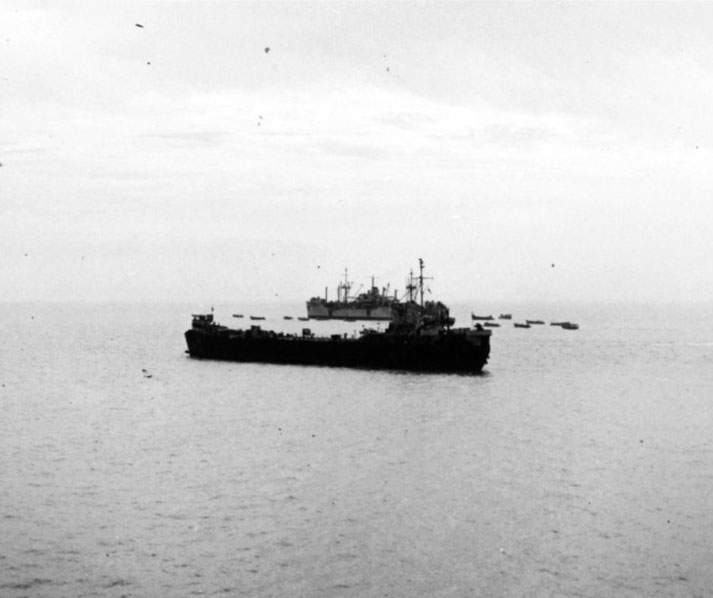
The landing at Inchon
On the morning of 15 September 1950, the assault began with a coordinated attack on Wolmi-do, a small island at the mouth of Inchon Harbour that controlled access to the city’s inner port.
American cruisers and destroyers pounded enemy positions for several hours before the 3rd Battalion of the 5th Marines went ashore.
By midday, they had taken control of the island and had cleared the way for the main landing later that evening, when the high tide would allow amphibious vehicles to navigate the dangerous approaches into Inchon proper.
That night, as the tide surged into the harbour, the main landing force moved toward the seawall, where Marines used scaling ladders and ropes to climb into the city under fire.
Street fighting began immediately, with the attackers moving from building to building in the tight lanes and alleys of the industrial district.
North Korean troops numbered roughly 2,000–4,000 in the Inchon area and resisted where they could, but they lacked heavy weapons and effective coordination, and within 48 hours, UN forces controlled most of the port.
As engineers repaired key bridges and landing zones, reinforcements began pouring into Inchon by sea.
By 19 September, American army units had joined the Marines and had begun advancing toward Seoul, encountering pockets of stiff resistance along the way.
The capital was a vital objective both symbolically and militarily, and had been heavily fortified by the North Koreans, who knew its loss would cripple their southern operations.
Despite this, the UN advance pressed forward, and after days of bitter fighting that included several major engagements in the city’s core, the South Korean flag was raised over the government complex by the ROK 1st Infantry Division on the afternoon of 25 September.

What impact did it have on the Korean War?
As the front at Inchon collapsed and the effects spread across the peninsula, the KPA divisions near the Pusan Perimeter, cut off from their supply bases and threatened with encirclement, abandoned their positions and began retreating in confusion.
Many units had pushed too far south too quickly and lacked the fuel and food needed to reach safety.
American and South Korean forces, now on the offensive, pursued the retreating enemy northward, capturing thousands and recovering territory at a relatively rapid pace.
By early October, UN sources reported that approximately 80,000 to 90,000 North Korean soldiers had been taken prisoner.
Following the initial landing, more troops and equipment were brought ashore, including elements of the U.S. Army's 7th Infantry Division.
The U.N. forces quickly expanded their beachhead and began moving inland, encountering sporadic resistance from North Korean troops, who were disorganized and ill-prepared for such an assault.
By early October, UN forces had crossed the 38th Parallel and had entered North Korean territory, and they believed that final victory was within reach.
President Truman authorised MacArthur to continue the pursuit, and American columns pushed toward the Yalu River, which marked the border with the People’s Republic of China.
Chinese leaders grew increasingly alarmed by the prospect of foreign armies near their frontier and issued repeated warnings, but American commanders dismissed them.
MacArthur argued that Chinese intervention remained unlikely and continued to focus on destroying what remained of the KPA.
Chinese forces had already begun to enter North Korea during the First Phase Offensive in mid-October, but MacArthur's underestimation contributed directly to the surprise Chinese counter-offensive at the Ch’ongch’on River in late November 1950.
From a military perspective, Inchon revived ideas about amphibious warfare and showed that, for many planners, landing operations had once been considered too risky for modern warfare and still held strategic value.
The U.S. Marine Corps had faced an uncertain future during postwar defence cuts and had used the success to show that it still had an important role in expeditionary operations.
Within American political circles, Inchon boosted morale and renewed support for UN involvement in Korea, while temporarily lifting President Truman’s approval rating.
It also influenced NATO planning to some extent by reinforcing the importance of flexible military responses in Cold War conflicts.