
Why didn't America join the League of Nations?
After they had endured four years of mechanised slaughter and diplomatic failure, the victors of the First World War looked to create a system that they hoped could at least prevent any similar disaster in the future.
U.S. President Woodrow Wilson proposed the League of Nations as the centrepiece of this new international order because he believed that committing countries to shared security and peaceful talks would help to prevent future wars.
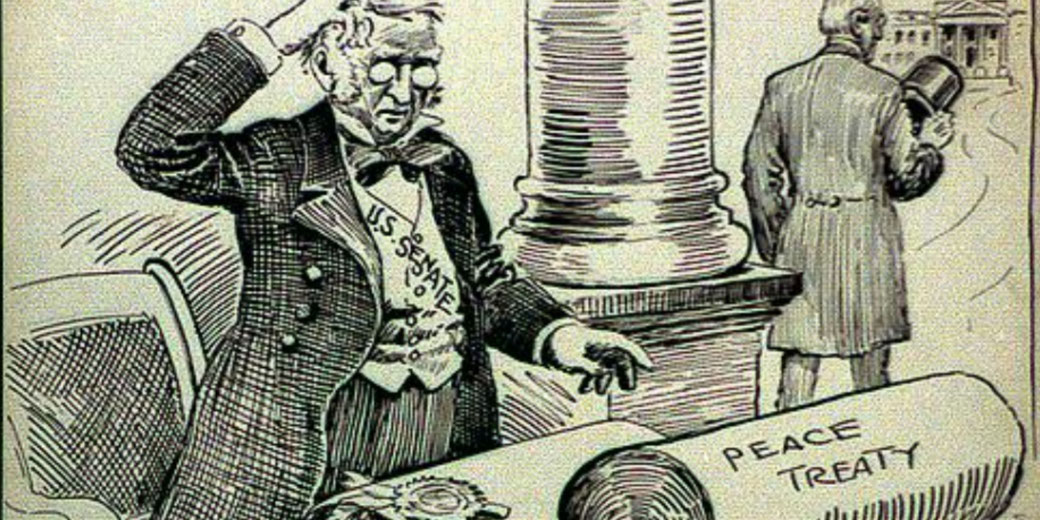
Although the League became a formal part of the 1919 Treaty of Versailles, signed on 28 June, the United States refused to ratify the treaty or join the organisation, due mainly to a combination of constitutional concerns and political rivalries, as well as a widespread fear of permanent foreign entanglements.
Wilson’s vision and the Treaty of Versailles
When Wilson arrived at the Paris Peace Conference in January 1919, he introduced a set of ideas intended to change international relations, which he had outlined a year earlier in his Fourteen Points.
These points called for open diplomacy, freedom of navigation, disarmament, free trade, and self-determination for oppressed nationalities.
At the heart of his vision stood the fourteenth point: a general association of nations, designed to guarantee, at least in principle, the independence and territorial integrity of its members.
Wilson believed that the League would settle disputes and would also act as a moral influence strong enough to discourage aggression and uphold peace.
During work on the Treaty of Versailles, Wilson successfully persuaded other Allied leaders to include the League Covenant, despite their concerns about national interests and colonial holdings.
Among its articles, Article X became arguably the most controversial. It declared that all members would "respect and preserve against external aggression the territorial integrity and existing political independence of all Members of the League."
Wilson viewed this obligation as essential, and he insisted that promises made by all sides would help peace agreements last.
For him, America’s leadership in such a body would carry moral weight and act as a real warning to any country that considered starting a war.
Still, his refusal to allow for meaningful amendments would later prove a serious political mistake.
Opposition in the United States Senate
At home, the Constitution required a two-thirds majority in the Senate to ratify any treaty, and Wilson’s international promises quickly came under close criticism.
Key Republican senators, who were led by Henry Cabot Lodge of Massachusetts, believed that the League was a direct threat to congressional authority, especially the power to declare war.
Lodge specifically feared that Article X would force American troops to defend foreign nations without congressional consent, and he believed that this would undermine the Constitution.
For Lodge and his "Reservationist" allies, the treaty required major changes to protect national sovereignty.
At the same time, a separate faction of "Irreconcilables," who were isolationist and progressive senators such as William Borah and Hiram Johnson, rejected the League outright.
They argued that America’s involvement in foreign wars had generally brought heavy casualties and few benefits.
According to them, the League would trap the United States in a pattern of constant interventions, driven by European rivalries and imperial goals.
Public support for their position increased as many Americans absorbed the cost of war and questioned the wisdom of permanent alliances.
On 19 November 1919, the Senate rejected the treaty for the first time, and the debate continued for several months.
Wilson’s refusal to compromise
Rather than negotiate with the Senate majority, Wilson appealed directly to the members of the American public.
In September 1919, he began a nationwide speaking tour to promote the treaty, during which he travelled approximately 13,000 kilometres and delivered around 40 speeches in 22 days.
Under pressure from the pace and strain, his health deteriorated. On 2 October, after a rally in Pueblo, Colorado, he suffered a massive stroke that left him very weak and unable to govern without assistance.
After his collapse, his wife Edith Wilson and close advisers limited access to the president and shielded his condition from public view.
Meanwhile, Lodge presented a version of the treaty that contained fourteen reservations that restated congressional authority over war powers.
Wilson was unwilling to accept any alterations and directed his supporters to vote against the revised version.
On 19 March 1920, the Senate held its final vote. The treaty failed to pass, and the United States remained outside the League of Nations.
American isolationism during the 1920s
By 1920, public opinion had largely turned against international involvement.
Many Americans believed that the nation had entered the war unnecessarily and now increasingly wished to avoid similar commitments.
As they faced post-war inflation and labour unrest, along with a wave of anti-communist sentiment, voters embraced calls to focus on domestic issues and limit foreign obligations.
In the presidential election later that year, Republican candidate Warren G. Harding won a clear victory on a platform that promised a "return to normalcy," and he won more than 60 percent of the popular vote and 404 electoral votes to Cox's 127.
His election showed widespread opposition to Wilson’s plans for greater international involvement.
Soon after he had taken office, Harding signed separate peace treaties with Germany and Austria in 1921, along with a separate settlement with Hungary, which officially ended the war without the United States joining the League.
These treaties, which were known respectively as the Treaties of Berlin and Vienna, together with the Treaty of Budapest, secured peace with the former Central Powers for the time being.
Also, the United States continued to participate in international conferences, such as the Washington Naval Conference of 1921–22, which tried to limit naval weapons and keep stability in the Pacific, but avoided any permanent commitments to mutual defence.
Although American diplomats occasionally observed League proceedings and cooperated on specific issues like public health and humanitarian aid, the country largely maintained its distance from the organisation’s decisions.
The League without the United States
Without American membership, the League of Nations began its work in Geneva under the leadership of Britain and France.
From the outset, its reputation, at least among many observers, suffered. Although it included many of the world’s nations, its ability to make its decisions happen remained limited.
It lacked a permanent military force and depended on the willing cooperation of its members.
By the 1920s, the United States, which had become the world’s largest economy and a naval power that grew quickly, was absent from the League, and this absence left it without the support it badly needed.
Over the following decade, the League managed efforts at arms control, helped settle small territorial disputes such as the Aaland Islands crisis between Finland and Sweden in 1921, and supported relief work, but it had largely failed to prevent major attacks.
By the early 1930s, it had collapsed in the face of serious challenges, and Japan’s invasion of Manchuria in 1931 and Italy’s conquest of Ethiopia in 1935, along with Hitler’s defiance of the Treaty of Versailles, showed that it could not act firmly.
Its repeated failures eventually seemed to confirm the arguments of its critics and showed the limits of international diplomacy without unified support.