
The dark history of Alcatraz, America's most notorious prison
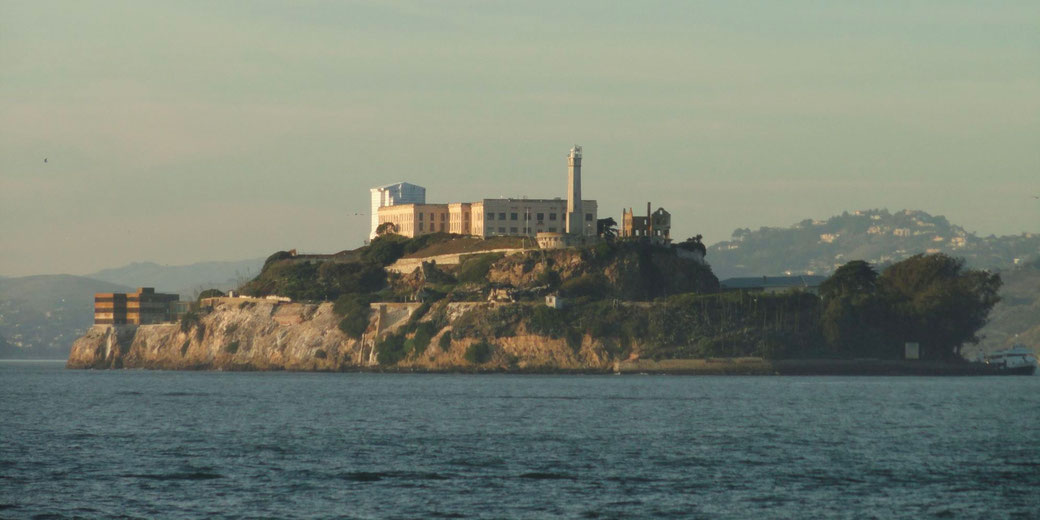
Covered in fog and surrounded by powerful currents, Alcatraz Island was arguably one of the most isolated and feared places of punishment in American prison history.
Situated in San Francisco Bay and reinforced with thick concrete and barbed wire, the prison, which was guarded by armed patrols, soon became notorious for housing violent criminals who had defied authority elsewhere.
Over three decades, Alcatraz became more than a place of confinement, and it became a symbol of severe control, where federal power met human desperation and discipline came before rehabilitation.
Alcatraz's imposing location
Alcatraz rose from the waters of San Francisco Bay, approximately 2 kilometres (or 1.25 miles) from the shoreline, and it appeared almost purpose-built for imprisonment.
Jagged cliffs reached 41 metres above sea level, and they encircled the island so that no accessible beach remained for escapees to exploit.
Although the island measured just 22 acres, its natural barriers enhanced the impression of isolation and hopelessness for those trapped inside.
Currents around the island often flowed rapidly and unpredictably, while the temperature of the surrounding water hovered between 10 and 12°C.
According to many inmates, the sea offered no path to freedom, and instead it presented a death sentence cloaked in the illusion of choice.
Often, fog settled over the bay so thickly that prisoners could no longer see the city skyline, only the outline of guard towers or the faint beam from the lighthouse.
By design, the prison complex sat atop exposed bedrock, and engineers constructed its foundations directly into the stone, which created an extremely solid structure that became part of the island itself.
Each boat to and from the island underwent strict security procedures, and the journey was both a practical necessity and a constant reminder that Alcatraz belonged to no other world but its own.
Its early use as a military base
Initially, Alcatraz had played no part in the federal prison system. In 1850, President Millard Fillmore ordered that the island be reserved for military use, prompted by growing fears that San Francisco’s gold wealth and strategic position would invite foreign attack.
Construction began three years later, and by the mid-1850s, the island featured defensive cannon positions that held dozens of smoothbore and rifled artillery pieces, and it also housed the first lighthouse on the American Pacific coast, which officially entered service in 1854 and guided vessels through the often foggy bay.
During the American Civil War, Union forces used Alcatraz to detain Confederate sympathisers and disobedient soldiers, along with selected political prisoners.
Over the following decades, its role had gradually expanded, especially by the 1890s, when the Spanish-American War caused a surge in military prisoners, and prisoner numbers at one point exceeded 450 men, which led to severe overcrowding.
As a result, the army demolished the original fortress in 1909 and began constructing a massive concrete cellhouse that opened in 1912.
At the time of its completion, the building was widely regarded as among the largest reinforced concrete structures in the United States.
Although the army continued to use it for military imprisonment, the building known as the Alcatraz Citadel already had many of the features that the Bureau of Prisons would later prioritise.
Its design and scale had already aligned with what the Bureau would eventually require, and its purpose did as well.
Transition to a federal penitentiary
By the early 1930s, federal officials concluded that a specialised prison was needed to contain the most dangerous inmates in the system, those who had continued violent behaviour or attempted escapes at other institutions.
For that reason, the War Department transferred ownership of Alcatraz to the Department of Justice in 1933, and by July 1934, the island officially reopened as a federal penitentiary under its first warden, James A. Johnston.
The new Alcatraz in many ways differed sharply from other federal prisons.
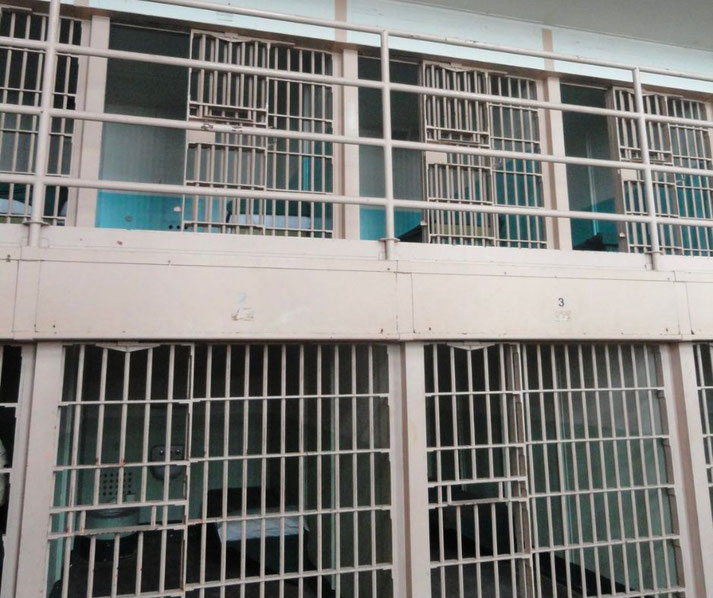
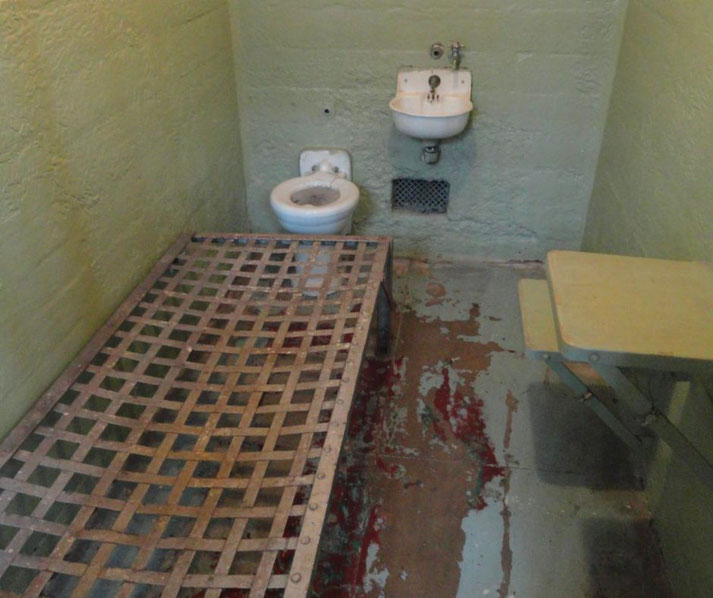
Each inmate lived in a single, narrow cell, which included a narrow bed and a toilet, with a small sink squeezed into the remaining space, and inmates endured a life without privacy or personal possessions and with only the most limited human contact.
Prisoners were woken at 6:30 a.m. and given meals that usually included oatmeal, beans, or stewed meat, with occasional bread or coffee.
Prison routines enforced a strict schedule: prisoners awoke early, moved in silence to meals, worked under guard supervision, and returned to their cells by mid-afternoon.
As a form of punishment, prison staff relied on solitary confinement and sensory deprivation.
Those who were sent to “The Hole” endured a complete absence of light and a silence broken only by mealtimes, as they lay on concrete floors without bedding.
Many reported long-term psychological effects from the conditions, particularly those who had been confined for extended periods, such as up to 19 days in darkness without bedding or communication.
This method aimed to crush resistance rather than to correct behaviour.
Meanwhile, prison guards and their families lived in separate housing on the island’s western end.
A small school operated for their children, and families gathered in a staff social hall.
Although they lived only metres from the cellblocks, a high fence and continuous armed patrols divided civilian life from the world of the prisoners, who could only observe from barred windows.
The most famous people imprisoned on Alcatraz
Although most of the 1,576 inmates confined to Alcatraz are still unknown to history, several famous prisoners helped define the public image of the prison.
Among them, Alphonse “Al” Capone, who was registered as prisoner AZ-85, attracted the most attention.
After his 1931 conviction for tax evasion, Capone was sent to Atlanta, where he had bribed guards and had maintained control over other inmates.
In 1934, authorities transferred him to Alcatraz, where isolation and constant surveillance had stripped him of influence.
As his health deteriorated due to advanced syphilis, Capone lost his grip on reality and spent his final months on the island receiving medical care in the prison hospital before being transferred in 1939.
Another notorious inmate was George “Machine Gun” Kelly, who was prisoner AZ-117 and became famous during the early 1930s for armed robbery and kidnapping.
He spent part of his life sentence on the island between 1934 and 1951, and another infamous prisoner was Robert Stroud, the so-called "Birdman of Alcatraz", who was transferred there in 1942.
Contrary to the myth popularised by the 1962 film, Stroud did not keep birds while at Alcatraz.
His bird research and breeding activities had occurred earlier at Leavenworth, but the reputation followed him to the Rock.
Prison officials described him as intelligent but dangerous and kept him in segregation for nearly his entire sentence.
Did anyone successfully escape from Alcatraz?
During the prison’s 29 years of operation, authorities recorded 14 escape attempts involving 36 men.
Most escapees were either killed by guards, recaptured soon after, or presumed to have drowned in the bay.
Strong tides and cold temperatures, combined with a lack of flotation materials, made escape virtually impossible under ordinary conditions.
Of the 36 men who attempted escape, 23 were caught, 6 were shot and killed, 2 drowned, and 5 were listed as missing, a group that included the 1962 escapees.
However, in June 1962, an escape attempt by Frank Morris and brothers John and Clarence Anglin broke that pattern.
Over several months, the men used spoons and smuggled tools to dig through the air vents at the back of their cells, and they hid the damage with cardboard painted to match the concrete.
They climbed into a utility corridor and assembled a raft from raincoats stitched and sealed with heat from steam pipes.
Late on the night of 11 June, they escaped through a rooftop hatch and reached the water’s edge.
By the time guards discovered the escape the next morning, the men had vanished.
Dummy heads were made from a mixture of soap and paint and were finished with real human hair, and they lay on their pillows, which delayed detection during routine bed checks.
Search efforts uncovered parts of the raft and life jackets near Angel Island and the Marin Headlands, yet no bodies were recovered.
In 1979, the FBI officially closed the case, but the U.S. Marshals Service left the file open and continues to list the men as fugitives.
Over the years, family members of the Anglin brothers claimed to have received letters and photographs that suggest survival, but none were verified.
Their story later inspired the 1979 film Escape from Alcatraz, which brought renewed public fascination to the case.
Why was Alcatraz prison closed?
By the early 1960s, Alcatraz had become increasingly expensive to run. Sea air corroded metal fixtures and cracked concrete, which forced constant repairs.
Supply ships delivered food, water, uniforms, and fuel, while waste removal added further cost.
According to Bureau of Prisons records, Alcatraz required over three times more spending per inmate than comparable mainland facilities, averaging $10 per day compared to $3 elsewhere, and full repairs were projected to cost over $3 million.
Public opinion also began to shift, as many questioned the value of a prison built on physical and psychological punishment without any attempt at rehabilitation.
Critics in the Justice Department and elsewhere argued that the prison’s power as a symbol no longer justified its expense or its brutal routine.
So, in early 1963, Attorney General Robert F. Kennedy ordered its permanent closure.
On 21 March 1963, the last group of prisoners departed under armed escort, and federal authorities locked the gates behind them for the final time.
The prison stayed empty for several years until the National Park Service made the site part of the Golden Gate National Recreation Area in 1972.
Since then, more than one million visitors have toured the prison annually, drawn by its eerie atmosphere and famous past.
Today, visitors walk past rusted bars and crumbling catwalks, under faded signs that once ordered silence and obedience.
Alcatraz no longer holds prisoners, but its reputation still lasts, fixed in American memory largely as a place of isolation and control, where punishment reached its farthest extremes in a system that could not always contain the men it feared the most.