
The history and meaning of the Australian Aboriginal flag
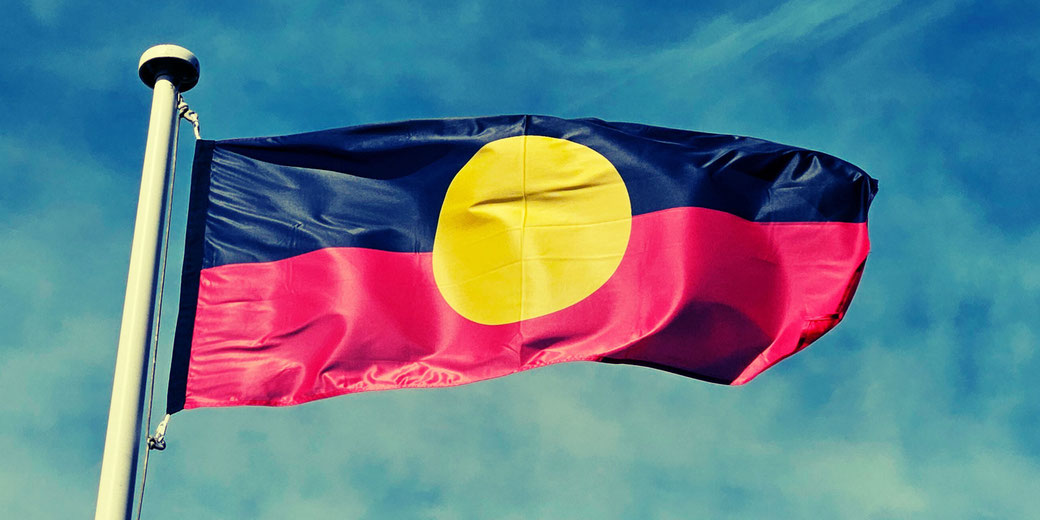
On 12 July 1971, a new flag appeared during a protest in Adelaide’s Victoria Square. The protest had been organised by Aboriginal rights activists in Adelaide, who had gathered to demand land rights and an end to racial discrimination that continued.
Although the Aboriginal Legal Rights Movement would later become a prominent organisation in South Australia, it had not yet been formally established at the time of this protest.
However, the flag’s striking colours quickly took on national meaning for many Australians as a political statement and a cultural emblem.
Who designed the Aboriginal Flag?
Harold Thomas, who had studied at the South Australian School of Art, developed the flag as a response to the dispossession and discrimination that continued to affect Aboriginal people, who are now referred to more accurately as 'First Nations Peoples' of Australia.
He chose three symbolic elements: black to symbolise Aboriginal people, red to signify the land and spiritual connection to country, and a yellow circle to depict the sun as the source of life.
His design drew on both his formal training in Western art and his extensive knowledge of Aboriginal visual traditions.
Rather than a decorative symbol, the flag expressed political resistance and asked for recognition, and it had immediately struck a chord with many Aboriginal communities.
Over the following months, it became a familiar sight at protests, where it featured on placards, banners, and handmade clothing.
Among the earliest displays was during the 1972 land rights rally in Adelaide mentioned above and at demonstrations in Redfern led by the National Black Theatre.
Also, at the Aboriginal Tent Embassy in Canberra, which began on 26 January 1972, the flag flew alongside a beach umbrella planted in the lawn outside Parliament House.
Protesters gathered to demand land rights and political recognition, and they asserted claims to self-determination.
They had responded directly to Prime Minister William McMahon’s announcement that Aboriginal Australians would be granted leases rather than legal ownership of land, and because of that, the Embassy became a focal point for Aboriginal activism.
The flag’s presence helped confirm its status as a unifying symbol for many activists and community groups.
It appeared in news footage, news photos, and community artwork, and its design soon became known nationwide.
Gaining national recognition
Over the 1980s, the flag became increasingly visible outside protest sites.
Aboriginal organisations and community groups displayed it proudly at schools, medical centres, art exhibitions, and local festivals.
In 1985, it flew during the handback ceremony at Uluru, when the federal government returned land title deeds to the Anangu people.
Governor-General Sir Ninian Stephen formally handed over the documents to senior Anangu elders, which constituted a historic moment in land rights history and confirmed the flag’s connection to land rights and cultural importance.
Many artists adopted the colour scheme in murals, fabric work, and performance, while others used it to reinforce community pride during NAIDOC celebrations, land councils, and local political campaigns.
Bit by bit, the flag became central to many expressions of Aboriginal identity.
However, for many, it was Cathy Freeman that brought the flag to the attention of a global audience.
After she won the 200-metre sprint at the Commonwealth Games in Canada on 22 August in 1996, she carried both the Australian and Aboriginal flags on her victory lap.
Officials had advised her to refrain from doing so, yet she ignored the warning, and she sparked controversy among some commentators, but earned widespread praise among Aboriginal Australians, who saw her action as a public declaration of cultural pride.
The incident renewed questions about the flag’s legal status and prompted wider public discussion in some quarters about inclusion and national symbols and how they represented the nation.
When it was officially accepted
On 14 July 1995, the Australian Government formally recognised the Aboriginal flag as an official “Flag of Australia” under the Flags Act 1953.
The Torres Strait Islander flag received the same recognition on the same day. The declaration was made by Robert Tickner, who was then Minister for Aboriginal and Torres Strait Islander Affairs.
As a result, the flag could be flown legally at government buildings, schools, and public ceremonies across the country.
From that point onward, many councils adopted policies to fly it permanently alongside the national and state flags.
Sports stadiums, hospitals, and police stations added flagpoles to include it in official displays.
When Prime Minister Kevin Rudd delivered the Apology to the Stolen Generations on 13 February 2008, both the Aboriginal and Torres Strait Islander flags stood beside the Australian flag in the House of Representatives.
Since that image reached millions across the country, it helped secure the flag’s place in national public life and led many Aboriginal Australians to see its inclusion as a sign that their experiences were no longer ignored.
Others viewed it as a step toward greater truth-telling and acknowledgement of historical injustices.
Tom Calma, who was then Aboriginal and Torres Strait Islander Social Justice Commissioner, and called the apology "a moment of national healing."
The tricky issue of copyright
However, legal control over the flag remained contested, especially since, in 1997, Harold Thomas had registered the copyright for the design.
In 2018, he had licensed exclusive rights to WAM Clothing, which began sending legal notices to Aboriginal-owned businesses and organisations that used the flag without permission.
Because groups such as Clothing the Gaps and Spark Health received legal threats despite the fact that they used the flag to promote Indigenous health and awareness, that decision caused a national backlash.
The "Free the Flag" campaign quickly won support as Aboriginal leaders, artists, and sporting codes like the AFL and NRL demanded the removal of corporate control.
Many argued that a symbol of protest and identity should never be restricted by commercial licensing.
To resolve the issue, the federal government had entered into negotiations with Thomas, which resulted in Prime Minister Scott Morrison announcing on 25 January 2022 that the Commonwealth had purchased the copyright for $20 million.
That deal included payments to existing licensees and a legal agreement to allow free use of the flag by all Australians.
The government stated that the flag could now be used without formal restrictions.
Under the agreement, the National Indigenous Australians Agency (NIAA) had become responsible for the management of the flag’s use.
Thomas welcomed the outcome and expressed his hope that the flag would continue to symbolise Aboriginal pride and to honour the continued survival and shared unity of Aboriginal people across communities.
After decades of legal and cultural debate, the symbol had returned to the people.
Today, the flag routinely flies from bridges, schools, council buildings, and sporting fields across the country, and its colours frequently appear on uniforms, posters, art installations, and educational resources.
People raise it during rallies, display it during reconciliation events, and wear it on national days of mourning and remembrance.
Over time, it has largely continued as a political symbol and has also become a cultural icon.
It continues to remind many Australians that Aboriginal people have long been here and that their struggle for justice continues.