
How America landed a man on the moon in 1969
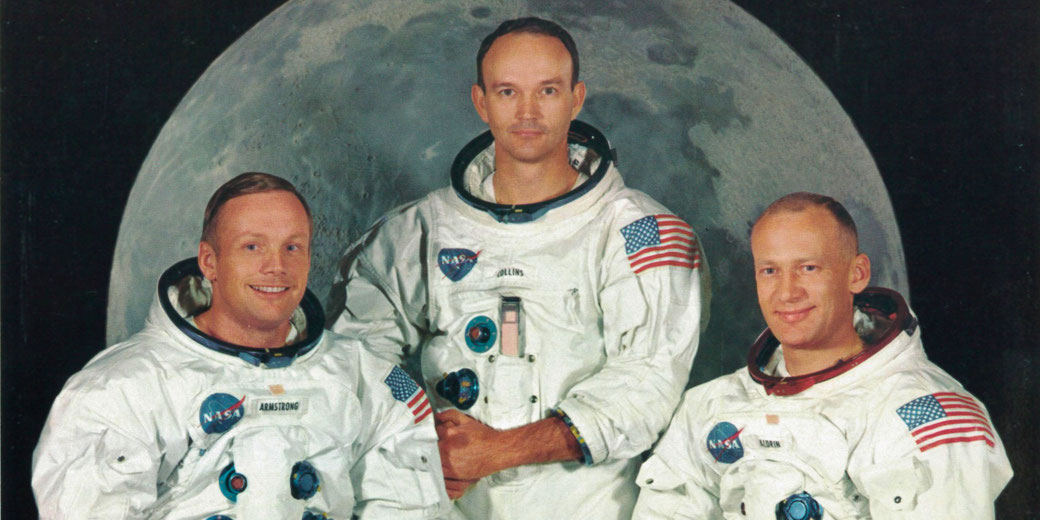
On 20 July 1969, after a four-day journey across nearly 400,000 kilometres of space, astronaut Neil Armstrong stepped onto the surface of the Moon.
He had arrived in the Lunar Module Eagle, part of NASA’s Apollo 11 mission, which had lifted off from Florida four days earlier atop a Saturn V rocket.
The entire operation resulted largely from eight years of coordinated effort from launch to splashdown across government agencies and through partnerships with industry and scientific institutions, all based on a Cold War commitment to outpace the Soviet Union in space.
How the 'race to the moon' began
After the Soviet Union launched Sputnik 1 on 4 October 1957, Americans grew concerned that their country had fallen behind in both technological capability and national security.
Sputnik was a small communications satellite but its launch confirmed that the Soviets had developed powerful rockets that could eventually carry warheads or astronauts into space.
Pressure mounted when Yuri Gagarin, who travelled aboard Vostok 1, became the first human to orbit Earth on 12 April 1961.
President John F. Kennedy soon after addressed a joint session of Congress on 25 May 1961, where he proposed that the United States commit to “landing a man on the Moon and returning him safely to the Earth” before the decade ended.
At that point, NASA had not even achieved human orbital flight, yet Kennedy’s goal offered a specific target that gave the agency a purpose both symbolic and strategic.
Over the following years, Cold War rivalry drove funding and support for NASA, as Congress allocated billions of dollars and thousands of engineers, scientists, and technicians began working to fulfil the president’s challenge.
Crucially, the Moon landing became a way to demonstrate American superiority in science, industry, and national resolve.
At the same time, the U.S. government introduced the National Defense Education Act of 1958, which aimed to channel federal funding into science and engineering programs in schools and universities to develop the expertise that missions like Apollo would later require.
Building a rocket that could reach the moon
First, NASA needed a launch vehicle capable of carrying astronauts beyond low Earth orbit.
Engineers under the direction of Wernher von Braun developed the Saturn V, a multi-stage rocket that would deliver the necessary speed and lift.
At approximately 110 metres tall and weighing over 2.8 million kilograms when fuelled, the Saturn V produced approximately 34 million newtons of thrust in its first stage.
The first stage alone consumed an estimated 13 tonnes of fuel per second during its 2.5-minute burn.
No other rocket had approached that level of power or scale.
Eventually, test flights had confirmed the rocket’s reliability. After several uncrewed missions and crewed Apollo tests, NASA had come to trust the Saturn V to carry out a full lunar landing mission.
Of the thirteen Saturn V rockets that were launched between 1967 and 1973, none of the crewed missions failed in flight, according to mission records.
The rocket’s strength came from its engines and from the design that allowed each stage to fall away after its fuel was spent, reducing weight and increasing efficiency with every phase.
Alongside the rocket, NASA built a modular spacecraft. The Command Module, where the astronauts lived for most of the mission, attached to the Service Module, which provided power, fuel, and oxygen.
The Lunar Module, which was named Eagle, would detach in lunar orbit, descend to the surface, and later return to dock with the Command Module.
This three-part system, though technically difficult, gave NASA the flexibility to achieve the landing using available technology.

Choosing the right astronauts
By 1969, NASA had trained a core group of astronauts, many of whom were veterans of military aviation and earlier spaceflights.
For Apollo 11, officials selected Neil Armstrong, Edwin “Buzz” Aldrin, and Michael Collins.
Each brought specialised skills and experience essential for the mission’s success.
Armstrong had piloted Gemini 8 and responded calmly to a dangerous emergency during that mission, which made him a trusted leader.
Aldrin, who earned a doctorate from MIT, had written his thesis on orbital rendezvous, and his technical expertise matched the mission’s demands.
Meanwhile, Collins was chosen as Command Module Pilot, who would remain alone in lunar orbit aboard Columbia while the others explored the surface.
His prior experience on Gemini 10 and skill with spacecraft systems made him ideal for the role.
Before launch, the crew trained extensively in simulators that replicated every phase of the flight.
In addition to technical procedures, they practised movements in reduced-gravity aircraft and used underwater training tanks.
Step by step, their routine became muscle memory, and their coordination improved with each rehearsal.
The nail-biting journey from Earth to the moon
At 9:32 a.m. EDT on 16 July 1969, Apollo 11 lifted off from Kennedy Space Center as the Saturn V, which performed flawlessly, launched the spacecraft into Earth orbit before a translunar injection burn pushed it toward the Moon.
Over the next three days, the crew monitored systems, adjusted their course, and photographed Earth as it slowly moved away from view.
On 19 July, the spacecraft entered lunar orbit. Armstrong and Aldrin transferred into Eagle the next day while Collins was aboard Columbia.
At 1:46 p.m. EDT on 20 July, Eagle detached and began its descent. Partway down, a radar issue had overloaded the onboard computer, which had triggered "1201" and "1202" alarms.
However, the flight controller team in Houston had identified the cause as non-critical data overflow due to radar interference and had given the crew permission to continue.
During the final descent, Armstrong noticed a field of boulders at the original landing site.
He took manual control and searched for a safer spot, guiding the Lunar Module carefully.
With only 20 seconds of fuel left, he brought the craft down to a flat plain at 0.67408° N, 23.47297° E, in the Sea of Tranquility.
At 4:17 p.m. EDT, Armstrong announced, “Houston, Tranquility Base here. The Eagle has landed.”
"The Eagle Has Landed": Touching down on the moon
Soon after landing, the crew had completed their post-landing checklist and had requested permission to begin the moonwalk ahead of schedule, and NASA approved the change.
Armstrong, who exited first, stepped onto the Moon’s surface at 10:56 p.m. EDT.
He said the words, “That’s one small step for [a] man, one giant leap for mankind,” as millions watched the broadcast from Earth.
An estimated 600 million people viewed the event live, which made it the most-watched television broadcast in history at that time.
Aldrin joined him on the surface shortly afterwards. However, the Moon had no air or wind, so the astronauts planted an American flag that was equipped with a horizontal rod to keep it upright.
Because they had difficulty inserting it into the lunar soil, the flag was not deeply anchored and reportedly fell during liftoff.
They set up scientific equipment near the Lunar Module. One, a seismometer, measured moonquakes, while another, an array of reflectors, allowed scientists to fire lasers from Earth and measure the Moon’s exact distance.
They used a Hasselblad camera to capture photos and noted that the lunar dust stuck to their suits and smelled like spent gunpowder once inside the cabin, and each piece of equipment added valuable data to NASA’s research.
The first steps on the moon
Over two and a half hours, Armstrong and Aldrin collected rock and soil samples, took photographs, and recorded their observations aloud for mission control.
In total, they gathered about 21.5 kilograms of lunar material. They also fixed a plaque to the Lunar Module that read, “We came in peace for all mankind.”
During the walk, President Nixon called the astronauts to congratulate them, and the conversation, broadcast live, added a political layer to the scientific achievement.
The Moon landing was an international milestone, as it was firmly tied to the Cold War circumstances that had shaped its funding and purpose.
Interestingly, Nixon had even prepared a speech in case the mission failed.
Before returning inside the Lunar Module, Aldrin conducted a brief communion service and used a wafer and wine he had brought from Earth.
Due to a previous lawsuit regarding Apollo 8’s Bible reading, NASA had chosen not to publicise the service widely at the time.
The astronauts then re-entered Eagle and prepared for their return to lunar orbit.
The return: Splashdown and quarantine
At 1:54 p.m. EDT on 21 July, the ascent stage of the Lunar Module lifted off from the surface, as Armstrong and Aldrin guided Eagle to a precise docking with Columbia.
After they had transferred their samples and equipment, the crew jettisoned the Lunar Module and began their journey back to Earth.
Three days later, Apollo 11 re-entered Earth’s atmosphere as the Command Module’s heat shield endured temperatures over 2,700 degrees Celsius while it slowed down from orbital speed.
At 12:50 p.m. EDT on 24 July, the spacecraft splashed down in the Pacific Ocean, where the USS Hornet awaited their arrival.
Divers had reached the capsule quickly and had helped the astronauts into a mobile quarantine unit.
They were then transferred to a Mobile Quarantine Facility (MQF) aboard the ship.
For the next 21 days from the time of lunar departure, the crew remained in isolation as scientists examined the Moon rocks for any biological material and monitored the astronauts for signs of contamination.
After medical clearance, the men began their global tour as heroes of a scientific and political victory.
What did the moon landing achieve?
Apollo 11 proved that human spaceflight could succeed beyond Earth orbit using coordinated planning and rigorous training that relied on innovative technology.
The mission met its goal and showed that the billions spent since 1961 had achieved their aim.
It also produced scientific results, including new information about lunar geology and how the solar system formed.
In political terms, the Moon landing gave the United States a symbolic victory during the Cold War.
At a time of social unrest and international tension, it provided a unifying moment and showed the value of public investment in science and education.
The image of the American flag on the Moon was widely circulated and was taken by many as evidence of the country’s capabilities.
The landing inspired many people across generations since many schools reported increased interest in science and mathematics, and engineers who later worked on computers, satellites, and aerospace projects traced their career interests back to that moment.
The Moon landing, while a Cold War objective, became widely regarded as a lasting achievement in the history of all humanity.
Even though there were five more Apollo missions, and twelve astronauts walked on the Moon, the world always remembered Apollo 11 as the first.
The lasting impact continued in the scientific curiosity that inspired new study, the technological progress that followed and the personal daring the astronauts displayed.