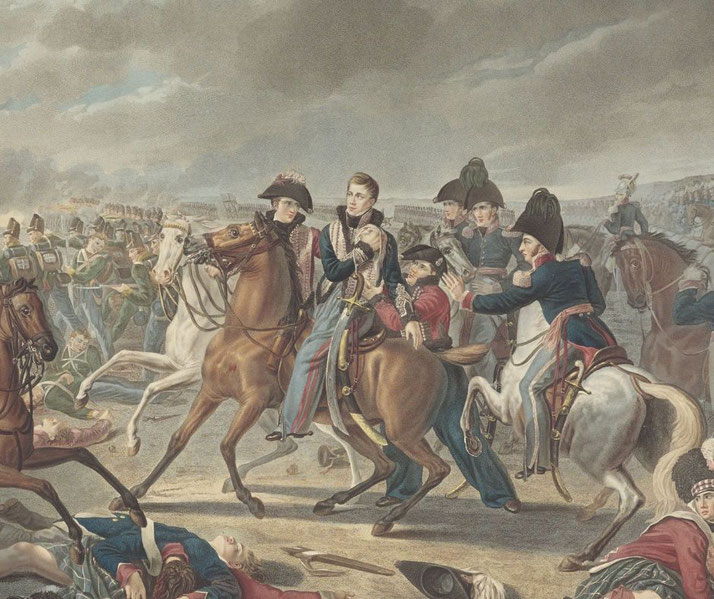
The Battle of Waterloo and Napoleon's last stand
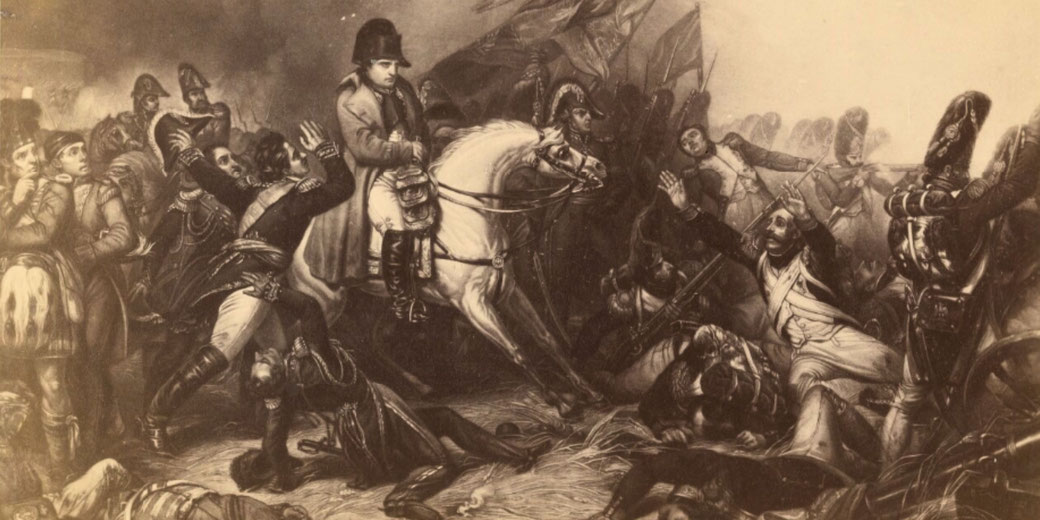
After Napoleon Bonaparte had escaped Elba in March 1815, he landed at Golfe-Juan with barely more than a thousand men, marched through the Alps, and reclaimed power in Paris without firing a single shot.
Within weeks, he had already mobilised a large army of veterans and conscripts because he aimed to strike a major blow against the Seventh Coalition before its members could combine their strength.
On 18 June, just south of the Belgian village of Waterloo, his hopes collapsed as rain-soaked fields, delayed attacks, stubborn Allied resistance, and Prussian reinforcements combined to end his reign for good.
Napoleon’s return and the road to Waterloo
After Napoleon had re-entered France, he advanced steadily north as units that were sent to arrest him joined his cause.
His return unsettled much of Europe, and Louis XVIII fled Paris on 19 March, which left the throne unguarded.
The next day, Napoleon resumed control of the government and began preparing for war.
Because he hoped to broaden his political support, he introduced the Acte Additionnel, drafted by Benjamin Constant and adopted in April, which promised constitutional reforms and civil liberties but failed to gain strong support across many of the different political groups in France.
Soon after, the Allies responded when they brought back their wartime coalition and declared Napoleon an outlaw.
They agreed to mobilise large forces and gradually move toward France from different directions.
Napoleon focused most on the two armies closest to the French border: Wellington’s Anglo-Allied force in Belgium and Blücher’s Prussian army, which was stationed near Liège.
Napoleon hoped that if he acted quickly, he could strike and defeat both before they could unite.
To launch his campaign, he crossed into Belgium on 15 June with roughly 124,000 men of the Armée du Nord, although only around 72,000 were present at Waterloo itself.
His plan aimed to drive a wedge between the British and Prussian armies. On 16 June, he defeated Blücher at Ligny, which caused around 16,000 casualties, but the Prussians managed to withdraw in good order.
On the same day, Marshal Ney engaged Wellington at Quatre Bras but failed to prevent the British from retreating northward and regrouping.
French losses at Ligny were closer to 12,000, and Wellington’s Anglo-Allied forces suffered approximately 4,500 casualties at Quatre Bras, with French losses at Quatre Bras reaching similar figures.
As a result, Napoleon’s efforts to isolate and destroy his opponents were already starting to fail.
The battlefield and initial French attacks
To prepare for battle, Wellington selected a strong and carefully chosen defensive position along a ridge just south of Waterloo.
His line stretched across several kilometres, anchored by fortified farms such as Hougoumont and La Haye Sainte, with the main Brussels–Charleroi road, which cut through the centre.
He placed his troops behind the ridge’s crest, which concealed them from French artillery and allowed him to move his units quickly along the line.
During the night of 17 June, heavy rain drenched the fields and turned the clay soil into mud, which seriously slowed the movement of artillery and cavalry.
As a result, Napoleon delayed his assault until around 11:30 a.m. as he hoped that the sun would dry the ground.
He began with an attack on Hougoumont because he intended to draw Allied reinforcements away from the centre.
The British Guards and Nassau troops who were inside held firm under repeated attacks, and as more French troops became drawn into the fighting, the attack grew into a very costly diversion that consumed large numbers of infantry.
At one point, French soldiers briefly breached the north gate, but British defenders repelled them in fierce close-quarters combat.
Next, Napoleon ordered Count d’Erlon’s I Corps to assault Wellington’s left-centre in large infantry columns.
The French advanced across open ground under artillery fire. Then, as they neared the crest of the ridge, British infantry under General Picton opened fire with disciplined volleys.
Almost immediately, heavy cavalry from the Union Brigade charged into the French flank and caused further disruption.
Though the British cavalry temporarily broke d’Erlon’s corps, they continued forward without orders and became disorganised in the confused fighting, which led to heavy losses in the counterattack.
The Prussians approach and French cavalry charges
By early afternoon, Napoleon had received reports that confirmed that the Prussians were moving rapidly toward his right flank.
He had already sent Marshal Grouchy with 33,000 men to pursue the retreating Prussians after Ligny, but Grouchy had failed to prevent Blücher’s army from regrouping and marching toward Wellington.
Grouchy’s forces were still near Wavre and had remained too distant to influence the battle.
As Prussian columns approached the battlefield, Napoleon recognised the need to act before the Allied armies could join forces.
To break the stalemate, he ordered Ney to launch a large-scale cavalry assault against the Allied centre.
From around 4 p.m., wave after wave of roughly 9,000 French cuirassiers and lancers charged uphill.
However, the British infantry had formed squares, supported by artillery and skirmishers.
Lacking infantry and artillery of his own to support the attack, Ney achieved very little.
The cavalry repeatedly broke against the squares, and the muddy conditions slowed them down.
Meanwhile, Blücher’s leading units were General Bülow’s IV Corps, which arrived on the French right around 4:30 p.m. and began to advance toward the village of Plancenoit, with additional Prussian reinforcements, including Zieten’s I Corps, which arrived later in the evening.
This new threat forced Napoleon to divert the Young Guard and other key reserves to defend the village.
The fighting there soon grew more intense. French troops battled street by street to hold the position for as long as possible, while Blücher continued to send reinforcements into the action.
The Imperial Guard’s final advance and collapse of the French line
By 7 p.m., as French forces struggled to hold back the Prussians and Ney’s attacks had failed to break the Allied centre, Napoleon committed his last reserve, the Imperial Guard.
Composed of veteran soldiers who had never yet been defeated in open combat, the Guard represented Napoleon’s final hope for victory.
As they advanced up the ridge, the Imperial Guard encountered heavy fire from Allied artillery and infantry.
British troops under General Maitland included the 1st Foot Guards and held their fire until the Guard closed to within short range.
Then, with a sudden volley and a counterattack, they forced the French elite to withdraw.
It was the Middle Guard, rather than the Old Guard, that broke under pressure. For the first time, the Guard fell back in battle.
Very quickly, word spread across the battlefield that the Guard had broken. French morale collapsed quickly and soldiers began to flee as officers lost control, and many units broke apart and turned into a general retreat.
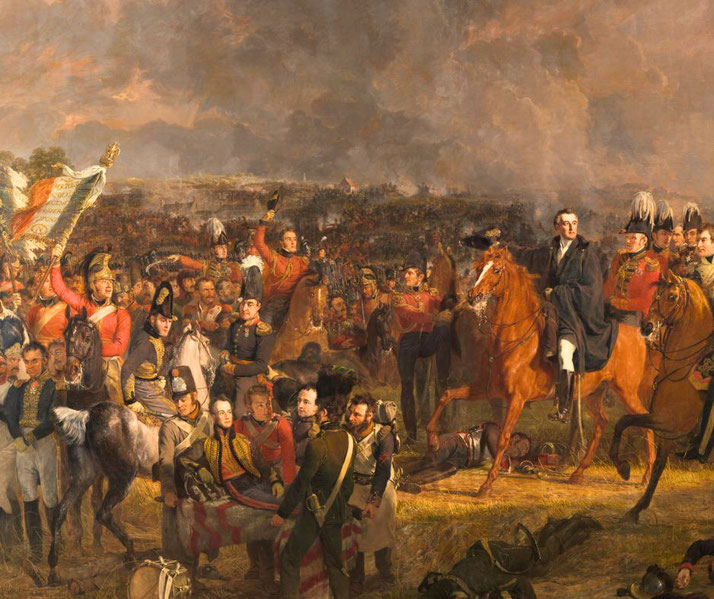
At that moment, Wellington stepped forward and gave the order for a general advance when he waved his hat.
The entire Allied line finally surged forward. At the same time, Prussian troops poured in from the east and completed the rout.
The aftermath and consequences of Waterloo
By 21 June, Napoleon had returned to Paris and faced the reality that political support had vanished.
The legislature no longer trusted him, and public opinion had turned against further bloodshed.
Pressured by the Chamber of Deputies, he abdicated once more on 22 June, naming his son as emperor, although this decision had no practical effect.
Two weeks later, he surrendered to Captain Maitland of HMS Bellerophon and was transported to Britain.
After a short period in custody, the British government ordered him into exile on the remote island of Saint Helena, where he arrived in October 1815 under heavy guard, with 2,000 British troops and a constant naval watch.
The Battle of Waterloo cost the French army around 25,000 killed or wounded and up to 10,000 captured during the retreat.
The Allies were victorious and still lost over 22,000 men. The scale of the losses showed how hard the fighting had been, but the consequences did not stay on the battlefield.
Waterloo brought a final end to Napoleon’s rule and effectively ensured the restoration of the Bourbon monarchy, and it also showed that the Allies controlled Europe’s post-war settlement.
By restoring Louis XVIII and re-establishing the balance of power agreed at the Congress of Vienna, which had resumed proceedings after Napoleon’s escape, the victors imposed a political order that would attempt to preserve peace for several decades.
For those who had followed Napoleon through victory and defeat, Waterloo ended an age, and for his enemies, it closed a chapter of revolution and war that had changed the European continent.