
The Storming of the Bastille and the birth of Revolutionary France
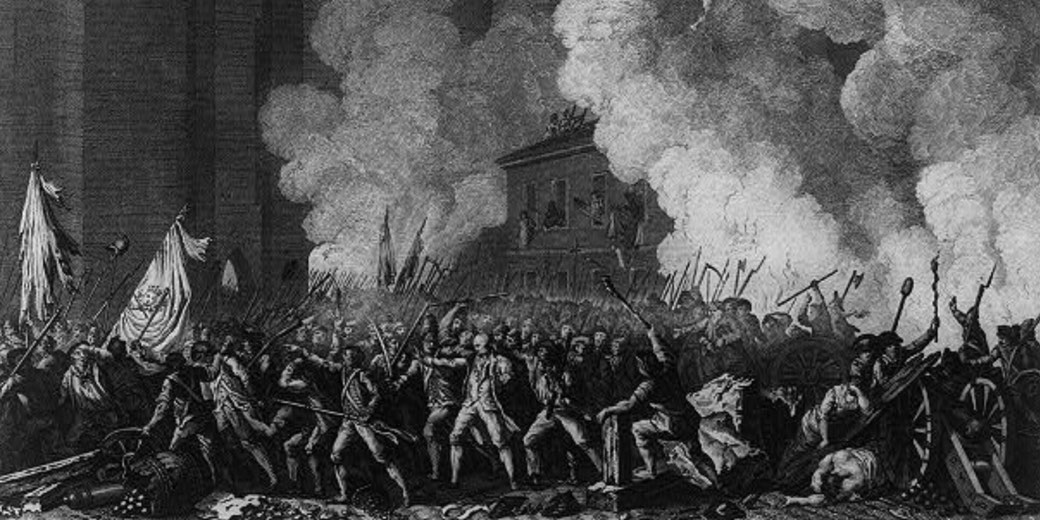
On 14 July 1789, a crowd of Parisian civilians stormed a royal fortress-prison, to seize gunpowder and confront what they believed was an likely royal assault instead of attempting to free political dissidents.
The Bastille towered over the Faubourg Saint-Antoine district and had come to symbolise what many Parisians saw as unchecked imprisonment and state violence under the Bourbon monarchy.
Bakers, apprentices, merchants, and labourers, who carried out its capture, helped trigger a revolution that would end centuries of royal authority and change France's political system.
Why was France in crisis?
For decades, France had struggled under the weight of debt that worsened after its costly participation in the American Revolutionary War.
By the late 1780s nearly half of the national income had been required to pay interest alone, which had largely consumed available revenue.
As a result, ministers such as Calonne and Brienne proposed new taxes, yet the privileged classes. the clergy and nobility. resisted any change that threatened their tax exemptions.
While the First and Second Estates avoided the financial burden, the Third Estate paid a tax burden that combined direct taxes and indirect duties with persistent feudal dues that kept rural peasants in deep poverty.
The Third Estate, which included nearly 98% of the population, faced a disproportionately high share of the kingdom's financial obligations.
Meanwhile, failed harvests in 1787 and 1788 brought food scarcity that substantially drove up bread prices and increased public frustration; so, by spring 1789, an average labourer in Paris, by some estimates, had spent nearly three-quarters of their daily wage on bread.
That financial pressure created unrest in both urban and rural areas, where desperate families looted storehouses and attacked toll gates.
Public anger intensified as many increasingly contrasted their suffering with the perceived extravagance of the royal court at Versailles.
At the same time, the influence of Enlightenment writers increasingly encouraged some educated citizens to question the idea of a religiously justified monarchy and hereditary privilege.
Rousseau’s The Social Contract argued for popular sovereignty, while Montesquieu’s The Spirit of the Laws defended legal restraint and constitutional balance.
Among the urban middle class, these ideas blended with economic hardship to produce demands for constitutional reform.
On 5 May 1789, Louis XVI opened the Estates-General in Versailles, hoping to secure support for new taxes.
However, disputes about voting procedures led the Third Estate to break away. On 17 June, they declared themselves the National Assembly and claimed exclusive authority to legislate for France.
When the king ordered the hall closed, they met in a nearby indoor tennis court and swore the Tennis Court Oath and vowed not to separate until they had written a constitution.
Soon after, troops began to gather outside Paris. That decision, made in a time of high tension, prompted widespread fears of a military crackdown.
What was the Bastille?
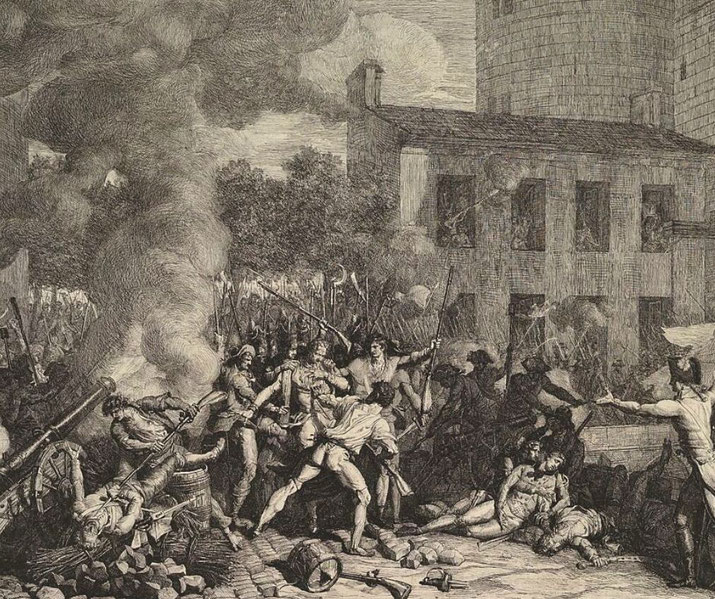
Located near the eastern gate of Paris, the Bastille began as a fortress built during the Hundred Years’ War but had long since become a royal prison.
Though it held few inmates by 1789. only seven at the time of its capture. it had acquired a reputation as a tool of oppressive rule.
Previous prisoners had included figures such as Voltaire and the Marquis de Sade. Prisoners could be confined under lettres de cachet, which were sealed royal orders that bypassed the courts and allowed indefinite detention.
For many Parisians, the Bastille represented the secretive and arbitrary nature of Bourbon justice.
Structurally, it remained formidable. With eight towers, 3-metre-thick walls, drawbridges, and a surrounding moat, the Bastille rose over 24 metres above the district and housed a significant cache of gunpowder and ammunition.
While its strategic importance had diminished over time, it had a threatening presence.
Crucially, its existence in the middle of a densely populated neighbourhood reinforced the idea that the monarchy ruled by fear.
Nearby residents, who often worked as carpenters, tanners, and printers, saw their resentment toward the Bastille grow with each story of mysterious imprisonment or injustice.
It became a prison and a symbol of everything the revolutionaries hoped to destroy. arbitrary royal command and laws that treated citizens unequally and restricted public expression.
The dramatic events leading up to July 14, 1789
After the king had dismissed Jacques Necker on 11 July 1789, panic spread through the streets of Paris. Necker, widely regarded as a minister supportive of reform, had argued for transparency in royal accounts and advised moderation.
Once he had been removed, many believed the king would launch an armed assault on the National Assembly and arrest its deputies, so armed demonstrations flared throughout the city.
On 12 July, journalist Camille Desmoulins climbed onto a table at the Palais-Royal and publicly delivered an emotional call to arms and urged citizens to take up weapons to defend liberty.
By 13 July, unrest turned to mobilisation. Crowds attacked customs houses, looted weapons from private armouries, and began forming militias.
That day, thousands gathered at Les Invalides, a military hospital and veterans’ home, where they seized more than 30,000 muskets.
But the gunpowder had already been moved. The search for powder quickly focused on the Bastille.
On the morning of 14 July, an enormous crowd formed outside the fortress and demanded the surrender of gunpowder and cannon.
Negotiations began, though neither side trusted the other. While the crowd pleaded for a peaceful resolution, some reportedly fired shots at the outer guards, and the fighting escalated.
What happened during the Storming of the Bastille?
By midday, the situation had devolved into fighting. Mutinous members of the Gardes Françaises reinforced armed citizens and brought both weapons and military training, as the armed citizens attacked the drawbridges and outer gates with muskets and two seized cannons.
Inside the Bastille, Governor Bernard-René de Launay hesitated. He was the son of a former Bastille governor and had served loyally for years, yet he lacked the clarity of orders and the unity among his men needed to command effectively in a crisis.
Though he commanded around 100 defenders and they included Swiss mercenaries and veteran soldiers, he lacked clear instructions from the king and knew that reinforcements were unlikely to arrive in time.
Eventually, as the crowd broke into the outer courtyard, the defenders opened fire.
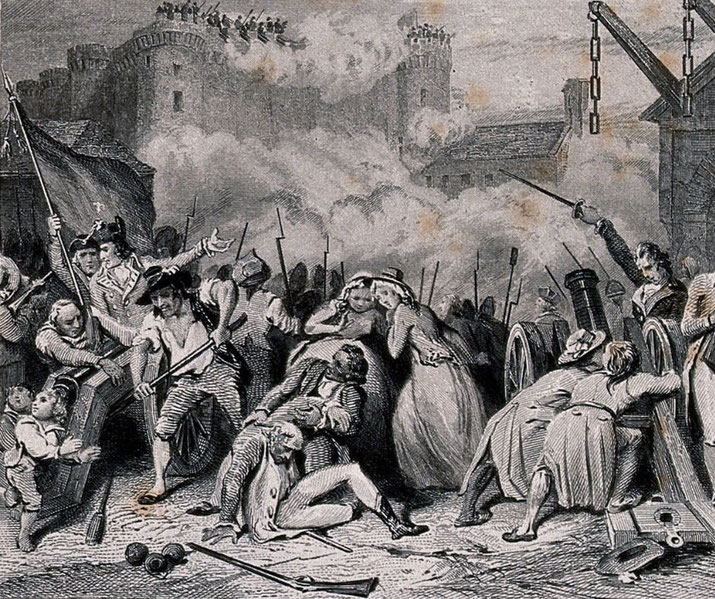
Several dozen attackers died in the first volley, but they did not retreat. Over several hours, they pressed forward under occasional gunfire.
The defenders, now surrounded and low on supplies, refused to fire again and many refused orders to continue, so around 5:00 p.m. de Launay surrendered and ordered the gates opened.
Soon after, the crowd poured into the inner court, took control of the prison, and seized the gunpowder, and the governor was taken prisoner but never reached city hall because an angry mob killed him in the street.
His severed head, which was impaled on a pike, became one of the revolution’s earliest symbols of vengeance.
Other officers were also killed, though the prisoners. four forgers, two madmen, and one aristocrat imprisoned at his family's request all walked free.
Altogether, approximately 98 attackers died in the assault, while at least six of the defenders were killed, including several Swiss and invalid soldiers.
The aftermath
By 15 July, word of the Bastille’s fall had already reached Versailles. Louis XVI asked his advisers if it was a revolt, and they replied, "No, Sire, it is a revolution."”
On the day of the storming, the king had reportedly written "Rien" ("Nothing") in his hunting diary, a reference to his unsuccessful hunt rather than the political crisis unfolding in his capital.
The king reluctantly travelled to Paris the next day, where he was forced to wear a tricolour cockade and publicly endorse the new National Guard, which was led by Lafayette.
Across France, the Bastille’s fall inspired widespread revolt, and in many areas peasants in the countryside attacked noble estates and destroyed feudal records.
That wave of violence, known as the Great Fear, convinced many deputies in the National Assembly that the revolution could not be contained with partial reforms.
On 4 August, they voted to abolish feudal privileges, manorial rights, and tithes.
Soon after, the Assembly passed the Declaration of the Rights of Man and of the Citizen, which clearly set out equality before the law along with guarantees for free speech and the principle that sovereignty rested with the people.
Politically, the monarchy’s authority disappeared. Royalists fled or tried to regroup in exile.
The Bastille had fallen because the people no longer feared the crown rather than by military force.
The momentum shifted to revolutionaries who insisted that power must rest with the nation, not a monarch who had failed to understand their suffering.
In the days that followed, the Bastille was was taken apart, and bricks from the structure were sold as souvenirs.
One of the fortress's keys was later sent to George Washington and still remains on display at Mount Vernon.
Why do the French still celebrate it today?
Every year on 14 July, Bastille Day primarily commemorates the storming of a prison and the moment when ordinary citizens overturned centuries of royal rule.
The event marked the beginning of France’s transformation into a constitutional state and later a republic, and across the country, parades, fireworks, and speeches celebrate the values first demanded in 1789.
For modern France, Bastille Day affirms that national identity emerged from people acting together rather than royal decree.
Its its lasting place in public memory largely came not from the number of prisoners freed or the fortress’s military value, but from the symbolic power of a people who decided to act.
That moment, when an armed crowd brought down a centuries-old structure of tyranny, is one of the most defining acts of political courage in modern history.