
The League of German Girls and the experiences of young women in Nazi Germany
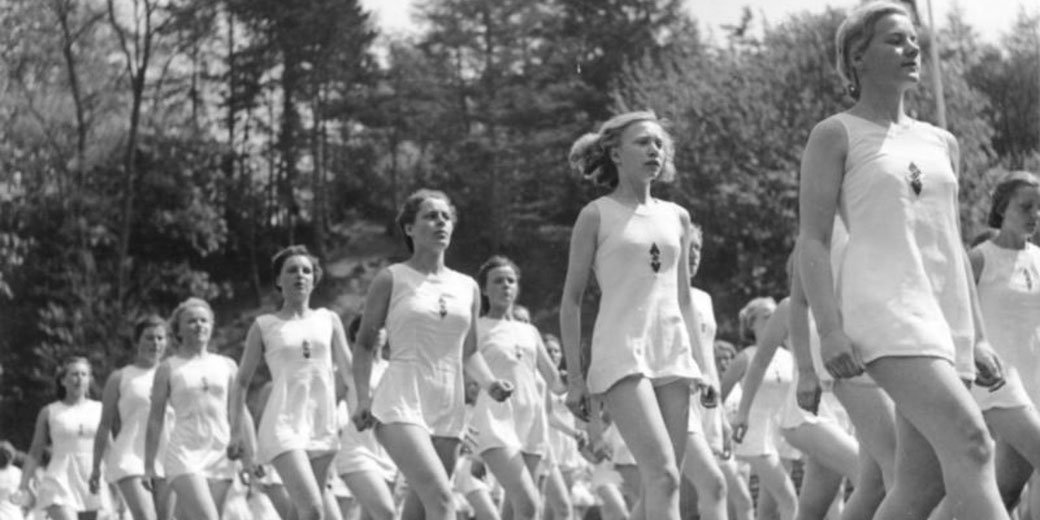
By 1939, more than 4.5 million young women belonged to the Bund Deutscher Mädel (BDM), the League of German Girls, which made it arguably the largest female youth organisation in the world.
As the female branch of the Hitler Youth, the BDM turned the everyday lives of German girls into a tool of ideological control and dictated how they exercised and what they believed, as well as what their futures would look like.
The Nazi regime targeted girls as young as ten years old, mainly through a deliberate system that created one of the twentieth century’s most problematic programmes of youth indoctrination.
From scattered groups to a compulsory organisation
The BDM had modest beginnings. In the early 1920s, a Nazi activist who was named Gustav Adolf Lenk attempted to establish localised girls’ groups, which were sometimes called Mädchenschaften, but these small clusters struggled to attract members.
In 1926, the creation of the Hitler Youth under Kurt Gruber led to a new women’s department which was run by Helene Kunold and Anna Bauer, but recruitment continued to disappoint.
On 20 April 1930, the BDM was formally founded, and by 1931 it had become the official female branch of the Hitler Youth under Baldur von Schirach, who was then just twenty-five years old.
Even so, membership hovered at an estimated 10,000 to 15,000 girls by the end of 1932, because the Nazi Party itself had not yet taken power.
Once Adolf Hitler became Chancellor in January 1933, the situation changed dramatically: rival youth organisations were dissolved or absorbed, and BDM membership surged.
On 17 June 1933, all non-Nazi youth movements were banned by law.
A critical turning point came on 1 December 1936, when the Gesetz über die Hitlerjugend (Law on the Hitler Youth) declared that all German youth belonged to the Hitler Youth movement.
A further decree in March 1939 made membership compulsory for every eligible young person aged ten to eighteen, with penalties for parents who refused to enrol their children.
By this stage, the BDM had transformed from a fringe political group into a state-mandated institution that controlled the lives of millions of girls.

What membership actually required
The BDM operated through an age-based structure, with girls between ten and fourteen joined the Jungmädelbund (Young Girls’ League), where they learned basic Nazi ideology through folk songs and group activities.
However, once they turned fourteen, they moved into the BDM proper, which demanded a more intensive commitment of time.
In 1938, a third tier was introduced: the Glaube und Schönheit (Faith and Beauty) society, a voluntary programme for young women who were aged seventeen to twenty-one that prepared them for domestic life and employment.
Weekly schedules were demanding. Members attended regular club meetings, which were known as Heimabende (home evenings), where instruction focused on domestic skills such as cooking and sewing alongside ideological training.
Saturdays involved intense physical training, with girls who were expected to complete gymnastics routines and long-distance marches.
The stated purpose of this physical training was to produce healthy young women capable of bearing children for the Reich, which meant that every sporting activity carried an ideological justification.
Outside the weekly routine, the BDM organised summer camps and harvest work in rural areas.
At these camps, girls lived together and often slept in tents or farmhouses, and they followed a strict daily timetable.
For many girls, particularly those from working-class urban families, these camps provided rare opportunities for travel and outdoor activity, which made the organisation genuinely appealing in ways the regime deliberately exploited.

Preparing girls for motherhood and the Reich
At the centre of BDM ideology sat a single, constant message: a German woman’s primary duty was to bear and raise children for the Volksgemeinschaft, the Nazi concept of a racially pure people’s community.
Nearly every aspect of the programme reinforced this message, from domestic training at Heimabende to the physical fitness regime.
The BDM’s own magazine was called Das Deutsche Mädel, and it regularly published articles that celebrated motherhood and encouraged girls to see child-rearing as their highest calling.
Leadership of the BDM enforced this vision strictly, as Trude Mohr was a former postal worker who had been appointed as the first Reichsreferentin (National Speaker) in 1934, and she declared that the organisation needed girls who were “sure and confident” in their femininity.
When Mohr married in 1937, she was required to resign, because BDM policy had prohibited married women from holding leadership positions.
Her successor was Dr Jutta Rüdiger, who was a psychologist from Düsseldorf, and she led the organisation from 1937 until 1945 and proved to be a more assertive figure who resisted attempts by Gertrud Scholtz-Klink, who was the head of the Nazi Women’s League, to absorb the BDM.
Racial ideology was woven into every level of BDM education. Members had to prove that they were ethnically German and free of hereditary diseases in conformity with Nazi racial standards.
Anti-Semitic teachings featured regularly in meetings and camp instruction, where girls learned to view Jewish people as threats to the German nation.
In effect, the BDM trained them to accept and carry on the regime’s programme of racial exclusion.
How the war changed the role of BDM members
After the outbreak of the Second World War in September 1939, the BDM’s activities shifted to support the war effort.
Younger members collected clothing and old newspapers for the Winterhilfswerk (Winter Relief), which was a major Nazi charitable programme.
BDM musical groups visited wounded soldiers in hospitals, and girls knitted socks and grew vegetable gardens, as well as assembling care packages for troops at the front.
As the war dragged on and Germany’s military situation worsened, demands on BDM members intensified.
From 1943, increasing Allied air raids on German cities pushed thousands of older BDM girls into military auxiliary roles.
They worked as Flakhelferinnen (anti-aircraft helpers) and signals auxiliaries for the Luftwaffe, and others operated searchlights that guarded German cities.
Some trained as volunteer nurses closer to the front lines. The Reichsarbeitsdienst (National Labour Service) also became compulsory for young women, which required six months of agricultural work.
In the final months of the war, a small number of BDM members joined the Volkssturm, which was the last-ditch civilian militia that defended German cities against the advancing Allied forces.
Jutta Rüdiger herself opposed arming BDM girls, and she declared in 1942 that “women should give life and not take it” when Martin Bormann had proposed creating female combat battalions.
By September 1944, however, German women were being conscripted to reinforce frontier fortifications.
The personal cost of ideological control
For millions of young women, the BDM likely consumed an enormous portion of their teenage years.
The regime’s strategy of filling girls’ schedules with meetings and compulsory service arguably weakened the influence of parents and teachers.
The BDM even encouraged members to report on what happened inside their families and schools, which created an atmosphere of surveillance that eroded trust between children and the adults around them.
After the war, many former BDM members struggled to come to terms with the role they had played.
The organisation had provided them a sense of community and purpose during their adolescence, but it had simultaneously trained them to support a genocidal regime.
With Germany’s surrender in May 1945, the BDM ceased to exist, and on 10 October 1945 it was formally dissolved along with all other Nazi organisations.
For a generation of German women, reckoning with what they had been taught lasted for decades.