
The train incident that changed Gandhi’s life forever
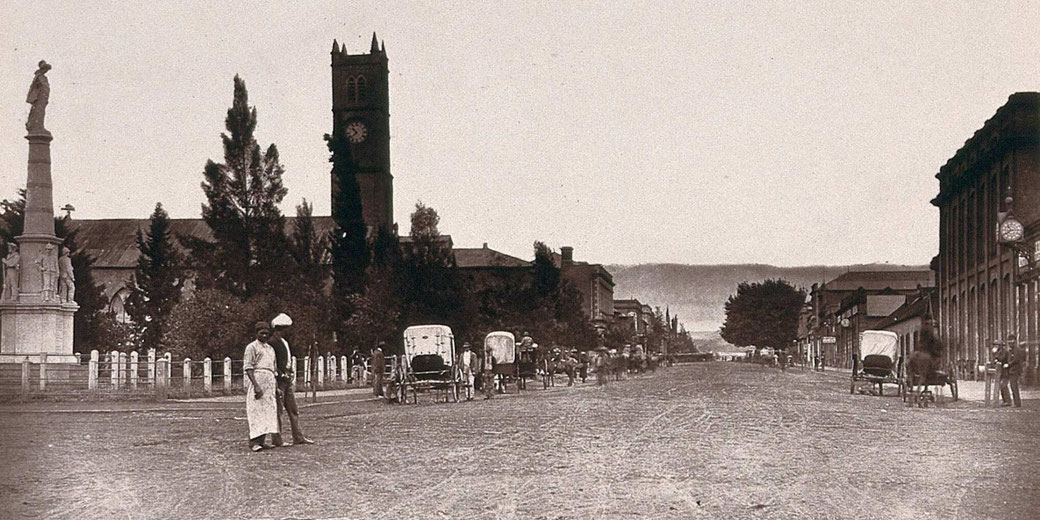
On the night of 7 June 1893, a 23-year-old Indian lawyer named Mohandas Karamchand Gandhi was physically thrown off a first-class train carriage at Pietermaritzburg station in South Africa, for no reason other than the colour of his skin.
As he sat shivering through the freezing winter night in the station’s deserted waiting room, Gandhi made a decision that would alter the direction of his entire life: he would stay in South Africa and fight the system of racial discrimination that had humiliated him.
From that single act of injustice on a railway platform in the colony of Natal, one of history’s most influential philosophies of nonviolent resistance began to take form.
A young lawyer arrives in South Africa
In May 1893, Gandhi arrived in the port city of Durban after accepting a legal contract from Dada Abdullah Jhaveri, a Gujarati-speaking merchant based in Natal.
Abdullah ran a successful trading company and needed a London-trained lawyer who could also speak Gujarati to help resolve a commercial dispute worth around 40,000 pounds.
Gandhi had completed his law degree in England in 1891, but after returning to India, he had struggled to build a legal career, since a disagreement with the local British Political Agent in Rajkot, Gujarat, made his professional life difficult.
Gandhi accepted Abdullah’s offer of a one-year contract with a fee of 105 pounds, a first-class return fare, and living expenses.
At the time of Gandhi’s arrival, Natal was a British colony with a significant Indian population.
Many Indians had come to the region as indentured labourers during the 1860s, brought by the British to work on sugar plantations, and Indian merchants had followed.
Under colonial law, Indians were classified as non-white and were subject to numerous restrictions, including limitations on property ownership and the expectation that they would not travel in first-class railway compartments.
The night at Pietermaritzburg station
Shortly after settling into his work with Abdullah in Durban, Gandhi was asked to travel to Pretoria in the Transvaal to attend to the legal dispute.
Abdullah purchased a first-class train ticket for him, and Gandhi boarded the train from Durban on 7 June 1893.
The journey required a stop at Pietermaritzburg, the capital of Natal, located at a high altitude where winter temperatures dropped sharply at night.
When the train arrived at Pietermaritzburg at around 9 p.m., a white passenger entered Gandhi’s first-class compartment and objected to the presence of an Indian.
The passenger summoned railway officials, who ordered Gandhi to move to the third-class van compartment, the section reserved for non-white travellers.
The officials used the word “coolie,” a derogatory term commonly applied to Indians in South Africa at that time.
Gandhi protested and produced his valid first-class ticket, but the officials warned him that he would be removed by force if he refused to comply.
When Gandhi held his ground, a police constable seized him and pushed him out of the carriage.
His luggage was thrown onto the platform after him, and the train departed.
Gandhi picked himself up from the cold platform and made his way to the station’s waiting room.
His overcoat was locked inside his luggage, which the railway authorities had taken charge of, and he did not dare ask for it back for fear of further mistreatment.
As he later wrote in his autobiography, first published in the Indian magazine Navajivan between 1925 and 1928: the cold at Pietermaritzburg was “extremely bitter.”
He sat alone in the dark, shivering through the entire night.
A decision made in a cold waiting room
During those long hours in the waiting room, Gandhi wrestled with what to do next.
He considered returning to India immediately, since his contract was temporary and he had no obligation to endure such treatment.
In his autobiography, Gandhi described the night as one of deep internal conflict, during which he weighed his personal safety against what he called his “duty” to resist injustice.
By morning, Gandhi had reached his conclusion. He would not return to India, and he would not accept the racial discrimination he had experienced.
When the American missionary Dr John Mott later asked Gandhi what had been the most creative experience of his life, Gandhi pointed directly to that night at Pietermaritzburg.
He told Mott: “My active nonviolence began from that day.”
From personal humiliation to political action
After the Pietermaritzburg incident, Gandhi continued his journey to Pretoria, where he encountered further racial discrimination. Indians in the Transvaal were forced to carry identification passes and were barred from using public footpaths.
On one occasion near the house of President Paul Kruger, a policeman physically assaulted Gandhi for walking on the pavement.
Each of these experiences reinforced his determination to organise resistance.
Once Gandhi completed his legal work in Pretoria, he returned to Durban and prepared to leave South Africa.
At his farewell dinner in 1894, however, he came across a newspaper report about a bill in the Natal Legislative Assembly that aimed to strip Indian residents of their right to vote.
Gandhi urged the community leaders at the dinner to resist the proposed law, and they asked him to stay and lead the campaign.
On 22 August 1894, Gandhi founded the Natal Indian Congress, with Dada Abdullah as its first president and Gandhi as honorary secretary.
Gandhi drafted petitions to both the Natal Legislature and the British government in London, collecting signatures from hundreds of Indian residents.
He did not succeed in stopping the bill from passing, but the campaign drew significant public attention across South Africa and in Britain, as the grievances of the Indian population were being heard on an international level for the first time.
The slow birth of satyagraha
Gandhi spent 21 years in South Africa, from 1893 to 1914, and the train incident at Pietermaritzburg is widely considered the turning point that set him on this path.
Over those two decades, he refined his philosophy of satyagraha, a term he coined from the Sanskrit words for “truth” (satya) and “firmness” (agraha).
Satyagraha meant resisting injustice without resorting to violence, using methods such as petitions and the deliberate defiance of unjust laws.
In 1903, Gandhi founded the newspaper Indian Opinion to publicise the conditions facing Indians in South Africa.
The following year, he established the Phoenix Settlement near Durban, a community built on principles of self-sufficiency.
In 1906, when the Transvaal government introduced the Asiatic Registration Act requiring all Indians to carry identification documents, Gandhi organised the first mass campaign of passive resistance.
A gathering of over 3,000 Indians at the Empire Theatre in Johannesburg on 11 September 1906 pledged to defy the law, and many were arrested, including Gandhi himself, who was sentenced to jail four separate times during his years in South Africa.
When Gandhi finally returned to India in 1915, he brought with him the principles he had developed in response to the humiliation on a cold railway platform in Natal.
He applied satyagraha to the Indian independence movement, organising campaigns that mobilised millions of people against British colonial rule.
Nelson Mandela, South Africa’s first post-apartheid president, later credited Gandhi’s philosophy as an influence on the African National Congress.
In 1997, Mandela conferred the Freedom of Pietermaritzburg posthumously on Gandhi.
A plaque at the railway station now reads: “In the vicinity of this plaque M.K. Gandhi was evicted from a first-class compartment on the night of 7 June 1893. This incident changed the course of his life.”