
Why Washington’s crossing of the Delaware River was such a crucial moment in American history
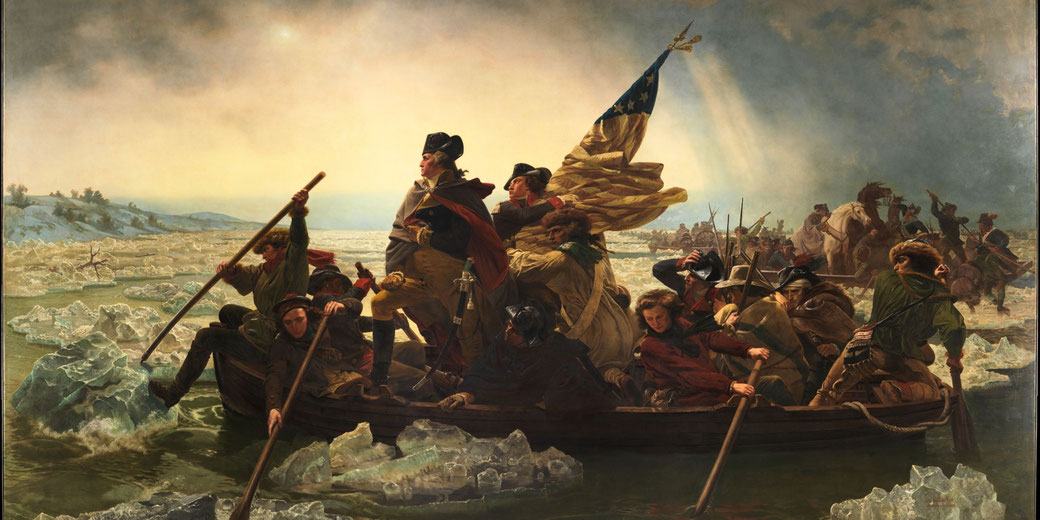
On the freezing night of 25 December 1776, George Washington led 2,400 exhausted Continental soldiers across the ice-choked Delaware River.
That single decision was made after a year of defeats and a decline in morale and helped to halt the collapse of the Revolutionary War and reversed public doubt about the fight for independence.
Since enlistments were set to expire and the British widely believed the rebellion was already dead, the attack that followed may have actually saved the revolution itself.
The failing American Revolutionary War in 1776
After the Continental Congress declared independence in July 1776, the American cause entered a period of serious disaster, as General William Howe’s British forces landed at Staten Island and soon began a major campaign to crush the rebellion.
By late August, Washington’s army had been defeated at the Battle of Long Island and had barely escaped by sea under cover of fog, and as a result, they had lost Manhattan, Fort Lee, and Fort Washington.
Around 2,800 American troops surrendered at Fort Washington alone.
Next, the battered army retreated across New Jersey, and as towns fell under British control, many civilians declared loyalty to the Crown, and support for independence faded.
Troop morale broke down, and hundreds of soldiers deserted. Commanders struggled to maintain supply lines while enlistments continued to expire.
After reaching the western bank of the Delaware River in early December, Washington’s forces had fewer than 5,000 men fit for duty.
At once, Congress abandoned Philadelphia in fear of British capture, and as its members fled to Baltimore, they granted Washington emergency powers to take any measure necessary.
The young republic had no secure capital and no funds, and it lacked any real assurance that an army would exist in the new year.
The dire strategic situation in December 1776
By mid-December, it had become clear that the American rebellion could not continue without prompt action, since thousands of enlistments would expire at the end of the month and most soldiers refused to commit to a losing cause.
Washington knew that if he failed to launch an offensive, he would lose his army without another battle, and as a result, he urgently considered risky options to reverse the tide before the end of the year.
The British command believed the campaign season had ended. Since they had secured control over New York and most of New Jersey, they stationed their forces across the state in winter outposts.
One such post, which sat in Trenton, was garrisoned by roughly 1,500 Hessian troops under Colonel Johann Rall, along with Majors von Dechow and von Wiederholdt.
That unit had no fortifications and, although several reports warned of possible American movement, officers chose to disregard them and initially maintained limited expectations of a real attack.
Officers ignored reports of rebel scouts and largely believed that the American army lacked the strength to fight again.
While later American accounts claimed the Hessians had celebrated heavily the night before, modern research suggests their reduced readiness largely stemmed from fatigue and overconfidence rather than drunkenness.
Given that enemy positions were isolated and vulnerable, Washington prepared to strike the Trenton outpost directly.
Success would likely deliver a moral victory, disrupt enemy planning, and prove to Congress and the American people that the Continental Army was capable of winning battles.
As pressure mounted, Washington placed his hopes in a single risky operation designed to achieve maximum effect with limited manpower.
Planning the surprise attack
Over several days, Washington and his officers finalised a three-pronged assault.
The main force would cross the Delaware River north of Trenton and approach the town before dawn, while a second column under General James Ewing was ordered to block any Hessian retreat by seizing the bridge south of Trenton.
Meanwhile, General John Cadwalader’s militia would cross farther downstream to distract and divide British attention.
Each crossing required that men, horses, and cannon be moved over an icy river at night.
Preparations began immediately, as Colonel John Glover’s Massachusetts mariners handled the boats and Henry Knox arranged for artillery transport.
The crossing relied on large, flat-bottomed Durham boats that were designed to ferry cargo such as iron ore.
Officers selected only the most reliable regiments, which included the 1st Pennsylvania Rifles, the 3rd Virginia Regiment, and the Delaware Regiment, to make the main crossing.
Washington gave few details to lower ranks and kept the plan secret to protect the operation.
As weather worsened, he refused to delay, since he understood that surprise largely depended on the belief that no army would attempt such a crossing under winter conditions.
By 25 December, ice floes had already drifted across the river in great sheets.
Snow fell without pause, and winds battered the boats as soldiers prepared to embark.
Washington was visible throughout the operation, as he rode along the shore, gave orders, and urged the men to stay the course.
A dangerous and icy journey
The crossing began at sunset with Durham boats moving soldiers across in waves, each of which struggled against the current and heavy ice.
Artillery pieces followed on larger ferries, guided by lanterns and shouted commands.
Men stood soaked and were shivering, their uniforms frozen against their bodies, and several collapsed as they waited on the riverbank, some dying before reaching the far side.
By 3 a.m., the final units had completed the crossing. However, the operations by Ewing and Cadwalader had failed.
The river ice had proven impassable at their locations, despite repeated attempts.
Washington now faced the march alone, but he chose to proceed, since abandonment of the plan would have destroyed what little morale there was.
Then came the nine-mile march to Trenton during which snow and hail lashed the columns, and men walked in near silence.
Officers wrote later of bloodstains in the snow where bare feet had left prints. At least two men died on the route from exposure.
Yet the soldiers pushed forward as they held their weapons under their coats and marched without complaint.
Washington rode near the front. Earlier that evening, he had read aloud from Thomas Paine’s newly published pamphlet The American Crisis, whose opening lines, “These are the times that try men’s souls,” helped to steel the men against fear.
The Battle of Trenton
At dawn, the Americans reached Trenton and divided their forces as planned.
General Nathanael Greene’s division advanced from the north, while General John Sullivan’s troops moved to cut off the south.
Washington placed artillery at the head of the main road. As Hessian sentries fired warning shots, Knox’s guns began to shell the centre of town with canister and grapeshot.
Inside the garrison, Colonel Rall scrambled to form resistance. However, confusion spread quickly as Hessian officers tried to rally companies in the snow-covered streets.
American infantry fought from fences and behind houses and outflanked defensive positions.
Then, as the Hessians regrouped near a small orchard, Washington ordered his men to press forward and block their escape.
Within ninety minutes, the Hessian resistance had collapsed. Rall suffered a wound from musket fire and died later that day.
Around 900 Hessians surrendered, and the rest fled toward Princeton while American losses remained minimal.
Two men had died during the march, and only a few suffered injuries in the engagement itself.
Washington ordered the troops to return across the river with their prisoners, at least six captured field pieces, approximately 1,200 muskets, and critical supplies.

The importance of morale in turning the tide
News of the victory travelled quickly, as American newspapers praised the attack and civilians who had lost faith in the cause found renewed hope.
Recruitment increased in the weeks that followed and Congress received confidence from Washington’s success, so granted new supplies and additional emergency powers.
Most importantly, the victory proved that the Continental Army had not dissolved, at least for the moment.
Next, Washington struck again. On 3 January 1777, he defeated British forces at the Battle of Princeton, forcing General Cornwallis to withdraw to New Brunswick.
Cornwallis had rushed to intercept Washington after the shock of Trenton, expecting to trap him near Assunpink Creek.
Instead, Washington slipped away under cover of night and struck at Princeton.
With two victories in ten days, the Continental Army had effectively reversed the course of the war and had driven the British from much of New Jersey.
For the first time since July, American forces launched a major offensive, having previously been confined mostly to retreats and minor skirmishes.