
How blood libels fueled medieval anti-Judaism in Europe
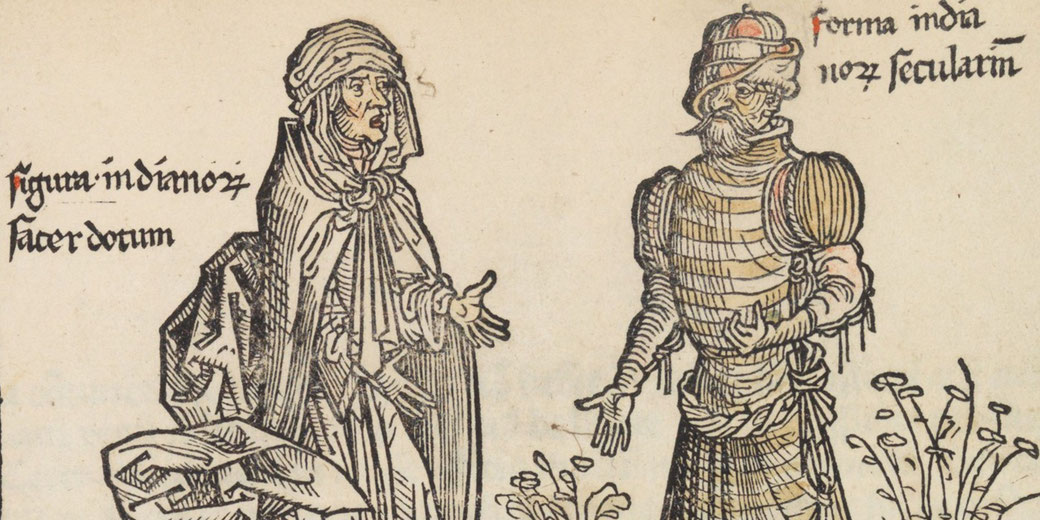
Throughout the medieval period, Christian fears about who belonged to the Church, insistence on visible ritual purity, and pressures to preserve local order often found a violent outlet in the figure of the Jew.
By the twelfth century, one of the most damaging expressions of this fear had taken root, known as the ‘blood libel’.
Fuelled by false claims that Jews kidnapped and murdered Christian children for ritual purposes, these stories created powerful and dangerous myths that spread widely into religious thinking, civic policy, and popular belief.
Origins of the blood libel
The first known blood libel in Europe appeared in 1144 in the English city of Norwich where a young boy named William was found dead in nearby woods, and local Jews were accused of killing him without any clear evidence.
Years later, a monk named Thomas of Monmouth composed The Life and Passion of William of Norwich, which described the boy’s death as a ritual crucifixion by Jews in mockery of Christ.
Thomas copied the structure of saints' lives that recounted Saint Edmund and Saint Eustace, and he applied that structure to William’s story, as this produced a template that portrayed Jews as religious murderers who plotted collectively across Europe.
His account had circulated among priests and monks, and it had often been spread by sermons and monasteries, which helped transform a local incident into a religious mythology.
Over the following decades, similar accusations multiplied in several regions. In 1181, the Jewish community in Gloucester was blamed in some accounts for the death of a Christian child, although no reliable witness testimony, physical evidence, or record of the child’s name survives to confirm the details.
Soon after, similar claims surfaced in the Rhineland cities of Fulda and Pforzheim, where Jewish communities faced interrogation and punishment based on confessions extracted under torture and mob threats.
Accusations appeared in other German cities as well, including Fulda in 1235 and Munich in 1285, where, in some cases, entire communities were killed or expelled.
Often, city and church leaders found it convenient to accept such charges, as the narrative of ritual murder justified public executions, allowed rulers to seize Jewish property, and reinforced the idea that Jews posed a direct threat to Christian society.
What happened in Lincoln in 1255?
In 1255, a major incident unfolded in Lincoln, England, after a boy named Hugh went missing.
When his body was discovered in a well, local officials arrested a Jewish man named Copin, who confessed under torture and claimed that other Jews had assisted in the murder.
King Henry III seized the opportunity to exert royal power over England’s Jewish population, and he ordered the arrest of ninety-one Jews and executed nineteen of them, regardless of their connection to the incident.
The chronicler Matthew Paris recorded the events in shocking detail in his Chronica Majora, in which he portrayed Jews as fanatics who had a supposed religious urge to murder Christian children.
His writing confirmed existing suspicions and gave authority to the idea that Jews had engaged in ritual murder for generations.
The role of Mendicant preachers
Over time, such stories became integrated into wider anti-Jewish arguments.
Many wandering friars who were Franciscans and Dominicans began to include blood libel themes regularly in their sermons, and some claimed that rabbinic writings taught hatred of Christians and demanded Christian blood for Passover rituals.
Though these claims lacked textual basis, they resonated with audiences already predisposed to distrust religious outsiders.
In several church districts, bishops sometimes issued orders requiring Jews to wear badges or distinctive garments, which made them more visible and vulnerable during moments of unrest.
At the same time, confession guides began to incorporate warnings about Jewish communities.
Black Death pogroms
During the mid-fourteenth century, blood libels contributed to a wider pattern of anti-Jewish violence as Europe faced waves of plague and economic upheaval.
Between 1348 and 1350, the Black Death killed large portions of the population, and Jews were often accused of poisoning wells, spreading disease, or angering God.
In Strasbourg in February 1349, nearly 2,000 Jews were burned alive or expelled, while cities like Mainz and Cologne also witnessed mob violence that destroyed entire communities.
While Pope Clement VI issued bulls declaring Jews innocent of plague-spreading, he failed to stem the wave of killings.
As early as 1247, Pope Innocent IV had issued a similar decree condemning ritual murder accusations as baseless, though such interventions rarely swayed public opinion.
Inquisitors such as Bernard Gui incorporated references to ritual murder into their manuals, which gave the accusations legal standing.
At the local level, some clergy used blood libel tales to stir up fear and devotion, and they argued that Christian society needed protection from hidden threats within its own cities.
Simon of Trent
In 1475, one of the most infamous cases occurred in Trent, a small city in the northern Italian Alps.
After a young boy named Simon had disappeared, authorities detained the Jewish community, tortured several members, and extracted confessions that described a fabricated ritual murder.
The resulting trials ended with the execution of fifteen men. City officials collaborated with clergy to promote Simon as a saint and martyr, and they turned his death into a pilgrimage site.
Though never formally declared a saint by the Church, Simon of Trent was honoured locally, and images of his death spread widely in German-speaking territories of the Holy Roman Empire.
However, papal investigators sent by Sixtus IV had questioned the legitimacy of the cult and opposed its formal recognition, but public enthusiasm for Simon’s veneration overruled papal caution.
Very soon, stories of Simon’s sanctity spread into German-speaking lands, and printed saints' lives that circulated helped standardise the narrative that Jews had sacrificed him in a twisted mockery of the Passion.
Legal exclusion patterns
Gradually, blood libel accusations became embedded in patterns of legal restriction and social exclusion.
In Spain during the fifteenth century, the Inquisition began targeting conversos, Jews who had converted to Christianity, accusing them of secretly practising Judaism and reviving forbidden rituals.
Some inquisitors repeated blood libel claims during trials, especially when trying to prove that converts had rejoined their former communities.
Likewise, in eastern Europe, particularly during the seventeenth century, blood libels became common in times of rebellion or famine, as nobles and clergy used the accusations to incite violence against Jewish merchants and lenders, often destroying entire communities in the process.
Printed pamphlets showed alleged crimes in clear detail and spread rumours quickly, especially in Poland and the German states.
Scholars estimate that tens of thousands of Jews were killed across more than 200 communities during such episodes, though not all were linked directly to blood libel accusations, and many were part of wider patterns of pogroms, rebellion, and religious hysteria.
Later, during the nineteenth century, blood libel accusations returned in updated forms.
In 1840, the Damascus Affair erupted when a Capuchin friar named Father Thomas and his servant disappeared in Syria.
French consular authorities had encouraged local accusations against Jews, and Ottoman officials had imprisoned and tortured several community leaders, including Isaac Abulafia, who was the son of the physician Moses Abulafia.
The incident led to international protests and brought new attention to the persistence of medieval myths.
Still, the episode showed that blood libel accusations could find support among modern officials, diplomats, and journalists.
In 1913, a Jewish factory supervisor named Menahem Mendel Beilis was put on trial in Kiev for the murder of a Christian boy.
The case had received global attention and had ended in Beilis's acquittal, yet it showed the continuing power of ritual murder stories in modern Europe, and soon after Russian authorities began to include blood libel stories in anti-Jewish propaganda.
During pogroms in the late nineteenth century, the idea that Jews murdered children remained a powerful tool for stirring popular violence.
Modern Nazi propaganda
Under the Nazi regime, blood libel narratives became part of a wider campaign to portray Jews as racial and moral enemies of the German people.
Magazines like Der Stürmer, which Julius Streicher edited, included shocking images and stories of Jewish ritual murder, often drawn from medieval sources.
For example, a 1934 issue depicted a Jewish man stabbing a child beneath a banner reading "The Jews Are Our Misfortune."
Nazi propaganda writers promoted these ideas through formal school curricula, which focused more on false racial science that presented Jews as threats to both children and national survival.
While Nazi anti-Semitism relied heavily on pseudoscientific racial theory, it also drew on older religious myths, which provided a ready-made framework of public alarm, visceral disgust and rumours of secret plots.
Across the centuries, the blood libel became a means by which Christian societies transformed suspicion into accusation and prejudice into policy.
With each retelling, the myth adapted to new contexts but retained its core function: to cast the Jew as a hidden threat who required containment or elimination.
Its effectiveness lay in its emotional appeal, with stories of murdered children arousing panic among townspeople, provoked violent public outrage and prompted processions and acts of mourning at local shrines.
When medieval and early modern societies treated these myths as historical truth, they built legal codes, theological arguments and civic customs that justified violence and exclusion.