
Why Napoleon's French fleet was destroyed at the Battle of the Nile in 1798
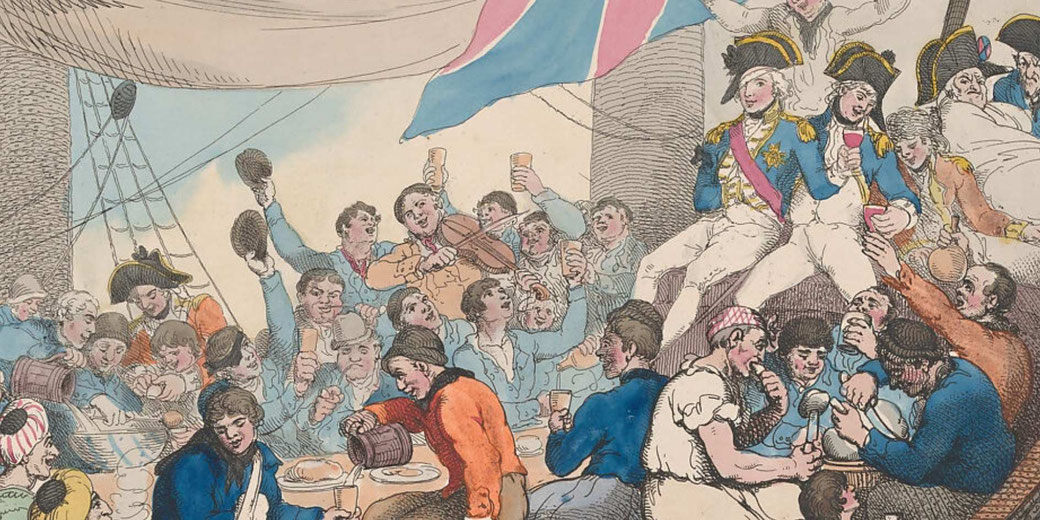
On the evening of 1 August 1798, a British squadron of fourteen warships descended on a French fleet anchored in Aboukir Bay, near the Egyptian coast, and within hours had reduced it to burning wreckage.
Rear Admiral Sir Horatio Nelson, commanding from his flagship HMS Vanguard, had spent more than two months hunting the French across the Mediterranean, missing them by days and sometimes hours, before finally locating them at anchor near the mouth of the Nile.
The battle that followed annihilated French naval power in the eastern Mediterranean and stranded Napoleon Bonaparte’s army in Egypt, triggering a new coalition of European powers determined to challenge France.
Napoleon’s Egyptian gamble
In 1798, France had defeated most of its continental enemies, and Britain was the last major power still at war with the French Republic.
Since a direct invasion of Britain appeared impractical because the Royal Navy controlled the English Channel, Napoleon proposed an alternative strategy: an expedition to Egypt.
By seizing control of Egypt, which was nominally part of the Ottoman Empire, Napoleon intended to threaten Britain’s communication and trade routes to India.
He envisioned using Egypt as a staging point for future operations against British India, which would sever the trade connections that generated much of Britain’s wartime wealth.
During the spring of 1798, Napoleon assembled a substantial force at the French port of Toulon.
His fleet numbered thirteen ships of the line and four frigates, carrying a combined total of 1,196 guns.
Roughly 400 transport vessels loaded with 35,000 troops accompanied them. The French Directory, the ruling government of the Republic, approved the expedition partly because it wanted the politically ambitious Napoleon and his fiercely loyal veterans as far from Paris as possible.
On 19 May 1798, the expedition sailed from Toulon under the protection of Vice Admiral Francois-Paul Brueys d’Aigalliers, who commanded the naval escort.
A desperate chase across the Mediterranean
Shortly after Napoleon departed Toulon, the British Admiralty ordered Nelson to take a squadron into the Mediterranean and locate the French fleet.
Nelson had only recently returned to active duty after losing his right arm at the Battle of Santa Cruz de Tenerife in 1797, and he commanded just fourteen ships of the line.
For more than two months, Nelson chased the French across the Mediterranean in a pursuit that was repeatedly frustrated by poor intelligence and bad luck.
He correctly guessed that Egypt was Napoleon’s target, yet his fleet actually overtook the slower French convoy and arrived at Alexandria on 28 June, only to find the harbour empty.
Assuming he had been wrong, Nelson sailed north towards Turkey, and missed Napoleon’s arrival at Alexandria by a matter of hours on 1 July.
After weeks of fruitless searching, Nelson received new intelligence and turned back towards Egypt, arriving off the coast on 1 August 1798.
Why Brueys believed his position was safe
After landing Napoleon’s army near Alexandria, Brueys faced a critical decision about where to station his fleet.
Brueys found Alexandria’s harbour too shallow for his larger warships, so he chose Aboukir Bay, a wide anchorage roughly 20 miles northeast of Alexandria that he considered naturally defensive.
Brueys arranged his thirteen ships of the line in a single curved line across the bay, with the head of his line close to the shallows near Aboukir Island, where a shore battery provided additional firepower.
He believed the shallow water on his inshore flank would prevent enemy ships from passing between his line and the shore, which meant he expected to fight only on his seaward side.
For this reason, many of the French ships had their port-side gun decks cluttered with stores and equipment, because the crews did not expect to fire from that side.
Brueys also lacked adequate reconnaissance, since many of his sailors and officers had been sent ashore to forage for food and fresh water, which left his ships undermanned and his scouting capacity dangerously reduced.
Nelson strikes at dusk
When Nelson’s squadron sighted the French fleet at anchor on the afternoon of 1 August, only a few hours of daylight were left.
Most commanders would have waited until the following morning to attack, as entering an unfamiliar bay in fading light was extremely risky.
Nelson, however, ordered an immediate assault, because he recognised that the French were unprepared and that delay would surrender the advantage of surprise.
As the British ships approached in a rough line, Captain Thomas Foley of HMS Goliath made a crucial observation: there was enough water between the head of the French line and the shore for British ships to pass through.
Foley led five ships around the bow of the Guerrier, the first vessel in the French line, and positioned them on the inshore side.
The remaining British ships attacked from the seaward side, which meant the leading French vessels were now caught in a devastating crossfire from both flanks.
Since the French had not prepared their port-side guns, they were unable to return effective fire from the landward side, and the results were catastrophic.
Over the next three hours, the vanguard of the French line was systematically destroyed.
The Guerrier and the Conquerant lost all their masts within minutes. The Spartiate and Aquilon were battered into submission, followed quickly by the Peuple Souverain, as British ships doubled up on individual French vessels.
Nelson himself was hit by a piece of flying metal that tore a flap of skin over his good eye, temporarily blinding him, yet he refused to leave the quarterdeck until his surgeons insisted.
The explosion of L’Orient and the aftermath
At the centre of the French line, Brueys’ enormous flagship L’Orient held out longer than the rest, partly because of her immense size and her 120 guns.
The 80-gun Franklin, commanded by Rear Admiral Armand Blanquet, fought alongside her.
During the evening, HMS Bellerophon, captained by Henry Darby, engaged L’Orient at close range but was so badly damaged that she had to drift away with all her masts shot down and over 200 casualties.
Fresh British ships moved into her place, and by 9 pm, fire had broken out aboard L’Orient, spreading through her rigging and hull.
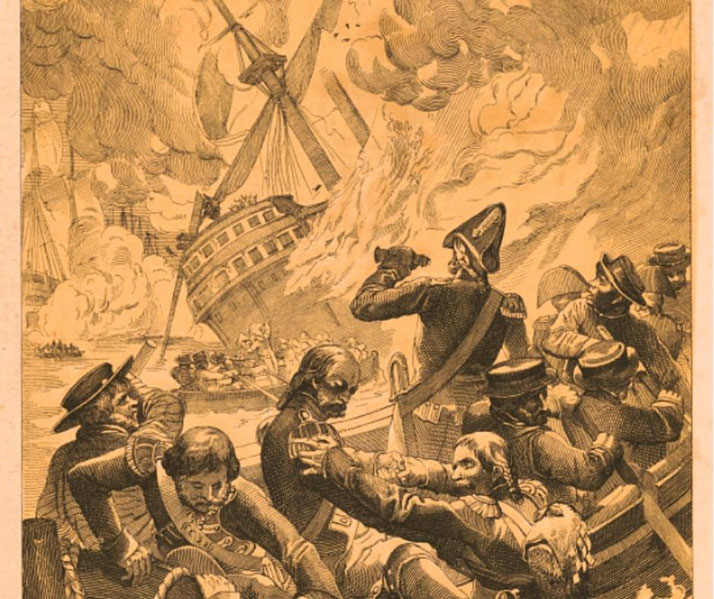
At approximately 10 pm, the flames reached L’Orient’s powder magazine, and the flagship exploded in a detonation so powerful that it was heard in Alexandria, 20 miles away.
The blast scattered burning debris across the bay and momentarily silenced the guns on every ship as sailors from both fleets stared in shock.
Brueys had already been killed earlier in the fighting, struck by a cannonball that nearly cut him in half.
Commodore Luc-Julien-Joseph Casabianca, who captained L’Orient, also perished in the explosion, along with his young son.
The boy’s death later inspired the famous opening line of Felicia Hemans’ 1826 poem Casabianca: “The boy stood on the burning deck / Whence all but he had fled.”
After the explosion, fighting resumed but the outcome was no longer in doubt. Of the thirteen French ships of the line, nine were captured and two were destroyed.
Only Rear Admiral Pierre-Charles Villeneuve, commanding from the Guillaume Tell at the rear of the line, managed to escape with one other ship of the line and two frigates.
French casualties were staggering: estimates suggest that up to 5,000 men were killed or wounded, and roughly 3,000 more were taken prisoner.
British losses totalled 218 dead and 677 wounded.
A stranded army and a new European war
The destruction of the French fleet at Aboukir Bay produced immediate strategic consequences.
Napoleon’s army of 35,000 soldiers was now stranded in Egypt, cut off from reinforcement and resupply by sea.
The Royal Navy controlled the eastern Mediterranean, and French forces in Egypt would gradually deteriorate over the following years as disease and desertion took a mounting toll.
Napoleon himself would abandon his army in August 1799 and return secretly to France, where he seized power in the coup of 18 Brumaire that November.
Across Europe, news of Nelson’s victory electrified governments that had been reluctant to challenge France.
The Ottoman Empire declared war on France in September 1798, and Russia soon followed.
Austria joined shortly after, and together these powers formed the War of the Second Coalition.
Nelson became one of the most celebrated figures in Britain, receiving the title Baron Nelson of the Nile and earning honours from the Ottoman Sultan.
His captains, who had executed the attack with remarkable coordination, became known as “the Band of Brothers,” a phrase Nelson used himself to describe their loyalty and skill.
The Battle of the Nile confirmed that even the most carefully anchored fleet could be destroyed by an opponent willing to take extraordinary risks. Nelson’s decision to attack at dusk and Foley’s initiative in sailing inside the French line demonstrated a new intensity in British naval warfare.
For France, the loss at Aboukir Bay was a humiliation that foreshadowed the even greater defeat at Trafalgar in 1805.