
How close America came to removing a president during the impeachment of Andrew Johnson
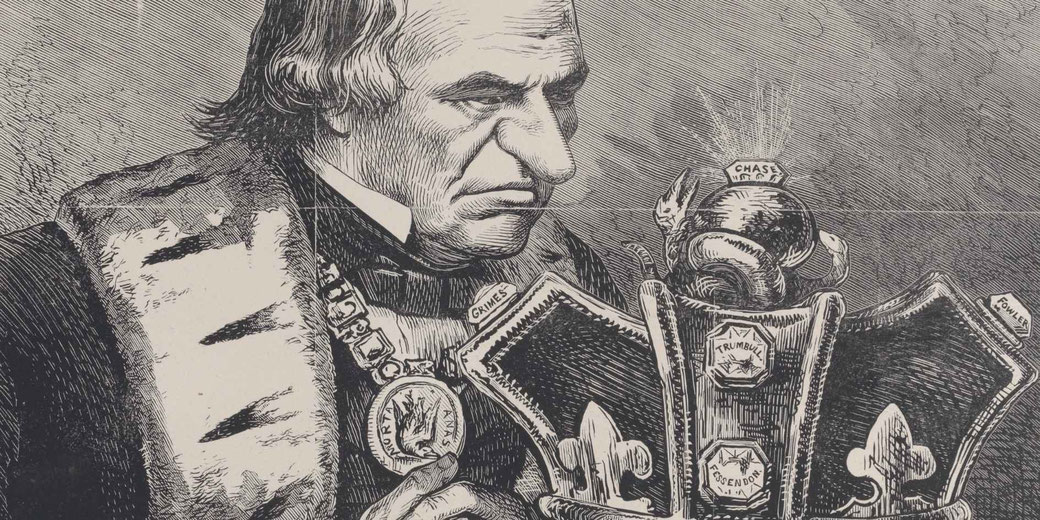
On 16 May 1868, the United States Senate came within a single vote of removing President Andrew Johnson from office, which would arguably have permanently altered the balance of power between Congress and the presidency.
The trial had consumed Washington for more than two months, and it pitted a defiant president against a Republican-controlled Congress that was determined to enforce its vision of Reconstruction.
At the centre of the crisis was a question that still carries weight: could Congress remove a president for disagreeing over policy, or did removal require proof of an actual crime?
A president without a party
Andrew Johnson’s path to the presidency was unusual, because he was a Southern Democrat who had stayed loyal to the Union during the Civil War.
Lincoln chose Johnson as his running mate in 1864 for precisely this reason, because he hoped to widen support for the Republican ticket by selecting a War Democrat from Tennessee.
After Lincoln’s assassination on 14 April 1865, Johnson inherited the presidency and immediately clashed with the Republican majority in Congress over Reconstruction.
Johnson favoured a lenient approach to Reconstruction that allowed former Confederate states to rejoin the Union quickly with minimal conditions.
He vetoed legislation that was designed to protect the rights of formerly enslaved people, including the Civil Rights Act of 1866 and the Freedmen’s Bureau Bill.
Congress overrode his vetoes more frequently than those of any previous president, which created an increasingly hostile relationship between the two branches.
Radical Republicans such as Thaddeus Stevens of Pennsylvania and Charles Sumner of Massachusetts saw Johnson as an obstacle to meaningful reform, and they began looking for grounds to remove him.
The law that set the trap
In March 1867, Congress passed the Tenure of Office Act over Johnson’s veto. The law prohibited the president from removing any Cabinet official who had been appointed with Senate confirmation unless the Senate approved the dismissal.
The primary target of this legislation was Secretary of War Edwin Stanton, a remaining appointee from Lincoln’s Cabinet who had aligned himself with the Radical Republicans and who oversaw Reconstruction policy through the War Department.
Since Johnson regarded the Tenure of Office Act as an unconstitutional restriction on presidential authority, he was determined to test it.
In August 1867, he suspended Stanton and appointed General Ulysses S. Grant as interim Secretary of War.
When the Senate refused to approve Stanton’s removal in January 1868, Grant stepped down and Stanton reclaimed his office.
Furious, Johnson escalated the confrontation on 21 February 1868 by formally dismissing Stanton and appointing Major General Lorenzo Thomas as his replacement.
Stanton refused to leave and barricaded himself inside the War Department, which created a constitutional standoff.
Eleven articles and a swift vote
On 24 February 1868, the House of Representatives voted 126 to 47 to impeach Johnson, which made him the first president in American history to face such charges.
The vote fell along party lines: nearly every Republican supported impeachment and every Democrat opposed it.
Over the following days, the House drafted eleven articles of impeachment, eight of which focused on Johnson’s violation of the Tenure of Office Act.
Among the remaining articles, the ninth accused Johnson of violating the Command of the Army Act by pressuring General William H. Emory to take orders directly from the president rather than through the Secretary of War.
A tenth alleged that Johnson had made inflammatory public speeches attacking Congress.
The eleventh article was considered the most important by Johnson’s opponents, and it was a broad summary that combined elements of the other charges.
Thaddeus Stevens was elderly and in poor health by this point, and he led the team of seven House managers who were appointed to prosecute the case before the Senate.
A trial that gripped the nation
On 5 March 1868, the Senate trial began, and Chief Justice Salmon P. Chase presided over the proceedings.
Johnson’s defence team included former Supreme Court Justice Benjamin Curtis and Republican lawyer William Evarts, as well as former Attorney General Henry Stanbery, who had resigned from Johnson’s Cabinet to defend him.
Opening arguments and testimony ran from 30 March through 20 April, and closing arguments continued until 7 May.
Several issues dominated the trial. Johnson’s lawyers argued that the Tenure of Office Act did not actually apply to Stanton, since Lincoln had appointed him and the law only protected officials who had been appointed by the sitting president.
They also argued that the act was unconstitutional, a position that the Supreme Court would confirm in 1926 in Myers v. United States.
The defence contended that Johnson had deliberately violated the act to create a legal test case, which was a legitimate exercise of presidential authority.
The prosecution was led by Stevens and Benjamin Butler of Massachusetts, and it insisted that Johnson’s defiance of a validly enacted law constituted a high crime worthy of removal.
One vote from removal
On 16 May, the Senate voted first on Article XI, the summary article, because Johnson’s opponents believed it provided the best chance of securing a conviction.
The roll call produced one of the most dramatic moments in American political history: 35 senators voted guilty and 19 voted not guilty.
Since a two-thirds majority of 36 votes was required for conviction, Johnson survived by a single vote.
Seven Republican senators had broken with their party to vote for acquittal, and they became known as the “Republican Recusants.”
Senator Edmund Ross of Kansas attracted the most attention because he had been widely expected to vote for conviction until the very last moment.
Senator James Grimes of Iowa explained his decision by stating that he could not agree to damage the constitutional structure of government in order to remove an unpopular president.
After a ten-day adjournment, the Senate voted on Articles II and III on 26 May, with the same 35-to-19 result each time, and the Senate then adjourned the trial without addressing the remaining eight articles.
Why seven Republicans defied their party
For senators like Grimes and Lyman Trumbull of Illinois, the decision to acquit rested on a constitutional argument: that removing Johnson would allow future Congresses to remove any president whose policies they opposed, and that this would have undermined the separation of powers.
Trumbull warned that a conviction would have destroyed the president’s ability to disagree with Congress without facing removal, which would have made the executive branch permanently subordinate to the legislature.
Practical political calculations also influenced the outcome, as the removal of Johnson would have elevated the Senate president pro tempore, Benjamin Wade of Ohio, to the presidency.
Wade was unpopular with many moderate Republicans, and some senators were reluctant to place him in the highest office.
In the case of Edmund Ross, historians have debated whether his vote was motivated by principle or by financial incentives from Johnson’s allies, as evidence later surfaced of patronage deals that had been arranged through a political fixer named Perry Fuller.
A House investigation found no definitive proof of bribery, but Ross swiftly requested numerous political appointments from Johnson in the weeks following the trial.
At least four other senators had reportedly prepared to switch to acquittal if needed, which suggests the margin was not quite as narrow as it appeared.
The acquittal arguably preserved the independence of the presidency and established a critical precedent: that impeachment required evidence of genuine wrongdoing rather than policy disagreements.