
Trajan’s Column was a marble marvel of ancient Roman Military propaganda
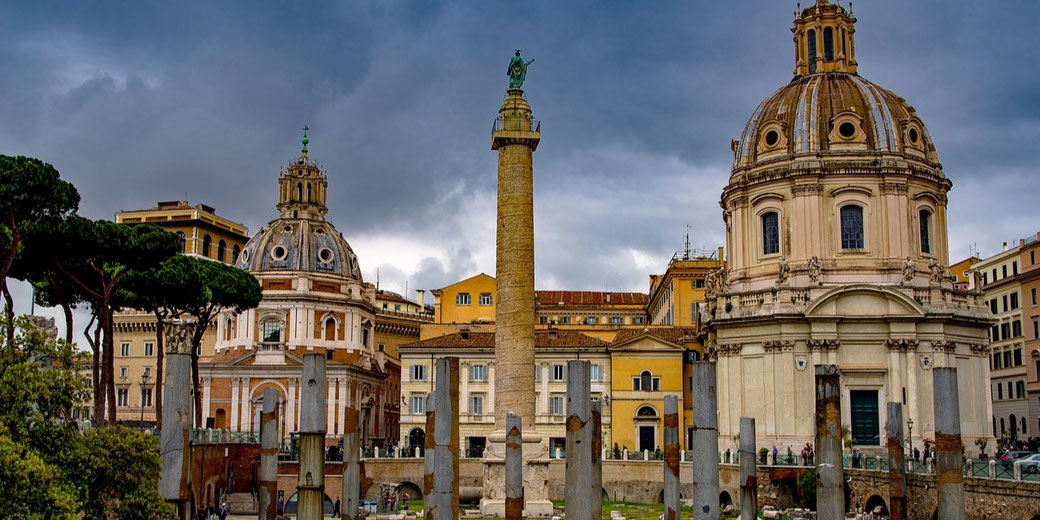
In the centre of modern Rome, a column of white Carrara marble rises about 38.4 metres from the paving of Trajan’s Forum precinct to the top of the statue base, and it has stood over the surrounding ruins for close to two thousand years.
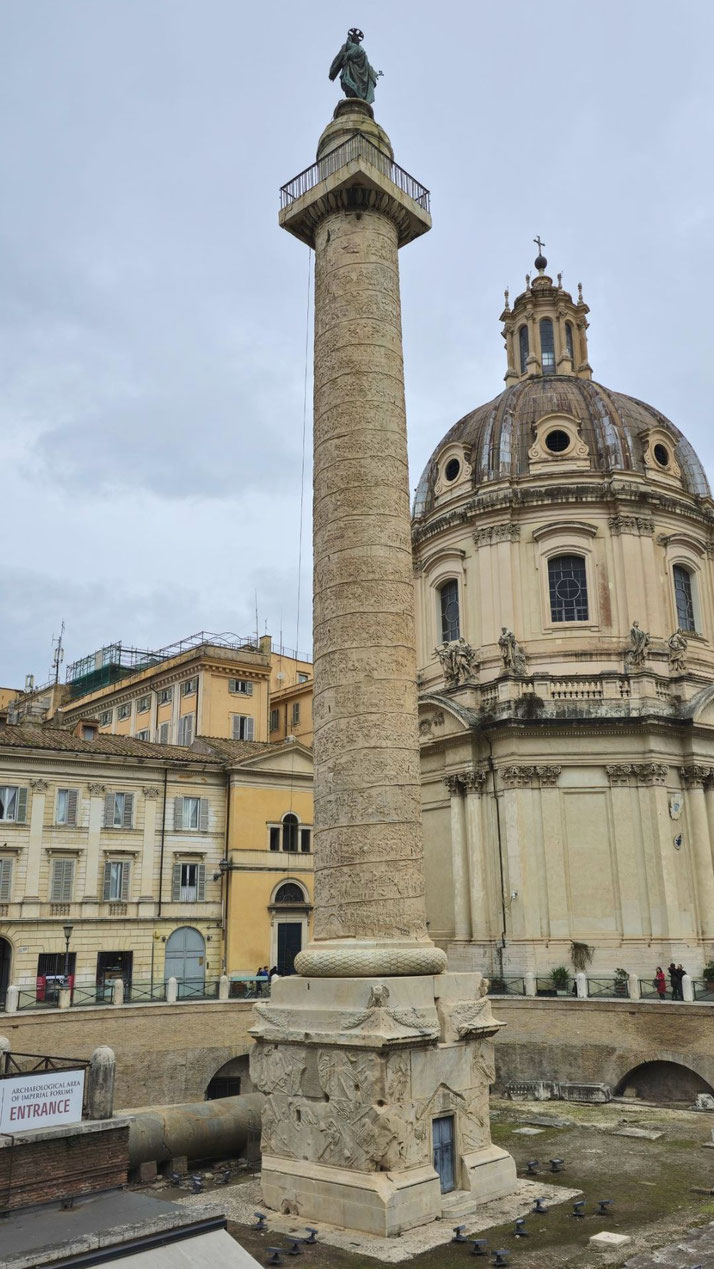
The column proper, meaning the shaft and capital above the pedestal, measured about 29.8 metres, which came close to 100 Roman feet, and the shaft’s diameter measured about 3.7 metres.
It was erected between 107 and 113 CE and officially dedicated on 12 May 113 CE, and the purpose behind it was to commemorate Trajan’s conquest of Dacia.
Every scene carved into its surface was carefully designed to project Roman power and imperial authority, which made it one of the most extraordinary surviving examples of state-sponsored propaganda from the ancient world.
The emperor behind the monument
Marcus Ulpius Traianus, known to history as Trajan, ruled Rome from 98 to 117 CE, and his reign coincided with the empire’s greatest territorial expansion.
He was born in the Roman colony of Italica in modern-day Spain around 53 CE, and he became the first emperor of provincial origin, a fact that made his military achievements all the more important to his public image.
Because Trajan needed to prove himself worthy of the imperial title, his wars against the Dacian kingdom provided the perfect opportunity.
Dacia was located in the region of modern Romania and had been a persistent problem for Rome since the reign of Domitian in the 80s and 90s CE.
In fact, the Dacian king Decebalus had humiliated Roman forces and extracted favourable peace terms from Domitian, which many in the Roman Senate considered shameful.
Trajan launched his first campaign against Dacia in 101 CE, and that first war ran through 101–102 CE.
He then renewed the fighting in 105 CE, and the second war ended in 106 CE with the destruction of the Dacian kingdom.
The plunder from Dacia was staggering: later accounts put the haul at about 165 tonnes of gold and 330 tonnes of silver, figures that were much larger than anything Cassius Dio specified, since he referred only to a large store of gold and silver.
The conquest clearly delivered the resources that financed major building work in Rome.
How the Column communicates its message
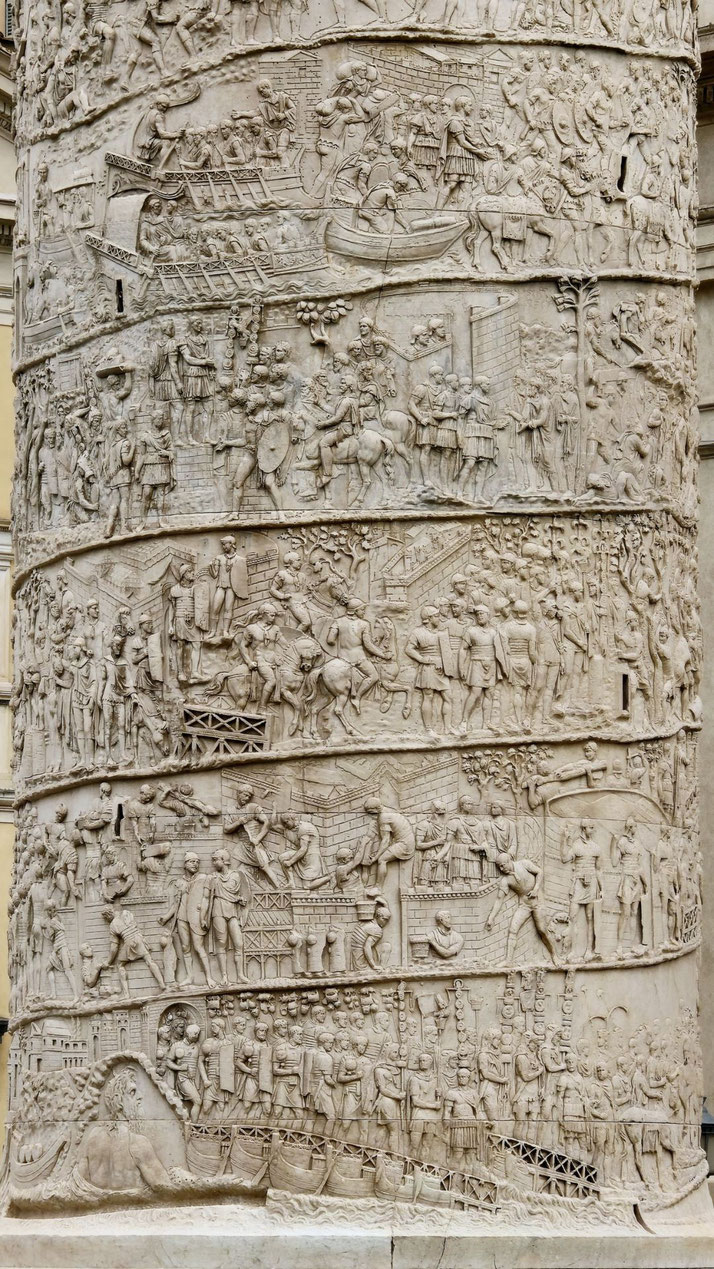
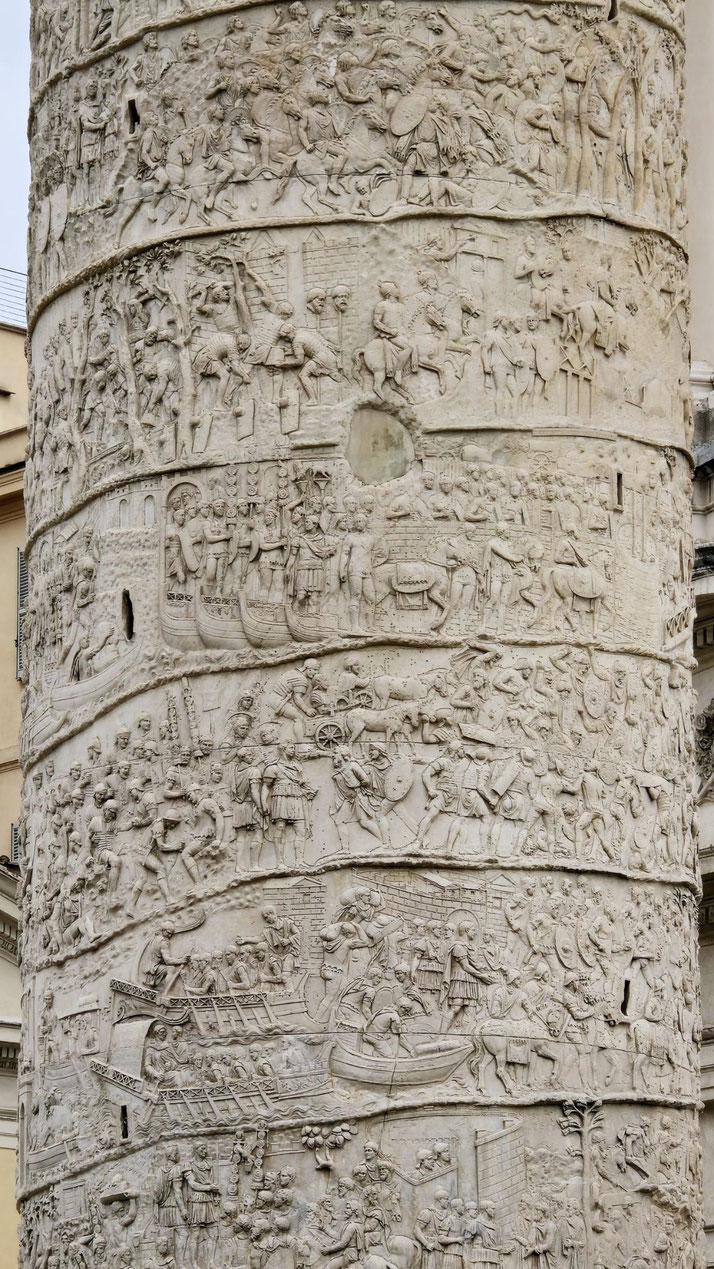
At its most basic level, Trajan’s Column tells the story of both Dacian Wars through a continuous spiral frieze that winds around the shaft 23 times from base to summit.
The frieze contained approximately 2,662 individual figures carved in low relief, and modern studies often group those carvings into 155 scenes.
If you could somehow unroll the entire frieze, it would stretch to roughly 190 metres in total length.
Apollodorus of Damascus, who designed parts of Trajan’s forum complex, is often suggested as the designer or overseer of the column, but the surviving evidence does not allow a secure attribution.
Because the column’s primary audience was the Roman public, the scenes were carefully selected to emphasise particular themes about Trajan and his army.
Trajan himself appeared in the frieze about 58 times, and he was consistently depicted as a calm and authoritative leader who addressed his troops, oversaw construction projects, and received the surrender of enemy combatants.
The emperor was never shown in the act of killing an opponent, because the propaganda required him to appear as a dignified commander rather than a common soldier.
His repeated presence throughout the story reinforced the idea that every victory belonged personally to him.
The column’s physical setting also supported that message, as it stood in a tight court behind the Basilica Ulpia and between two library buildings, one associated with Greek texts and one associated with Latin texts, and those structures likely offered elevated viewing points for parts of the relief.
The relief band also increased in height as it rose, which helped viewers pick out figures from ground level and from the surrounding buildings.
Within the story itself, the opening sequence used a personification of the Danube as a river god, and the army’s crossing signalled the move from Roman territory into enemy land.
Near the middle of the spiral, a winged Victory wrote on a shield, creating a visual break that separated the story of the first war from the second.
On top of imperial leadership scenes, the frieze repeated standardised moments of Roman military life that the public would have recognised.
Trajan appeared in formal addresses to assembled troops, scenes that modern scholars often label an adlocutio.
The relief also showed ritual sacrifice and purification before major actions, scenes often described with the term lustratio.
It included departures and marches that fit the conventional sequence of a campaign, scenes often grouped as profectio.
The frieze also dedicated a remarkable amount of space to scenes of the Roman army performing non-combat tasks.
For example, soldiers were shown building bridges, constructing fortifications, felling trees, and marching in disciplined formations.
This focus meant that the column projected an image of the Roman military as an organised and industrious force, one whose victories came from superior engineering and discipline rather than brute violence alone.
The famous scene of soldiers crossing the Danube River on a pontoon bridge near the base of the column demonstrated exactly this principle, because it prioritised Roman technical capability over battlefield heroism.
The wider Dacian campaigns also included major engineering projects such as the bridge at Drobeta on the Danube, constructed under Trajan and commonly connected with Apollodorus of Damascus, which gave Roman forces a permanent crossing point during the fighting.
The treatment of the Dacian enemy
One of the most fascinating aspects of Trajan’s Column is its surprisingly respectful portrayal of the Dacians, because Roman propaganda did not always require the enemy to appear weak or contemptible.
Decebalus, the Dacian king, appears multiple times as a worthy adversary who commands loyalty from his warriors.
In the column’s final scenes, Decebalus takes his own life rather than submit to Roman capture, and the carving presents this moment without mockery.
From a propagandistic standpoint, the dignified treatment of the enemy actually supported Roman interests, since a victory over a formidable opponent carried far more prestige than the defeat of a disorganised rabble.
The Dacian warriors wear distinctive caps and carry their curved falx swords, details that identify them as a specific and recognisable people.
By giving the Dacians a clear visual identity and showing them fighting bravely, the column amplified the scale of Trajan’s achievement in subduing them.
Architecture as political statement
The column itself, independent of its carved frieze, carried significant political meaning because of where it stood and how it was constructed.
Trajan placed the monument at the centre of his new forum, the Forum Traiani, which was the largest and most impressive of Rome’s imperial forums.
The forum was built into the slope of the Quirinal Hill, and an inscription on the column’s base stated that it indicated the height of the hillside that was excavated to create the forum’s level ground.
Originally, a bronze statue of Trajan stood on top of the column, surveying the forum below.
After Trajan’s death in 117 CE, his ashes and those of his wife Plotina were reportedly placed in the column’s base, turning the monument into a funerary marker as well.
In 1587, Pope Sixtus V replaced the original statue with one of Saint Peter, which still crowns the column today.
Inside the column, a spiral staircase of 185 steps ascends to the viewing platform at the top.
The carved surfaces also likely looked different in antiquity, since evidence suggests the relief carried painted detail and included metal fittings that sharpened features and equipment.
The structure was built from large marble blocks that were hoisted and set in place before carving and finishing work, and published measurements differ on how those blocks should be counted and described.
The shaft itself was made from a stack of massive drums, and additional cylindrical blocks above the balcony supported the statue base.
Many descriptions also note drums that weighed on the order of 32 tonnes each.
The engineering required to lift these blocks to the appropriate height and then carve such detailed relief at those elevations demonstrates an extraordinary level of technical skill.
Why the Column still matters to historians
For modern scholars, Trajan’s Column is an invaluable primary source because so little written material about the Dacian Wars has survived.
The most detailed ancient account, written by Cassius Dio in the early third century CE, survives mainly through Byzantine epitomes and excerpts.
As a result, the column’s frieze provides the most comprehensive visual record of Roman military equipment, tactics, and campaign logistics from the early second century CE.
Historians and archaeologists routinely consult the column to understand details about Roman armour, auxiliary units, siege techniques, and the physical appearance of Dacian settlements.
It also points readers toward post-conquest change in the region, since the Romans founded a new provincial centre at Ulpia Traiana Sarmizegetusa, separate from Decebalus’s hilltop capital at Sarmizegetusa Regia.
At the same time, scholars must treat the column with appropriate caution, because it is propaganda rather than documentary evidence.
The scenes were composed to celebrate Trajan and justify Roman conquest, which means certain events may be exaggerated, rearranged, or omitted entirely.
The near-absence of Roman casualties in the frieze, for instance, is clearly unrealistic given that the Dacian Wars involved years of difficult fighting in mountainous terrain.
Modern work on the column also has its own history, and the plates published by Conrad Cichorius between 1896 and 1900 became a major foundation for later scene-by-scene study.
Historians like Jon Coulston and Filippo Coarelli have spent decades analysing the column’s scenes, cross-referencing them with archaeological evidence from Dacia itself, including the ruins of Decebalus’s capital at Sarmizegetusa Regia, to build a more accurate picture of the conflict.
For the Roman citizen walking through Trajan’s Forum in the second century CE, the spiralling scenes of military triumph projected an unmistakable message about imperial power.
For the modern historian, those same scenes contain critical information about an ancient world that would otherwise be lost, and they remind us that every historical source carries the fingerprints of the people who created it.