
St. Augustine of Hippo: The greatest theological mind in the history of the Church?
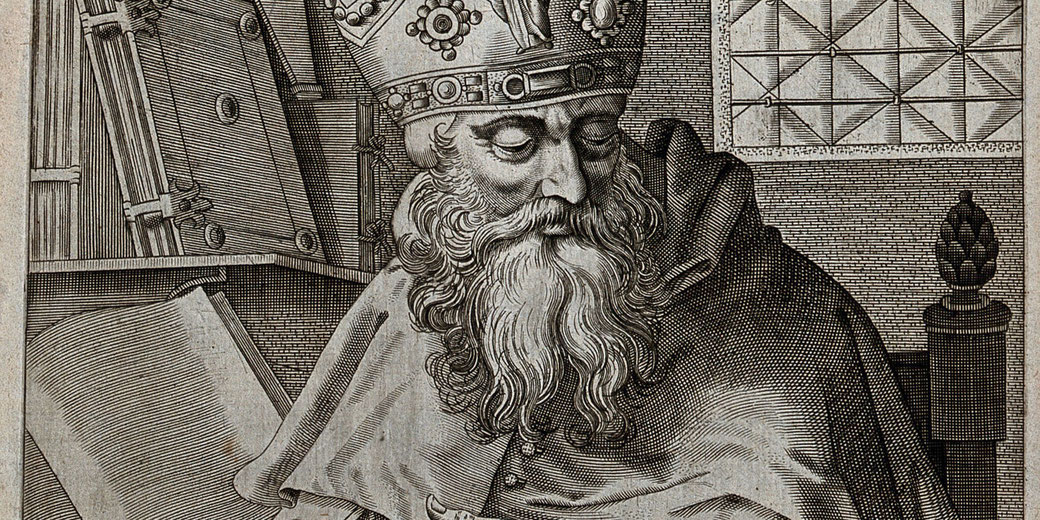
As Roman legions withdrew from the frontiers and barbarian invasions weakened imperial control, a Christian thinker from North Africa changed how people understood belief for a world that was breaking apart.
Augustine of Hippo was the author of Confessions and The City of God, who addressed the deepest struggles of faith and sin, and examined how God's grace answered those struggles with clear thinking and honest spiritual writing.
From a classroom in Carthage to the office as bishop at Hippo Regius, his influence rested on the arguments he made and the questions he refused to ignore rather than on the authority of his office.
What we know about his childhood and early life
Augustine was born on 13 November 354 in the town of Thagaste, located in the Roman province of Numidia, which is now in modern-day Algeria.
His father Patricius held a minor post in the Roman bureaucracy and continued to follow pagan practices, while his mother Monica remained committed to Christianity and maintained a disciplined home life, which she hoped would help influence her son’s character.
The tension between pagan culture and Christian belief within the household introduced Augustine to different values from childhood.
As a young student in Madaurus, he developed a strong foundation in Latin grammar and classical rhetoric, by reading authors such as Virgil and Cicero.
At Madaurus, where he studied from age eleven, Augustine often recalled being punished for speaking his native Punic instead of Latin.
His academic talent appeared early, yet his formal education also fed his growing desire for career success and public recognition.
By age seventeen, he moved to Carthage, a major centre of learning in Roman Africa, where he pursued higher studies in rhetoric.
There, his passion for knowledge became entangled with his pursuit of pleasure, and he immersed himself in theatre, poetry, and relationships outside marriage.
At this point, he entered a long-term relationship with a woman who bore him a son, Adeodatus, in 372, whom he never married, though he remained attached to both mother and child for many years.
Around the same time, Augustine had for a time joined the Manichaeans, a religious sect that blended elements of Christianity, Persian dualism, and Gnostic teachings.
Their explanation of evil as a cosmic force trapped within matter appealed to his desire for a rational faith.
Although Augustine initially admired the Manichaeans’ rational claims, he became increasingly disappointed after meeting Faustus, a leading teacher whose shallow understanding of philosophy he found unsatisfactory.
Indeed, Augustine’s growing doubts coincided with a broader change in his intellectual life.
After he had read books from the Neoplatonist tradition, particularly the writings of Plotinus that Marius Victorinus translated, he began to accept the idea of a spiritual realm outside the material world.
So, when he left Africa in 383 to teach rhetoric in Rome and later in Milan, his spiritual unease deepened.

Why did Augustine become a Christian?
Augustine arrived in Milan in 384, after he had accepted an important teaching post arranged by Symmachus, a Roman senator.
In Milan, he encountered Bishop Ambrose, whose knowledge of Scripture and skill as a speaker introduced him to allegorical interpretations of the Bible, which helped Augustine overcome his earlier objections to Christianity’s apparent simplicity.
At the same time, Neoplatonist writings helped clarify his ideas about immaterial reality and divine perfection, though Augustine encountered them primarily through Latin paraphrases and philosophical adaptations rather than direct translations of Plotinus.
Even so, Augustine remained conflicted, as he understood the truth of Christianity intellectually, yet he continued to feel controlled by his habits and desires.
In his Confessions, he recalled crying out, “Grant me chastity and continence, but not yet,” which captured his unwillingness to surrender completely.
Eventually, in a garden outside Milan, while he was with his close friend Alypius, he believed he heard a child’s voice singing “tolle lege” (“take and read”).
He opened a copy of the New Testament and read Romans 13:13–14, which urged him to cast off immoral behaviour and live honourably.
Alongside this passage, he later cited Matthew 19:12 and the Psalms as instrumental in preparing his heart for baptism.
From that moment, his conversion accelerated as he resigned from teaching, retired to Cassiciacum with a small group of friends and family, and spent the winter in reflection on Christian doctrine.
On the night of Easter in 387, Bishop Ambrose baptised him and his son. Several months later, Monica died in Ostia while awaiting passage back to Africa, satisfied that her prayers had been answered.
Augustine, no longer a seeker but now a Christian, returned to Africa to live in prayer and study.
How did Augustine become a bishop?
Back in Thagaste, Augustine sold his family inheritance and formed a small monastic community devoted to regular reading and group discussion, which followed a routine of shared discipline.
During this period, he wrote what became known as the Rule of St Augustine, which later created the foundation for Western monastic life which emphasised communal life and a person's responsibility to one another based upon regular study of scripture.
By early 391, when he visited Hippo Regius, he had already attracted the attention of the local Christian community, who urged him to accept ordination as a priest.
He agreed, though reluctantly, and began preaching and offering theological instruction.
For four years, he served under Bishop Valerius, who recognised Augustine’s talents and arranged for him to be formally made an assistant bishop.
When Valerius died around 395, Augustine succeeded him as bishop, as had been intended by their co-consecration arrangement.
For the next thirty-five years, he led the Church in Hippo through political instability.
He wrote sermons, letters, and long works, and he attended regional councils and debated heretics face to face.
For example, Augustine fought against the Donatists, who rejected the sacraments administered by clergy who had renounced the faith under persecution.
He argued that the validity of sacraments came from Christ, not the moral state of the minister.
In 411, Augustine debated Donatist leaders at the Council of Carthage, and the final judgment rejected Donatism, and the imperial government backed enforcement, though resistance among Donatist communities continued in parts of North Africa.
He also opposed the Pelagians, who denied original sin and taught that humans could achieve salvation by their own efforts.
Augustine insisted that human nature had been corrupted by the Fall and that divine grace alone restored the will.

How Augustine influenced Christian theology
Over time, Augustine’s influence on Christian doctrine came to be widely recognised, especially his response to Pelagianism, which formed the basis for the Western Church’s understanding of original sin and grace.
In treatises such as On Nature and Grace and Against Two Letters of the Pelagians, he argued that divine help was necessary for every human act of goodness.
He wrote that humans were created good and had inherited a weakened will and could not seek God without divine intervention.
Grace, for Augustine, proved necessary rather than merely helpful. Only God could heal the soul and lead it toward salvation.
His most ambitious work, The City of God, was written after the sack of Rome in 410 and explained human history as a conflict between two communities: one based on love of self and earthly power, and the other based on love of God.
When he traced both biblical and secular history that way, he provided a new Christian philosophy that treated time as history, examined authority and clarified human purpose.
Equally influential for many theologians was his doctrine of the Trinity. In De Trinitate, he used the human mind, particularly memory and understanding, and he described the will as the active part of the mind, as a mirror for understanding the unity and distinction of the Father, Son and Holy Spirit.
Though not exhaustive, his analogy helped Western theologians discuss the mystery of divine unity without falling into heresy or contradiction.
In On the Gift of Perseverance, written near the end of his life, Augustine explicitly argued that God’s grace not only initiates salvation but ensures its completion.
He drew upon scriptural themes such as those found in John 6:44 and Romans 8:30 to support the view that divine initiative and final perseverance were inseparable.
Unlike Stoic philosophers, who emphasised self-control and human virtue, Augustine insisted that fallen willpower required inner change by God’s free gift.
So, from sacraments and salvation to history and divine nature, Augustine's thought became the framework upon which many later theologians, both Catholic and Protestant, built their systems.
Why he remains central to the Church, even today
Augustine died on 28 August 430 as Vandals laid siege to Hippo. By then, his reputation had already spread across the Latin-speaking Church.
Monasteries, bishops, and scholars preserved his works, and his writings became part of the standard library of theological instruction.
As a result, during the medieval period, thinkers such as Anselm, Bonaventure, and Aquinas often relied on his formulations of grace and sin, together with his account of God's will.
Peter Lombard’s Sentences and Thomas Aquinas’ Summa Theologiae both drew directly from Augustine’s theology, especially his views on divine causality and interior illumination.
During the Reformation, Protestants such as Martin Luther and John Calvin often turned to Augustine for support of doctrines such as sola gratia and predestination.
At the same time, Catholic leaders generally upheld his views on apostolic succession, the sacraments, and ecclesial authority.
His ability to speak to both sides of the confessional divide helped his ideas remain important.
Even now, his works are still widely in print, studied for their theological insights and for their emotional power and clear philosophical thought.
Confessions continues to attract readers for its honesty and poetic style combined with intense self-examination, and The City of God remains essential for understanding early Christian responses to political crisis.
During the Second Vatican Council, Church documents such as Dei Verbum and Gaudium et Spes often showed Augustine’s influence on questions of revelation, human desire, and divine truth.
His thought also influenced Western literature and psychology, with modern thinkers such as Freud and Kierkegaard, who drew upon his introspective method.
Indeed, no other Western theologian has influenced so many parts of Christian belief for so long.
For this reason, Augustine of Hippo is widely seen as one of the greatest theological minds in Church history.