
Why was the Spartan army so effective?
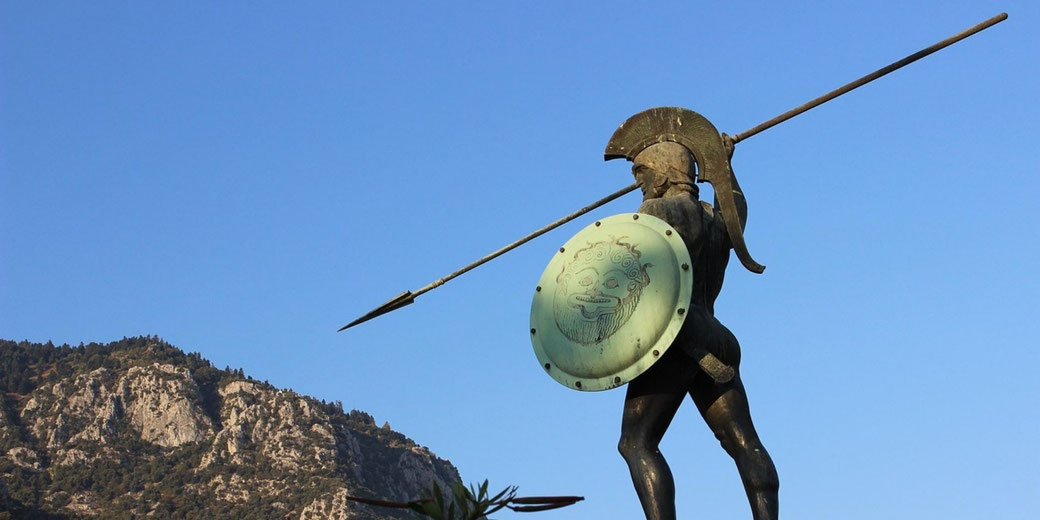
Ancient Sparta produced what many military historians regard as the most professionally trained fighting force the ancient world had ever seen.
Unlike the citizen-militias of Athens or Corinth, where men trained part-time and returned to trades and farms, Spartan soldiers devoted their entire lives to the work of war, producing a military machine of extraordinary effectiveness.
At its peak in the fifth and fourth centuries BCE, it made Sparta the leading land power in Greece. However, was this due to something unique about their culture, the result of a planned strategy that militarised their entire society, or a curious mix of both?
A state designed around military readiness
The city-state of Sparta was located in the Eurotas valley of the Peloponnese and followed a constitutional order that was traditionally attributed to Lycurgus, a figure whom ancient writers placed in the ninth or eighth century BCE.
Sparta also maintained a dual kingship, which was divided between the Agiad and Eurypontid royal houses, and kings commonly took the field as generals.
Alongside the kings sat powerful public institutions that kept the citizen body on a war footing, including five annually elected ephors and the gerousia, a council of elders.
Under this system, Spartan citizens, who were known as Spartiates or homoioi ("equals"), carried one overriding obligation: lifelong readiness for war.
Agricultural labour fell to the helots, a subjugated population that was drawn primarily from conquered Messenia.
This relationship had taken shape through the long struggle that was remembered as the Messenian Wars in the eighth and seventh centuries BCE.
Since helots farmed the land and produced food, the Spartiates did not need to rely on trade or farming for survival.
Another group, the perioikoi, lived in the surrounding towns as free non-citizens.
They supplied crafts and equipment, and they also provided extra manpower in wartime, even though they lacked Spartiate political rights.
As Plutarch reported in his Life of Lycurgus, Spartan citizens faced strict limits on craft and commerce, since these pursuits clashed with constant training.
The Spartiate economy rested on land allotments that were known as kleroi, which supported each citizen's contribution to communal mess life and sustained full citizenship status.
Control over the helots also had a direct and violent effect on Spartan military life.
In fact, ancient writers described the krypteia as a state programme that sent selected young men out to terrorise helot communities, and some sources also reported an annual declaration of war on the helots that framed violence against them as lawful.
Modern historians have generally treated the details and timing of these claims with caution, because the evidence came late and did not fully agree.
Regardless, Sparta developed a force of unusually constant readiness from this system, since most Greek city-states relied on part-time citizen militias that were drawn from farmers and tradesmen.
The agoge and the creation of Spartan soldiers
Spartan military superiority was driven by the agoge, a state-run training programme that all male citizens had to complete.
Plutarch wrote that boys entered the agoge at the age of seven, when they left their families and moved into communal barracks.
Adult officials supervised the system, including the paidonomos, and older youths also took charge of younger boys.
Ancient descriptions divided boys and youths into age groupings that later writers labelled paidia (children) and paidiskoi (adolescents), and a senior youth, who was often called an eiren, directed groups of younger trainees inside the barracks.
For more than a decade, trainees endured a programme that was designed to build physical toughness and group loyalty.
Training included running and wrestling, as well as javelin throwing and weapons handling, alongside deliberate exposure to hunger and physical punishment.
Boys received minimal clothing and insufficient food rations, which pushed them to steal provisions as a test of stealth and nerve.
Punishment followed capture rather than theft itself, since the system prized concealment and self-control.
Some well-known Spartan rituals reinforced the same values in public. Ancient sources described ritual whipping at the sanctuary of Artemis Orthia, a practice that was recorded in sources written long after the early classical period, and the form also appeared to shift over time.
Even so, the story circulated for centuries because it expressed an ideal that pain and shame had no place in a Spartiate's public life.
Xenophon, in his Constitution of the Lacedaemonians, described a training culture that rewarded obedience and collective discipline, so men learned to put unit cohesion ahead of personal comfort.
Upon reaching the age of twenty, young Spartans joined a military mess group called a syssitia, where they ate communal meals and strengthened bonds with their fellow soldiers.
Each man contributed a monthly share of provisions, and admission required unanimous acceptance by existing members.
Full citizenship came only at the age of thirty, after more than two decades of training and communal living had enforced the habits that were expected of a Spartiate.
Tactical discipline and the hoplite phalanx
Greek armies fought in the hoplite phalanx, so Sparta's advantage lay in the particular way it executed this common form of combat.
The phalanx consisted of heavily armed infantrymen (hoplites) who stood shoulder to shoulder in tight ranks.
Each man carried a large round shield (the aspis), a thrusting spear of roughly two to three metres, and a short iron sword as a secondary weapon.
Success depended on cohesion, since each shield protected the left side of the man beside it.
Most Greek armies struggled to hold formation once battle began. Poorly drilled troops drifted rightward, and gaps opened as fear and fatigue spread.
Spartan soldiers, who had been drilled for years, could follow orders with far greater consistency.
Thucydides, in his account of the Battle of Mantinea in 418 BCE, described a clear chain of command in the Spartan army.
Orders passed from king to senior commanders and then down through officers who controlled units at several levels.
Spartan organisation included the mora as a large formation, and it broke further into smaller units that included the enomotia, which was the basic file group that made precise movement possible in battle.
Spartan discipline also appeared in the culture that surrounded the army. Ancient writers described adult Spartans who wore long hair in wartime and appeared in distinctive clothing, including the famous red cloak in later tradition.
Some features changed over time, such as the "Lambda" shield emblem, which became a familiar symbol in later periods rather than a universal feature across the early fifth century BCE, and many scholars placed its widespread use later still.
Xenophon also noted that Spartans advanced to the sound of flute music, a detail that conveyed ordered movement under pressure and that helped keep the line steady during an approach.
The psychological dimension of Spartan warfare
Fear likely played a major role in Spartan effectiveness, since Sparta's reputation often undermined enemy morale before the first spear thrust.
Ancient sources recorded cases in which opposing forces withdrew, surrendered, or avoided battle once they learned that a Spartan army was approaching.
Spartan confidence also came from a public culture that treated fear as shameful and courage as a duty.
The famous saying that was attributed to Spartan mothers, "with your shield or on it," expressed the expectation of victory or death.
Men who were accused of cowardice faced severe public punishment. They became tresantes ("tremblers"), a label that brought humiliation and exclusion from social life, along with loss of standing among peers.
The Theban victory at Leuctra in 371 BCE showed how powerful this psychological barrier had been.
Epaminondas had prepared for a fight that most Greek commanders had long avoided.
He massed his left wing to an exceptional depth, which was commonly reported as far deeper than normal, and he drove it directly against the Spartan right, the position of honour that usually contained Sparta's most capable men.
The Thebans also used elite troops, including the Sacred Band, to add striking power at the point of contact.
The battle turned into a violent collision of weight and timing rather than a standard shove along the whole line.
King Cleombrotus I fell during the fighting, and his death worsened confusion in the Spartan command at the moment when the right wing collapsed.
Why the system ultimately had limitations
Sparta's effectiveness carried limits that became harder to hide over time. The system relied on a stable population of full Spartiates, and it also relied on helot labour, which created constant fear of revolt.
That fear restricted Sparta's willingness to keep large numbers of citizens overseas for long periods, since long campaigns increased the risk of unrest at home.
By the fourth century BCE, the number of full citizens had dropped sharply.
Ancient writers later used the term oliganthropia to describe this shortage of manpower.
Estimates often suggested a steep fall from the early fifth century BCE to the period after Leuctra, and the exact figures depended on definitions and fragmentary evidence, so they remained contested.
Several forces drove this crisis, as battlefield deaths reduced the citizen body, and property and inheritance patterns had concentrated land in fewer hands over time.
The mess system also demanded regular contributions, and men who could not meet the requirement lost full standing.
As wealth narrowed and citizen numbers fell, Sparta's army lost the depth that was needed for recovery after heavy losses.
After Leuctra in 371 BCE, Epaminondas marched into the Peloponnese, and in 370–369 BCE he supported the liberation of Messenia and the establishment of new fortified centres.
The loss of Messenian labour struck at the base of Spartan survival, since the helot system had fed the citizen army and had freed it from agricultural work.
Sparta remained a recognised military power in later Greek history, but the social order that had produced its greatest infantry force could not survive once citizen numbers collapsed and the helot economy broke apart.