
Siege of Masada: the dramatic last stand of the Jewish rebels against the Romans
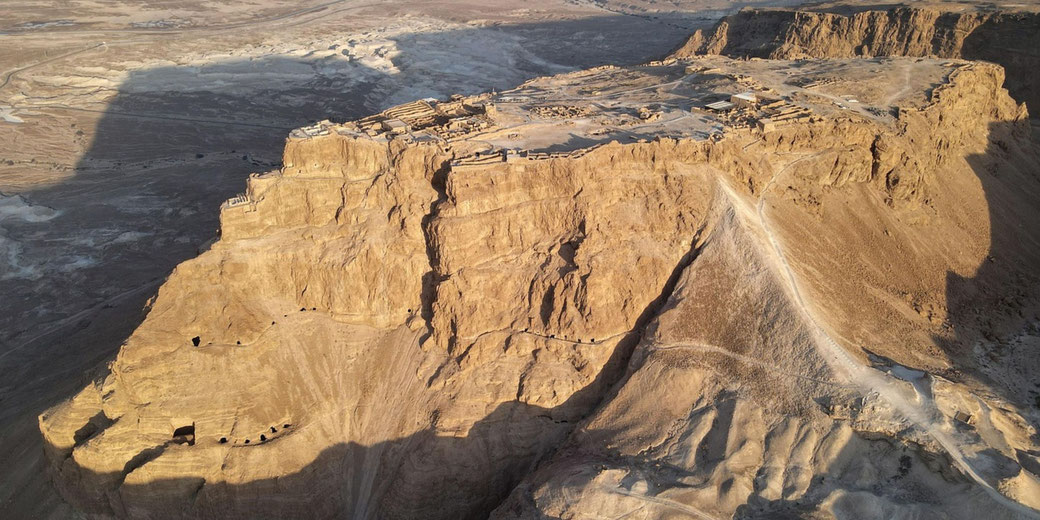
At the edge of the Judean Desert, near the western shore of the Dead Sea, the fortress of Masada rose 400 metres above the barren terrain.
In 73 or 74 CE, nearly a thousand Jewish men, women, and children prepared to die there rather than fall into the hands of the Roman Tenth Legion.
As Roman engineers advanced and the ramp neared completion, the rebels faced a decision that would turn their final stronghold into a symbol of absolute defiance and irreversible loss.
Roman control of Judaea
After the death of Herod the Great in 4 BCE, Roman control of Judaea gradually increased.
Initially, Rome had permitted Herod’s successors to govern parts of his former kingdom; however, political instability and local unrest forced Emperor Augustus to impose direct rule by 6 CE.
Roman procurators, who were based in Caesarea, held both administrative and military authority, collecting taxes and enforcing imperial law.
Roman officials generally paid little attention to Jewish customs and beliefs.
Over time, local resentment developed as Jewish opposition grew stronger as successive governors interfered with sacred institutions and exploited provincial wealth for personal gain.
Under Pontius Pilate, the introduction of imperial standards into Jerusalem provoked unrest, but the real breaking point came during the term of Gessius Florus.
That incident helped trigger an uprising that spread rapidly across the province because Florus plundered the Temple treasury in 66 CE, seizing seventeen talents of silver, and publicly mocked Jewish protests by ordering his troops to attack civilians.
Outbreak of the Great Jewish Revolt
By late 66 CE, the Jewish revolt had escalated into a full-scale rebellion. Rebel factions largely seized control of Jerusalem, expelled Roman forces, and regained control of the Temple.
Among the leading groups were the Zealots and Sicarii, who rejected all compromise and promoted total resistance.
Violence soon spread to Galilee, Idumea, and the coastal plain, with many towns either joining the revolt or becoming targets of looting and reprisal.
In response, Emperor Nero sent General Vespasian to crush the rebellion. Many Jewish towns, including Gamla and Jotapata, fell after fierce sieges, largely because Vespasian marched south with three legions and auxiliary forces, recapturing Galilee and Judea with deliberate brutality.
By 68 CE, Vespasian had secured most of the countryside. When Nero died and civil war broke out in Rome, Vespasian returned to secure the throne.
He had left his son Titus to complete the campaign. In 70 CE, Roman forces besieged and destroyed Jerusalem.
The Temple was set alight, thousands were killed or enslaved, and only a few rebel strongholds remained.
Among them was Masada, already under the control of the Sicarii. The Sicarii, who probably derived their name from the Latin sica, or dagger, were known for targeted assassinations and radical resistance to Roman occupation.
Geographic and Strategic Importance of Masada
Masada’s location gave it enormous defensive advantages, as the flat-topped plateau stretched nearly 600 metres in length and 300 metres in width, with sheer cliffs on every side.
Herod the Great had fortified the site between 37 and 31 BCE and built two palaces, storerooms, an advanced water system and defensive walls.
As a result, the fortress could house several hundred people for long periods without the need for outside supplies.
Early in the revolt, Eleazar ben Ya’ir led the Sicarii to seize Masada and drive out the Roman garrison.
From this elevated position, they launched raids against surrounding villages. One example was the massacre at Ein Gedi, which affected Jews who had opposed their methods, according to Josephus.
For the Romans, Masada appeared to be both a military threat and a lingering reminder that resistance had not yet been extinguished.
The Siege Begins
In 72 or 73 CE, Lucius Flavius Silva, the Roman governor of Judaea, led the Tenth Legion Fretensis to encircle Masada.
A veteran of earlier campaigns under Vespasian, Silva had earned a reputation for disciplined command and unyielding resolve.
He arrived with nearly 8,000 soldiers, engineers, and Jewish prisoners who were pressed into labour.
Escape was no longer possible because Roman forces had immediately begun constructing a siege wall around the base of the plateau that ran for over 11 kilometres and that was anchored by eight fortified camps and a command post.
Next, Silva ordered construction of an assault ramp on the western slope, where the cliffs were least steep.
Earth, stones, and timber had been hauled by enslaved workers to build the platform.
The ramp eventually rose over 100 metres high and grew wide enough to support siege towers and heavy equipment, thanks to the fact taht Roman engineers used a technique common to siegecraft in which they layered compacted earth and rubble and reinforced those layers with timber to create a stable incline.
Eventually, it reached the top of the plateau, which allowed engineers to position a siege tower with a battering ram because day after day the ramp grew taller.
The defenders were trapped above and watched helplessly as the machines of war closed in on their sanctuary.
According to Josephus, the Romans had employed Jewish prisoners in the ramp's construction, which created a moral problem for the rebels who now hesitated to fire upon their own people.
Conditions inside the siege
Inside Masada, Eleazar ben Ya’ir maintained order and urged his followers to embrace death rather than surrender.
He argued that the Romans would enslave the men, assault the women, and destroy their dignity.
To him, suicide offered a final act of freedom. His speeches, as recorded by Josephus, framed suicide as a duty and not as an act of despair.
Josephus claimed the speeches were recounted by surviving women, though modern scholars question whether such detailed monologues could have been preserved so precisely.
Importantly, the defenders still had food, water, and shelter. Herod’s storage facilities had stayed well-stocked, and the rainwater cisterns had continued to provide access to stored water.
However, they were isolated on the plateau and no reinforcements had come by the time the Roman siege tower had neared completion.
They realised the fortress could not hold, so Eleazar ordered that each man kill his household.
Volunteers would then kill one another by lot. The last man would take his own life.
Josephus claimed that 960 individuals, whom he said included men, women and children, had died by their own hands in the final moments of the siege.
No archaeological evidence has conclusively confirmed that exact number or the full sequence, but his account is the only detailed narrative we have.
The tragic end of the siege
As soldiers entered the compound, they found no defenders alive. What is more, by the time the Romans breached the wall, flames had begun to consume the storehouses.
They discovered bodies throughout the buildings, and later gave an account of what had happened.
Only two women and five children had survived due to the fact that they had hidden in a cistern.
Josephus, who wrote decades later under Roman patronage, described the event in dramatic detail.
His narrative may have included exaggerations or stylistic additions intended to impress his Roman audience.
Even so, archaeological digs have uncovered evidence that is broadly consistent with a large final event.
Those finds included many remains, burned buildings and the preserved siege ramp.
Those artifacts, which had been unearthed by excavations led by Yigael Yadin in the 1960s, appear to support much of Josephus’ description.
Whether every part of the mass suicide occurred exactly as described is uncertain.
The story influenced historical memory for many generations.
Roman dominance once more
After Masada fell, the Romans strengthened their control of Judaea because no more rebel strongholds existed.
The province, which had been depleted of people and resources, stayed under heavy military occupation.
Jewish political autonomy had ended, and Roman administrators took firmer control of religious institutions.
More than six decades later, following the Bar Kokhba revolt, Emperor Hadrian renamed the region Syria Palaestina in an effort to cut Jewish association with the land.
To celebrate the victory, the Roman state issued coins bearing the words Judaea Capta, depicting a weeping woman beneath a palm tree and a triumphant Roman soldier.
Public monuments in Rome, including the Arch of Titus, celebrated the destruction of Jerusalem.
Yet for many Jews, Masada became a symbol that expressed Jewish identity through acts of sacrifice that showed the heavy price paid for resisting empire.
Its story, preserved by a reluctant chronicler and found again by later generations, is one of the most powerful accounts of resistance in ancient history.
In the twentieth century, the site was embraced by some Zionist thinkers as a national symbol, and for many years, some Israeli military units held their induction ceremonies there, swearing that "Masada shall not fall again."
The siege of Masada effectively concluded the First Jewish Roman War, which had begun in 66 CE and ended in 73 or 74 CE.
It caused devastating losses and likely produced long-term consequences for Jewish life and culture under Roman rule.