
The cataclysmic siege of Jerusalem in AD 70 and its impact on Judaism and Christianity

During the summer of AD 70, Roman soldiers breached the walls of Jerusalem and set fire to the Second Temple, which ended centuries of Jewish sacrificial worship.
As the sacred precinct crumbled beneath the flames, probably thousands perished in the streets, and a once-central institution of Jewish identity largely vanished under Roman siegecraft and political vengeance.
For early Christians, the destruction became a symbolic turning point that strengthened the split with Jewish tradition and gave urgency to a developing faith that no longer depended on the Temple’s survival.
Simmering tensions between the Jews and Romans
At the beginning of the first century AD, Judaea remained under Roman control following Pompey’s occupation in 63 BC, yet tensions persisted beneath the surface of official authority.
Initially governed through client kings such as Herod the Great, the province experienced increasing Roman interference after the deposition of his successors, particularly after Judaea became a Roman province in AD 6.
From that point, imperial governors imposed direct rule, enforced taxation, and ignored local customs.
Roman officials frequently violated Jewish religious practices and beliefs, for example by disrespecting dietary laws, entering sacred spaces, and mishandling Temple revenues.
For years, resentment had grown considerably, as by the time Gessius Florus had assumed the governorship in the early 60s AD, even minor incidents provoked widespread outrage.
His open theft of Temple funds in AD 66, combined with public brutality against protesting Jews, helped ignite unrest that spread across the city and quickly escalated into open rebellion, as Roman authority broke down and armed resistance often became a rallying point for Jews across various social and religious groups.
Importantly, sectarian rivalries complicated the uprising. Pharisees, who valued oral interpretation of the law, often held views in tension with Sadducees, who controlled the priesthood and emphasised written Torah.
Meanwhile, Zealots demanded violent resistance, and Essenes withdrew into desert communities.
Despite their differences, many factions viewed Rome as a corrupt foreign power that had defiled the Temple and interfered with religious law.
Once Jerusalem descended into chaos, rebellion became increasingly likely.
The Jewish Revolt (66-70 AD)
Soon after the unrest began, Jewish rebels stormed the Antonia Fortress and overran the Roman garrison, establishing control over the city and its immediate surroundings.
Their early success encouraged rebellion in Galilee and other regions, while the Roman response revealed the seriousness of the threat.
Cestius Gallus attempted to retake Jerusalem, yet his forces suffered a significant defeat at Beth Horon, where his legion lost men, equipment, and credibility, so Nero appointed Vespasian, an experienced general, to crush the revolt.
He had received command in AD 67 and had quickly advanced with Legio X Fretensis, Legio V Macedonica, and Legio XV Apollinaris, moving steadily across Galilee and down the Jordan Valley.
By AD 68 Vespasian controlled most of Judaea and had largely reduced many rebel strongholds to ruins.
However, Nero’s death in AD 68 interrupted the campaign, as civil war broke out in Rome and delayed further operations until Vespasian emerged victorious and claimed the throne in AD 69.
He soon delegated final command to his son, Titus, who prepared to finish the war with an overwhelming assault on Jerusalem.
With his father now emperor, Titus carried both the weight of Roman military strategy and the political need to assert Flavian control.
The key power-players
Titus had served under Vespasian throughout the campaign and inherited command of a highly experienced army that included siege specialists, auxiliaries, and veterans of the Germanic and British frontiers.
He also had the support of Tiberius Julius Alexander, the Roman governor of Egypt and Titus's second-in-command, who had Jewish heritage but had renounced Jewish customs and played a major role in orchestrating the assault.
Titus’ objective was clear: destroy Jerusalem, crush all remaining resistance, and deliver a symbolic victory to help secure his father’s new regime.
For this task, he brought with him the discipline of imperial command and the authority of a dynastic successor.

Inside the walls, the city suffered from internal disintegration. The Zealots under Eleazar ben Simon fortified the Temple complex, while John of Gischala controlled other sectors and refused to submit to any leadership, insisting instead on his own command.
A third force led by Simon bar Giora added to the disorder, which turned the city into a battleground long before the Romans arrived.
As rival factions assassinated enemies, seized grain stores, and set fires, the civilian population suffered severe starvation under a siege that had not yet begun.
Meanwhile, Josephus, who had once been a Jewish commander captured in Galilee, worked alongside the Romans.
Josephus, who had predicted Vespasian’s rise to power, secured his own survival by becoming a translator and mediator.
Eventually, he had recorded the events in The Jewish War, which provided the most extensive account of the siege.
His narrative was influenced by Roman patronage and preserved details that would otherwise have vanished in the city’s destruction.
The Siege of Jerusalem
When Titus encircled Jerusalem in April of AD 70, he did so during the Passover festival, which had drawn thousands of pilgrims to the city.
Quickly, he ordered the construction of a circumvallation wall more than seven kilometres long, which sealed the population inside and prevented any escape.
According to Josephus, Roman engineers completed this massive barrier in just three days, though modern scholars question whether such rapid construction was possible.
Over the following months, they built siege towers, rams, and embankments, while defenders launched counterattacks that failed to prevent the slow, grinding Roman advance.
Eventually, the Romans captured the Antonia Fortress and moved toward the Temple.
Fighting intensified as the defenders retreated into sacred precincts, and the lower city suffered chronic hunger and recurrent outbreaks of illness as rival factions turned on one another and tore neighbourhoods apart.
Grain stores destroyed by factional warfare earlier in the siege left the population without hope of survival, so with each failed sortie Jerusalem’s resistance crumbled further.
By August, Roman forces had broken through the final defences and reached the Temple, and fires broke out as soldiers, either by command or disorder, torched the sanctuary.
Flames engulfed the inner courts and melted gold decorations, and priests died when they defended the altar.
The destruction brought an end to the Second Temple, which had originally been completed in the sixth century BC and had been extensively rebuilt and expanded under Herod the Great.
Its fall showed the collapse of Jewish ritual life as it had existed for centuries.
Slaughter and Destruction
Soon after the Temple fell, Roman troops swept through the city’s remaining districts, killing people without distinction and looting everything of value.
Josephus had recorded that over a million had died during the siege, though modern estimates suggest the actual number was probably several hundred thousand.
Still, the scale of the devastation is largely uncontested. Those who survived faced enslavement, forced labour, dispersal, or death in Roman arenas.
Children were sold, elders slaughtered, and women paraded in Titus’s triumph.
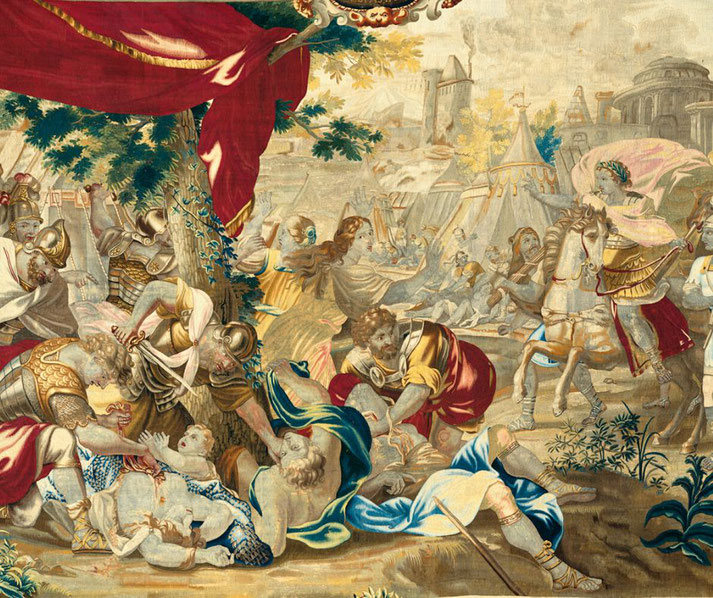
As the violence subsided, Titus ordered the destruction of most of the city’s fortifications and left Jerusalem in ruins.
Roman soldiers dismantled walls, set fire to public buildings, and reduced the Temple precinct to an empty shell.
Much of Jewish Jerusalem was effectively buried beneath collapsed masonry and ash, and the emptied streets carried a heavy silence that settled over the ruins.
To commemorate his triumph, Titus carried sacred artefacts, including the menorah and silver trumpets, back to Rome, where they were reportedly displayed during a lavish parade that included Jewish prisoners chained and humiliated before the crowds.

Later, the Arch of Titus immortalised the event. Carved reliefs still show Roman soldiers who carried the menorah and trumpets from the Temple, and the inscription appears to boast of Judaea’s defeat.
The menorah depicted in the relief later influenced the emblem of the modern state of Israel, tying ancient trauma to national rebirth.
For Roman audiences, the arch confirmed the strength of the Flavian dynasty. For Jewish memory, it constituted a largely permanent loss.
The widespread impacts of the fall
In the years that followed, Judaism changed in both structure and focus. Without the Temple, sacrifices could no longer be offered, and the priesthood lost its authority.
In its place, rabbinic leadership grew in importance, especially among the Pharisees, who had already emphasised study and synagogue worship.
The oral traditions they preserved became the foundation of later Jewish religious practice, particularly within the school of Rabbi Yohanan ben Zakkai, who established a new centre of learning at Yavneh.
Gradually, the diaspora expanded further. Jewish communities in Alexandria, Babylon, and other cities provided refuge for survivors, who carried memories of Jerusalem’s destruction into new settlements.
Liturgical responses developed over time, including the fast of Tisha B’Av, which mourns the loss of the Temple.
Apocalyptic writings increased significantly, expressing both grief and the hope for future redemption.
At the same time, Christianity, still emerging as a separate movement, often interpreted the Temple’s destruction as a divine judgement.
Christian texts such as the Gospel of Matthew, likely composed in the decades after the event, presented it as a fulfilment of prophecy and a sign that a new covenant had replaced the old.
Church traditions, recorded by later writers such as Eusebius, claimed that some Christians, recalling Christ’s warnings in the Gospels, reportedly fled to the city of Pella before the siege began.
As Christians increasingly worshipped outside of Jewish synagogues and separated themselves from Temple law, the physical loss of Jerusalem helped reinforce an existing shift in identity.
Over time, this moment deepened the divide between Judaism and Christianity.
But, can we trust the historical sources?
Much of what is known about the siege comes from Flavius Josephus, whose firsthand account in The Jewish War remains the primary source.
While he preserved important details, his reliance on Roman patronage and his desire to justify his survival raise some concerns about exaggeration and selective reporting.
He praised Titus, portrayed the Romans as reluctant destroyers, and condemned the Jewish factions for their disunity.
Other Roman authors, such as Tacitus, mentioned the war in briefer terms, but largely repeated many of the same claims.
Later rabbinic writings, which had been composed after the fact, focused less on military events and more on spiritual consequences, offering an understanding of Jewish theological responses but little historical narrative.
Even so, physical evidence supports many of the details found in Josephus.
Archaeological discoveries, including burnt building materials, destruction layers beneath the modern city, and the remains of Roman siege works, help confirm the scale of the fighting.
Excavations near the Western Wall have uncovered Herodian stones bearing signs of intense fire damage, and sling stones, arrowheads, and collapsed structures have been found in areas once defended by Jewish rebels.
Roman coinage, which was issued after the victory, bore the phrase Judaea Capta and helped illustrate the celebration of victory in the imperial narrative.
While no single source tells the whole truth, the combined weight of literary and material evidence suggests that the siege of Jerusalem in AD 70 significantly changed two faiths and effectively shattered the world that once centred on a single, sacred hill.