
Who were the Seven Sages of ancient Greece?

During the 7th and 6th centuries BCE, when Greek poleis struggled with political unrest and class conflict that exposed the limits of aristocratic rule, a small group of men became well known for a record of wise decisions and for public leadership that expressed moral lessons in simple, memorable sayings.
Later generations came to call them the Seven Sages, whose names appeared at Delphi as inscriptions and in early Greek literature as quotations by philosophers.
While their achievements ranged from constitutional reform to mathematical theory, each man became associated with practical wisdom drawn from experience and restraint rather than supernatural favour or heroic lineage.
1. Solon of Athens
At the start of the 6th century BCE, Athens stood close to internal conflict, as more and more small landholders fell into debt and a kind of slavery under the city’s wealthy elite.
Solon was appointed as archon in 594 BCE and introduced a reform programme that cancelled existing debts, banned debt slavery, and reorganised the citizen body into four property-based classes that determined eligibility for political office.
These classes, Pentakosiomedimnoi, Hippeis, Zeugitai, and Thetes, established a new social and political hierarchy based on wealth rather than birth.
Instead of abolishing the aristocracy outright, he undermined its control by granting new rights to common citizens while leaving elite privileges largely symbolic.
To strengthen this new order, Solon created a legal system based on published laws rather than inherited custom.
He introduced the right of appeal and expanded the role of juries, which allowed ordinary Athenians to take part in legal decisions.
After he had completed his laws, he left Athens for a decade to avoid pressure to revise them, insisting that the reforms needed time to settle without interference.
These reforms, which were collectively known as the Seisachtheia or "shaking off of burdens," became a major turning point in Athenian political history.
His sayings reflected his outlook. He advised, “Nothing in excess,” and warned, “Count no man happy until he is dead,” both of which urged Athenians to temper their expectations and avoid pride in uncertain times.
His reforms set the foundations for Athenian democracy, though they did not eliminate inequality or factional rivalry.
Much of what is known about Solon's life and sayings comes from later sources, for example, Plutarch's Life of Solon and fragments of his own poetry.

2. Chilon of Sparta
During the mid-6th century BCE, Chilon held the position of one of the five ephors in Sparta, where he played a role in efforts that strengthened that office and reinforced the authority of the law.
Rather than seeking personal glory, he worked within the Spartan constitution to ensure that decisions were made collectively and that discipline remained central to public life.
His influence largely arose from the consistent application of principle and the silent force of his example rather than from legislative change.
He encouraged values that suited Spartan society. He advised brevity and a careful silence in speech and action, joined with steady judgement.
Some traditions credit him with the saying “Know thyself,” later inscribed at Delphi, and he also cautioned others, “Do not speak evil of the dead.”
Both sayings encouraged self-awareness and restraint, qualities that Spartan education instilled from childhood.
The Delphic maxims were sometimes attributed to the Seven Sages collectively and were likely inscribed during this period as moral guides for all Greeks.
By reinforcing Spartan customs without seeking to replace them, Chilon left a model of traditional ethics built on caution and on a sense of moderation that valued clarity.
His influence persisted in the education of future Spartan leaders, who repeated his sayings as part of their instruction in public life.
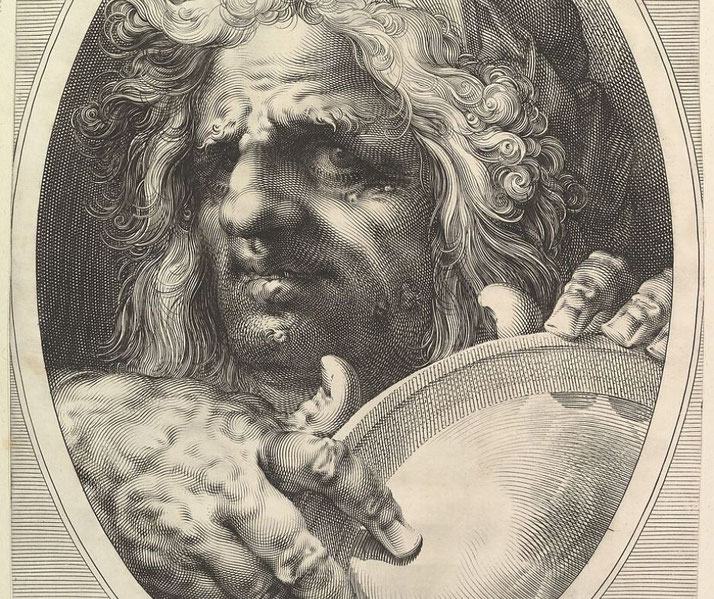
3. Thales of Miletus
Early in the 6th century BCE, Thales earned a great reputation in the Ionian city of Miletus as a thinker who explained the world through natural causes instead of myth.
He claimed that all matter came from water, and he used geometric principles to measure land and predict events in the sky.
For instance, he is said to have predicted a solar eclipse that ended a battle between the Lydians and the Medes in 585 BCE.
The event, which modern astronomers have identified as occurring on 28 May 585 BCE, was one of the earliest recorded uses of scientific prediction.
His studies in astronomy and geometry later gave him a reputation as the first Greek philosopher.
According to one story, Thales applied his knowledge of weather cycles to predict a very rich olive harvest, so he rented all the presses in advance and later made a profit by leasing them to others.
The story, regardless of its accuracy, suggested that wisdom could often turn into practical advantage when applied with foresight.
He also explored geometric truths such as the idea that an angle inscribed in a semicircle is a right angle and used similar triangles to estimate the height of pyramids.
He advised others to avoid guarantees and to understand their limitations. He stated, “Surety brings ruin”.
Later writers such as Aristotle, in his Metaphysics, described him as the founder of natural science in Greece, and his method of asking questions about causes influenced future philosophical study.
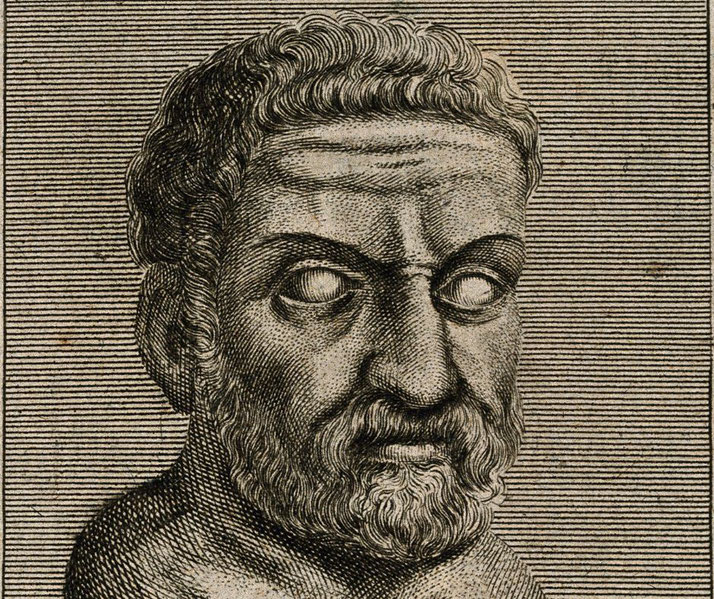
4. Bias of Priene
In the coastal city of Priene, Bias earned a reputation for justice and for a loyalty to the common people that others described as unusually fair.
He worked as an advocate in legal disputes, and he defended the poor and resisted bribes, which earned him praise from both citizens and important visitors.
He refused to exploit his skill for personal gain, and his reputation grew from his commitment to fairness.
According to Diogenes Laertius, who wrote about him, he consistently refused gifts and preferred to be known as a man of integrity.
When Priene faced a military threat and its inhabitants fled with their possessions, Bias left empty-handed and explained that his wealth travelled within him.
The remark captured the idea that intellectual and moral virtue could not be stolen, lost, or destroyed. His identity as a sage rested on that belief.
He often expressed a cautious view of human behaviour. He warned, “Most men are bad,” and added, “Love prudence,” suggesting that wisdom required both honesty and suspicion.
His words conveyed the need to act fairly even when others did not, and his public life embodied that ideal.
5. Cleobulus of Lindos
On the island of Rhodes, Cleobulus ruled the city of Lindos and promoted a model for city life that valued moderation and an education that aimed at public health.
He composed poetry in hexameter, taught by example, and expressed his ideas through riddles and aphorisms that blended wit with ethical advice.
His emphasis on practical improvement was especially noticeable among the sages, especially in the household and in personal habits.
Some traditions also credit him with writing the epitaph for the tomb of King Midas.
According to later traditions, Cleobulus had encouraged the education of both boys and girls, suggesting that wisdom should not be limited by gender.
This view likely stemmed from stories about his daughter Cleobulina, who had become known for the riddles in hexameter that she wrote.
He also promoted physical exercise and balanced meals as foundations for polite behaviour.
He believed that small, daily habits usually formed a person's character more effectively than grand speeches or rituals.
His most famous saying, “Moderation is best,” summed up his approach to life. He did not call for renunciation but instead warned against indulgence and encouraged balanced conduct in all things.
His views appeared frequently in later Greek texts that connected health with virtue and with a sense of public peace.
6. Pittacus of Mytilene
During a period of political instability on the island of Lesbos, Pittacus assumed temporary powers in Mytilene and ruled for ten years with both military skill and legal foresight.
He defeated the Athenian general Phrynon in single combat and secured victory for his city without a drawn-out conflict.
After he had established peace, he gave up power voluntarily and returned to private life, which strengthened his image as a fair-minded leader.
His leadership is generally dated to c. 590–580 BCE, during which he helped Mytilene recover from civil strife.
While in office, he introduced laws aimed at reducing the abuses of the aristocracy.
One statute doubled the penalty for crimes committed while drunk, and he argued that drunkenness removed reason and that crimes committed in that state deserved harsher punishment.
Aristotle later cited this measure as an example of sound legal thinking in the Politics.
His legal reforms showed a concern for public stability and personal responsibility.
He urged others to recognise the importance of timing and mercy. “Know the right moment,” he advised, and added, “Forgiveness is better than revenge.”
These sayings indicated his preference for reconciliation over punishment and showed that leadership required both judgement and restraint.
7. Periander of Corinth
Periander ruled Corinth as a tyrant during the early 6th century BCE, and his position among the Seven Sages remained controversial.
He modernised the city’s roads, buildings, and harbour, and increased its wealth through trade, and he also promoted cultural activity, for example, poetry and architecture.
However, stories of cruelty, including an account in Herodotus that claimed he murdered his wife Melissa, caused later writers to question whether he belonged among men praised for wisdom.
These stories often portrayed him as paranoid and violent and contrasted sharply with his administrative achievements.
Even so, Corinth generally did well under his rule, as he reorganised taxation and developed shipbuilding, and he secured trade routes that made the city one of the wealthiest in the Greek world.
He also ordered the construction of the Diolkos, a paved trackway across the Isthmus of Corinth that allowed ships to be transported overland.
He maintained power by watching people closely and by tight control, ensuring that opposition remained limited.
His sayings often focused on discipline and planning, and he advised, “Practice makes perfect,” and “Look ahead in all things,” which suggested that good leadership required long preparation.
His reputation after his death showed the tension between government success and personal brutality.
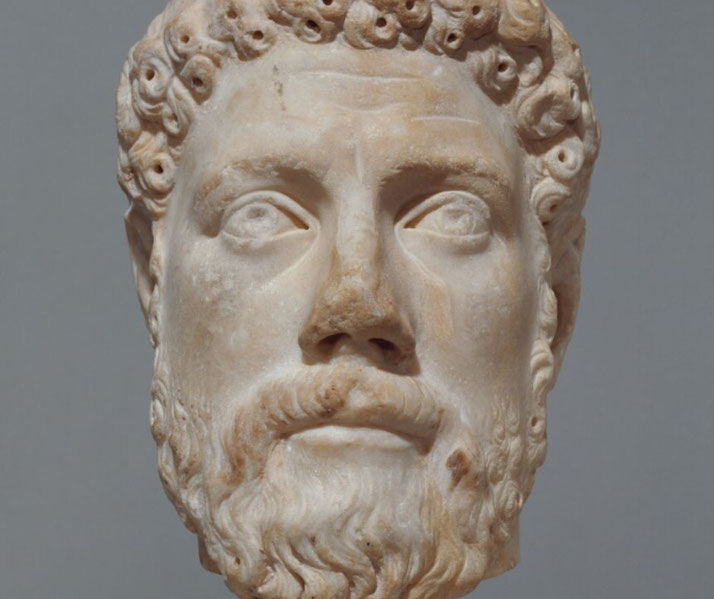
Recording the famous sayings of the Sages
Over time, later generations collected the sayings of the Seven Sages, which they repeated in temples and schools and used in homes.
At Delphi, three sayings, which were traditionally attributed to them, “Nothing in excess,” “Know thyself,” and “Observe the right time”, were engraved near the entrance to the Temple of Apollo, where visitors came to seek the god’s answer.
Some ancient sources later associated these moral inscriptions with the priestess Themistoclea, though the evidence for her role stayed limited and uncertain.
Their words showed common values among the Greek elite and stressed that success required a mixture of clear judgement and personal discipline that imposed control over impulse rather than simple luck or strength.
The short sayings did not explain the world but instead taught people how to live within it wisely, and Plato mentioned these sayings in his Protagoras and used them to explore the meaning of wisdom.
Later philosophers such as Socrates and the Stoics often found inspiration in these sayings and expanded them into full systems of ethics.
The sages wrote no treatises and founded no schools, and their influence helped form the Greek belief that wisdom could come from daily conduct and honest speech.
Their words endured partly because they offered guidance in a world where good judgement remained rare, and this weighed more than any attempt to solve every problem.