
The Roman Empire: How big was it really?
By the second century AD, the Roman Empire stretched across much of Europe, North Africa, and western Asia to a large extent. F
rom the icy marshes of northern Britain to the rich floodplains of Egypt and the fortified cities of Syria, Rome controlled a large connected area, broadly speaking.
Yet determining how large it truly was required more than measuring its borders in simple terms. It required an examination of its administrative systems, population, infrastructure, and the limits of imperial authority.
The origins of the Roman Empire
After the foundation of Rome in the eighth century BC, traditionally dated to 753 BC, Latin tribes lived along the Tiber River and began to form a single city-state under the rule of kings.
During the early centuries of the Republic, Roman leaders focused on securing the Italian peninsula by defeating rival groups such as the Samnites and Volsci, and they spread influence through colonies, alliances and military garrisons.
As the network of Latin cities expanded, roads such as the Via Appia connected Rome with distant bases, and Roman law began to take hold in surrounding regions.
Following its final victory over Carthage in 146 BC, Rome acquired overseas provinces, including Africa and parts of Hispania, which required a new form of rule over distant lands.
By the first century BC, campaigns led by Pompey in the east and Caesar in Gaul had created an empire that encircled the Mediterranean.
During this period, Rome’s power shifted from senatorial control to the control of military commanders whose personal armies became instruments of political influence.
Then, after Octavian defeated Mark Antony and Cleopatra at the Battle of Actium in 31 BC, he consolidated rule under a new title, Augustus, and established the principate, which set up single leadership over the growing imperial system.
Soon after, the empire absorbed Egypt, completed the conquest of Hispania, and reinforced its control over Asia Minor and Syria.
Under Augustus, Roman administrators made provincial taxation uniform, made military service regular, and introduced laws that rewarded loyalty to the imperial family.
Temples, theatres, and aqueducts appeared across distant provinces, which showed Rome’s presence and gave clear rewards for submission.
Laws such as the Lex Julia of 90 BC and the Lex Plautia Papiria of 89 BC had already granted citizenship to Italian allies, providing a precedent for future policies of integration.

Different ways of measuring the empire
At its height under Emperor Trajan in AD 117, the empire covered roughly 5.5 million square kilometres, which stretched from the Atlantic coast to the Persian frontier and from northern Britain to the southern edge of the Nile Valley.
While modern historians use satellite imagery and archaeological records to estimate this area, ancient Romans had relied on travellers’ reports, regional surveys, and military dispatches.
Roman geographers such as Ptolemy had collected data without consistent methods, which often produced inaccurate maps and unclear boundaries.
The Peutinger Table was a medieval copy of a Roman map, and it illustrated the empire's road networks rather than precise geography.
By population, Rome governed an estimated 50 to 70 million people, including citizens, provincials, freedmen, and slaves.
This figure accounted for about a fifth of the world’s inhabitants at the time. Large urban centres typically became hubs of administration and trade, with cities such as Rome, Alexandria, Antioch, and Carthage, which exceeded hundreds of thousands in population.
Rural communities, meanwhile, supplied grain, manpower, and taxes, linking agrarian economies to imperial demands.
These estimates are based on a combination of ancient census data, taxation records, and archaeological models developed by modern scholars such as Walter Scheidel.
Infrastructure also helped to define the limits of Roman power to some degree because over 80,000 kilometres of paved roads connected provinces with military bases, customs posts, and administrative centres.
Along these routes, messages generally travelled by relay, supplies moved with speed, and soldiers marched with order, and, as a result, the combined network created a practical unity that bound the empire together in practice, if not in name.
The cursus publicus was a state-run courier system that also facilitated limited official transport, which ensured rapid communication between imperial centres.
The reasons Rome grew to this size
From its earliest years, Rome often treated expansion as both a political necessity and a religious duty.
Victories often granted triumphs to generals, added land to the state, and enriched the treasury with tribute and slaves, and as new provinces appeared, the Senate appointed governors to oversee taxation, enforce justice, and command local legions.
These officials acquired wealth and prestige, while Rome secured its borders and opened new markets for trade.
To help preserve loyalty in the provinces, the empire offered a clear path to Roman identity.
Over time, communities that adopted Latin customs, supported imperial efforts, or provided soldiers could earn Latin rights or full citizenship.
The Edict of Caracalla in AD 212 granted citizenship to all free men within the empire, which made this process official and expanded the pool of taxpayers and military recruits.
It allowed local elites to share in Rome’s success, it encouraged cooperation rather than rebellion.
As a result, provincial cities often mirrored Roman ones, with basilicas, bathhouses, and amphitheatres built according to imperial standards.
Cities like Lugdunum in Gaul became major administrative and commercial hubs that exemplified successful Romanisation.
Economically, Rome’s expansion followed the flow of resources. Egyptian grain fed the capital’s growing population, Spanish silver funded military campaigns, and Gallic wine filled amphorae that travelled by sea to African ports.
Each conquest added new inputs to this system, which supported both urban development and military garrisons.
Meanwhile, trade routes frequently brought in luxury goods from India, Arabia, and sub-Saharan Africa, such as pepper, frankincense, and ivory, which expanded Roman knowledge and increased wealth among merchants.
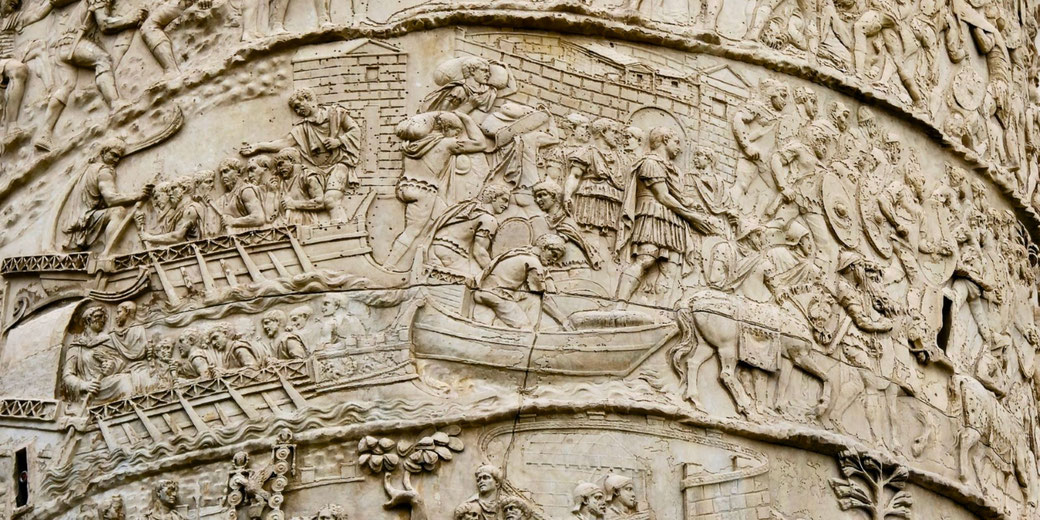
Public image also encouraged growth to a considerable degree. Emperors commissioned monuments to commemorate military success, such as the Arch of Titus and Trajan’s Column, which depicted conquered peoples and loyal soldiers in relief.
Coins minted after each victory circulated those achievements across the empire, which strengthened the idea that conquest preserved peace and rewarded obedience.
Across the provinces, several hundred amphitheatres and hundreds of bathhouses were constructed, which created physical symbols of Roman authority and public life.
The problems of having a vast empire
As the empire expanded, managing it became increasingly difficult, because messages from Rome could take weeks to reach frontier governors and instructions often arrived too late to affect events on the ground.
Some commanders occasionally acted without permission, while others hesitated in the absence of orders, and, as a result, a patchwork of responses to local crises developed where personal self-interest and regional interests sometimes outweighed imperial unity.
Along the borders, threats from peoples who migrated, from rebellious tribes, and from hostile kingdoms required a permanent military presence, as in Britain, Judea, Dacia, and along the Rhine, Roman legions held forts, patrolled roads, and guarded supply lines.
The limes Germanicus and limes Arabicus formed a frontier zone more clearly developed under the Severans, which acted as official boundary zones reinforced with forts and watchtowers.
The cost of feeding, paying, and maintaining these forces had substantially used up the treasury, while the need for more troops had led to recruitment from outside Italy.
By the 2nd century AD, the Roman military included both legions and auxiliaries, and it numbered over 400,000 soldiers.
However, military disasters often showed how vulnerable the empire could become when stretched too thin, as in AD 9, three Roman legions under Varus were destroyed in the Teutoburg Forest after Germanic tribes led by Arminius ambushed them.
That loss ended Roman expansion into central Germania, which forced Augustus to fortify the Rhine frontier and to abandon further conquest in the region.
Other defeats, such as those against Parthian and Sassanid forces in the east, at times demonstrated that some enemies could match Rome’s tactics and last longer than its supply lines.
Internally, the empire faced pressure on its central government. Imperial authority gradually weakened under widespread corruption that permitted tax evasion and that produced uneven application of the law.
Some governors, such as Gnaeus Calpurnius Piso in Syria, pursued personal agendas or defied imperial commands.
As provincial officials grew rich, ordinary subjects bore heavier burdens, and revolts periodically erupted in Gaul, Africa, and the east because people lost faith in Roman justice.
The Bagaudae uprising in Gaul and the Jewish Revolts across Judea exemplified this erosion of confidence.
In response, emperors increasingly relied on military intervention rather than reform, which eroded civil governance and gave the military more political power.
How did it compare with other large empires in history?
Compared to the Mongol Empire, which briefly ruled over approximately 24 million square kilometres during the 13th century, Rome governed a smaller area but for a much longer period.
It also administered its provinces through a combination of direct rule and structured delegation, rather than relying only on military garrisons or on extracting tribute.
While the Mongols often retained local systems of control, Rome introduced uniform laws, legal categories, and civic infrastructure, which created continuity across time and space.
Against the British Empire, which ruled over 35.5 million square kilometres by the early 20th century, Rome lacked both naval supremacy and industrial tools.
Yet internal unity depended on extending citizenship to provincial communities and on state promotion of public religion, with roads, cities and monuments providing the physical connections that made those ties effective.
Provincial governors used Roman law, spoke Latin or Greek, and followed standard procedures in taxation and legal appeals.
These commonalities allowed Rome to hold territories from Northumberland to the Red Sea with surprising consistency.
In contrast to looser imperial arrangements, Roman citizenship offered legal and economic privileges that bound subjects to the state more tightly than tribute systems alone.
More significantly, the growth of Roman cities provided a lasting framework.
Hundreds of cities followed the same layouts, used the same architectural forms, and hosted the same types of public events.
This civic model allowed Rome to create a shared identity among populations who spoke different languages and worshipped different gods.
Even after political collapse, many of these cities had continued to operate, which carried Roman traditions into later medieval societies.
How it all fell apart
During the fourth and fifth centuries, pressure from outside peoples, combined with internal decay, gradually weakened the empire.
The Huns moved westward, which forced Germanic tribes to seek refuge within Roman territory.
Some had been settled as allies, but others at times turned against imperial authority when mistreated or underpaid.
In AD 378, the Battle of Adrianople ended in disaster when the Eastern emperor Valens, who failed to wait for reinforcements, led his army into battle.
His death and the army’s destruction opened the Balkans to further invasion by Gothic forces led by Fritigern.
Soon after, Rome itself suffered two sacks: first by the Visigoths in AD 410 and then by the Vandals in AD 455, events that shocked the Roman world and destroyed the sense of security.
Meanwhile, rival emperors and generals fought for control, which drained resources and broke up authority.
Some provinces, such as Gaul and Hispania, broke away to form new kingdoms under Germanic rulers who retained Roman customs while discarding imperial loyalty.
In Gaul, the Visigothic Kingdom maintained Roman law codes such as the Breviary of Alaric.
By AD 476, the deposition of the boy-emperor Romulus Augustulus by the military leader Odoacer marked the formal end of the Western Roman Empire.
The Eastern Empire continued from Constantinople for another thousand years, but the unified Roman state no longer existed.
Roads gradually fell into disrepair, coinage lost value, and legal systems broke down.
Yet the empire’s size, once measured in distance and population, endured in another way.
Its administrative structures and the continued use of Latin and Greek largely acted as channels for Roman culture, which created a map of memory that lasted longer than any border.