
What was childhood like in Ancient Rome?
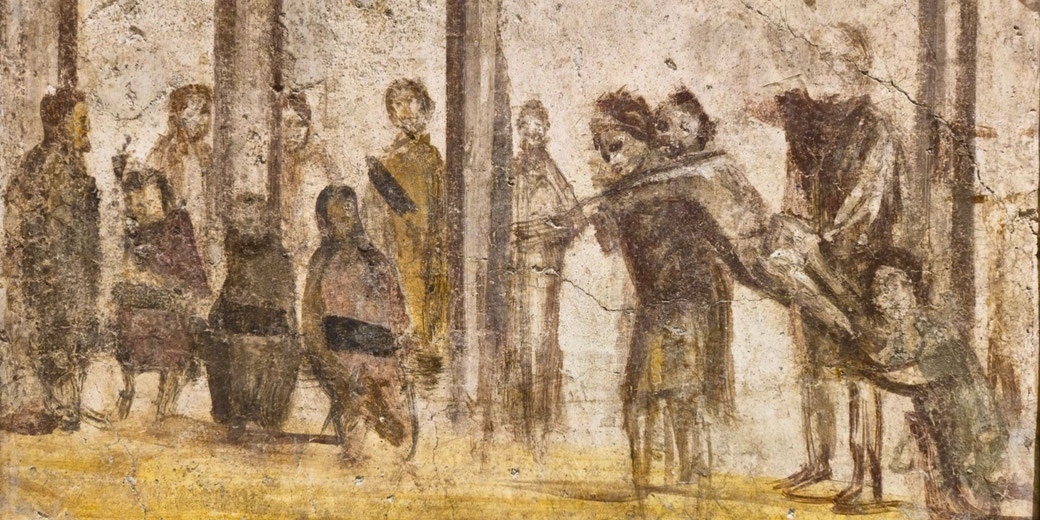
Across the crowded insulae of the Subura and the gated courtyards of patrician homes, Roman children lived under firm household control and constant public expectation within a legal structure that assigned them little independence.
Many did not survive infancy, and those who did learned to obey the paterfamilias and follow religious customs as they prepared for the social role their birth had assigned.
From ceremonial naming days to the symbolic exchange of the toga praetexta, Roman childhood unfolded as a sequence of milestones designed to form obedient adults, not preserve innocence.
The deadly reality of being born in ancient Rome
At birth, Roman infants often faced a high risk of death from disease or malnutrition, and their parents might even leave them to die, particularly among families with little wealth.
Midwives were often older women with practical experience, and they supervised the delivery in the household’s private quarters and performed traditional rituals intended to protect both mother and child.
Soon after birth, the paterfamilias decided whether the child would remain in the household or be left to die.
By custom, the father accepted the child by performing suscipio, an act which showed that he accepted the infant as a family member.
Literary references sometimes describe this as tollere liberum, though this later phrase referred to a gesture with special meaning rather than a formal legal ritual.
If the father chose not to acknowledge the child, the newborn could be exposed and left in a public space, where passers-by might adopt, enslave, or ignore it.
Many exposed infants probably died, although others were raised by those who found them, including childless couples or slave traders.
Later imperial reforms, such as those under Constantine, tried to reduce the practice of infant exposure without outlawing it entirely.
To protect the infant from harm from evil spirits, families placed a bulla around the baby’s neck, which they saw as a protective charm.
Boys wore it until their official passage to manhood, while girls surrendered it upon marriage.
Girls might also wear a lunula, a crescent-shaped pendant intended to guard against evil forces.
Among the upper classes, a hired wet nurse or nutrix who lived in the household often fed and cared for the child instead of the mother.
Roman writers such as Quintilian had warned against the moral influence and the influence of a nurse's speech, but their services still remained essential for elite households.
Nine days after birth for girls and eight for boys, the family held the Dies Lustricus, a ceremony that made the child ritually clean and formally gave it a name.
The ritual included prayers and a household sacrifice, followed by the placing of the name into family records, or tabulae.
The child received a praenomen, chosen from a relatively small pool of acceptable names, especially for boys.
It indicated the beginning of the child’s recognised life under Roman law.
Childhood and education
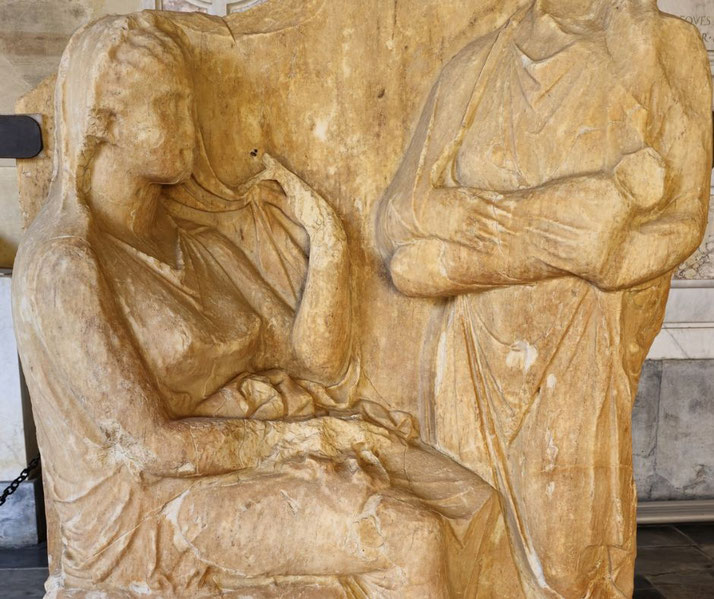
From early childhood, Roman children encountered organised learning and physical discipline alongside religious duties.
Boys and girls in wealthy homes began their education in the household, taught by tutors or educated slaves who introduced them to language and stories that framed social expectations.
Tutors used wax tablets and memory exercises, and they sometimes used letter-shaped teaching aids to teach correct behaviour and prepare children for formal instruction.
For most boys, formal schooling began around age seven. At the ludus litterarius, under the guidance of a litterator, they learned to read and write, then to calculate with basic tools like the abacus.
Instruction focused on repetition and the reciting of passages aloud, and teachers punished mistakes quickly to reinforce discipline.
Quintilian opposed excessive corporal punishment, but most Roman educators believed in strict correction.
After a few years, wealthier students continued under a grammaticus, who guided them through Greek and Latin literature.
Here, they read Homer, Virgil, Terence, and Cicero, and they memorised long passages and discussed the moral lessons in them.
Some then advanced to rhetorical study, where a rhetor trained them in legal speech and persuasive argument, and also in public performance with exercises such as suasoriae and controversiae.
Girls rarely joined these schools. Most received their training at home from mothers or female slaves, who taught them spinning and sewing, together with child-rearing and religious ceremonies.
A few upper-class girls learned to read and write, especially in literary families.
Notable examples include Cornelia, the mother of the Gracchi, who earned praise for her intellect, and the poet Sulpicia, whose verse survives.
Even so, female education remained focused on preparing them to manage a household, not to take part in public life.
Poorer families had fewer options. Children who came from working or enslaved households rarely attended school. Instead, they helped with labour from childhood onwards, and they learned skills from parents or masters.
Many worked in trades, workshops, markets, or fields, with little time for books or writing.
A child’s education, whether formal or practical, always reflected the social standing of the family that raised them.
Play, toys, and social life
Even in a society that strongly valued discipline, Roman children still often found time to play.
Archaeological discoveries from Pompeii and Herculaneum show a variety of toys that included small dolls with jointed limbs, carved animals, spinning tops, hoops, and game pieces.
Some of these toys were crepundia or rattles, and they were also worn as amulets.
Dolls made from ivory or terracotta often wore miniature clothing or jewellery and may have resembled real family members.
Items such as MET accession no. 23.184.5a-c (which is a set of carved ivory dolls) help modern historians reconstruct these aspects of Roman play.
Boys played more physically with balls and hoops, and they also threw knucklebones in games of skill and strength.
Some practised with wooden swords or staged mock chariot races, while others joined older boys in wrestling or running competitions.
Girls often played at home and pretended to manage households or care for dolls.
They learned to copy the tasks they would soon be expected to perform in real life, but also shared in family rituals and seasonal festivals.
During public celebrations like Saturnalia, the normal order briefly reversed.
Children received gifts and joined in the noisy celebrations, and the usual formality of Roman adult life gave way to laughter and role reversal, with more relaxed behaviour than usual.
Some children joined processions, sang hymns, or wore symbolic costumes that reflected their age and gender.
Occasionally, graffiti and inscriptions show that children also played in the streets and formed gangs, then misbehaved in ways that worried their elders.
Pompeian street markings suggest games similar to modern hopscotch, and wall graffiti sometimes names children who were involved in neighbourhood antics.
Teachers and magistrates complained of their noisy behaviour, and household slaves sometimes escorted them in public to prevent trouble.
Despite restrictions, children developed friendships and rivalries that grew out of the games that filled their days outside the home.
Rites of passage and legal status
Over time, Roman society prepared its children to assume the roles and responsibilities expected of adult citizens.
For girls, that transition came with marriage, often between the ages of twelve and fourteen.
Before the wedding, a girl had removed her bulla, had set aside her toys, and had put on the white bridal tunic and flame-coloured veil that marked her new identity.
Her family then escorted her to her new home, where she joined her husband’s household under legal control or symbolic guardianship.
For boys, the turning point arrived with the toga virilis ceremony, usually at age fifteen or sixteen.
On this day, a boy removed the purple-bordered toga praetexta of childhood and wore the plain white toga of a Roman man.
He visited the Capitoline Jupiter, offered sacrifices at the household shrine, and appeared in the forum as a sign of his new public identity.
Many boys probably completed this transition on March 17, during the Liberalia festival, when young men across the city stepped into public life together.
The bulla was often dedicated to the household Lares or to the boy’s Genius.
Although the toga virilis marked manhood and symbolic entry into adult citizenship, a boy still lived under the patria potestas of the father.
He could not act independently unless formally emancipated or after the father’s death.
Voting, military service, and property rights also depended on enrolment in the census and satisfaction of property requirements.
In elite families, this ceremony often began a political or legal career, since the family used the event to signal its future intentions and social rank.
Death, memory, and commemoration
For many Roman families, childhood ended in tragedy rather than in ceremony, and death before adulthood remained common.
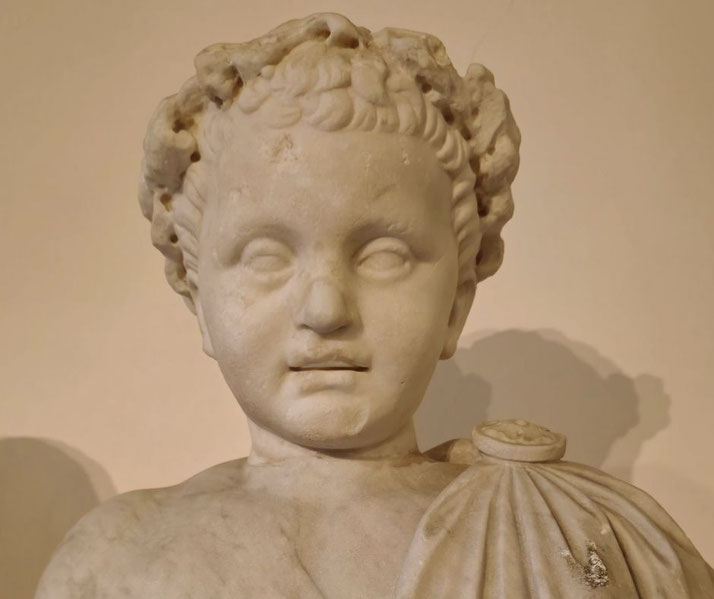
Children often died from infection, hunger, or illness, and parents marked their passing with tombstones and inscriptions, together with offerings.
Epitaphs from across the empire record their ages with great care, sometimes listing years and months as well as days.
Examples in the Corpus Inscriptionum Latinarum (CIL) include moving dedications by parents who had grieved for their children.
In wealthier families, burials included marble sarcophagi that carried carved images of the child playing, learning, or holding pets.
Notable examples survive in the Vatican Museums and in sites such as Ostia.
Parents had written verses of mourning or had recorded messages of love and grief.
One tomb in Rome described a girl who “had lived only six years, but brought joy to all.”
Another included a doll carved in stone beside the epitaph, which suggested that the object had been buried with her.
Families with less wealth often marked graves more simply. Many children were buried in reused pottery jars or plain wooden coffins outside the city walls.
Amphora burials appeared in various regions of the Mediterranean and were especially common for infants, and reflected both cultural tradition and everyday reuse.
Some graves sometimes included toys, coins, or food that families placed there for the next world.
Even in poor districts, children’s burials show care and emotion, and inscriptions show that parents remembered their children as beloved and innocent, and as people they considered worthy of mourning.