
Why was an Egyptian pyramid built in the middle of Ancient Rome?
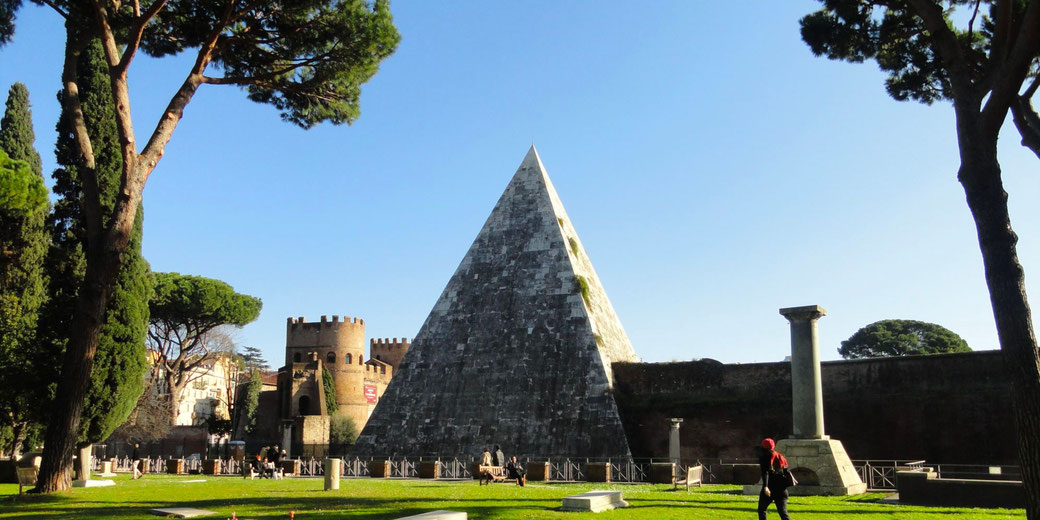
By the late first century BC, Rome had absorbed Egypt into its growing empire after the defeat of Cleopatra VII and Mark Antony at the Battle of Actium in 31 BC.
As Augustus transformed the city into a marble capital worthy of empire, many elite Romans embraced foreign designs that showed Rome's conquest and aristocratic taste, as well as projecting a new kind of social prestige.
One notable result of this cultural moment was the construction of a full Egyptian-style pyramid beside the Via Ostiensis, an unexpected monument that combined Roman engineering with the image of pharaonic death.
Why was the pyramid built?
During Augustus’s reign, many Roman elites began to experiment with new architectural forms that displayed both wealth and worldly identity.
After the annexation of Egypt in 30 BC, Egyptian motifs entered elite Roman spaces in the form of statues, obelisks, frescoes, and religious imagery.
At the same time, some tombs began to reflect this influence. For example, some patrons abandoned the traditional Roman columbarium or mausoleum in favour of Egyptian-style pyramid tombs.
Rather than imitating Giza’s royal complexes, such tombs belonged to a brief fashion trend among Rome’s wealthy.
Only two pyramid-shaped tombs are known to have been built in Rome, as surviving evidence suggests, the Pyramid of Cestius and the now-lost so-called Meta Romuli (a pyramidal tomb near the Vatican later misattributed to Romulus), which shows how rare and high-status this architectural choice truly was.
Often, instead of acting as religious sites for ancestor worship, they acted as elite statements of personal style.
During this time, architecture often became a medium through which aristocrats expressed their support for imperial themes.
For instance, foreign motifs could symbolise loyalty to Augustus’s image of global authority.
The Pyramid of Cestius was constructed between 18 and 12 BC and generally belongs to this moment in Roman cultural history.
Roman interest in Egypt was no longer a distant admiration but a political reality, and, as a result, Egyptian-inspired monuments increasingly became a way for individuals to show their participation in this new imperial order.
Augustus is believed to have removed the temple of the Egyptian goddess Isis from the Capitoline Hill around 28 BC, though the cult remained active in other parts of the city.
This policy helped create space for eastern styles to flourish in elite architecture.
Placement also mattered. Since Roman law forbade burials within the city’s sacred boundary (the pomerium), tombs appeared along roads leading into the city.
Cestius chose a site beside the Via Ostiensis, which connected Rome to its major seaport, which meant that travellers from Ostia would pass the monument as they approached the city gates.
As a result, the pyramid was intended to be a carefully located message about its owner’s visibility and importance.
Who was Cestius?
Although Gaius Cestius did not belong to the oldest or most high-status Roman families, his name, titles, and career confirm his upper-class status during the early empire.
His inscription identifies him as a praetor, which placed him among the senior magistrates of the Republic, and as a member of the Septemviri Epulonum, a powerful priesthood responsible for organising public feasts during religious festivals.
This group, created in 196 BC, had become one of the four major priestly colleges in Rome.
Together, these offices reveal a career that combined public authority with religious responsibility.
Cestius’s choice of a pyramid was probably not a random indulgence. Instead, it reveals how funerary architecture had become a tool for elite self-promotion.
At a time when Augustus promoted Egypt as a personal possession of the emperor, and when eastern aesthetics became popular in Roman circles, a pyramid could demonstrate cultural awareness and political skill.
It also echoed the Augustan message that Rome had become the master of the world.
An incredible architectural feat
The Pyramid of Cestius rises 36.4 metres high, with a base measuring roughly 29.5 metres on each side.
Unlike the wide, stepped pyramids of Giza, its steep profile follows the Nubian style seen further south in Meroë, the capital of the Kingdom of Kush, where royal tombs featured narrow proportions and sharp angles.
Romans encountered these styles indirectly through military campaigns, trade, and imported artworks after Egypt’s fall.
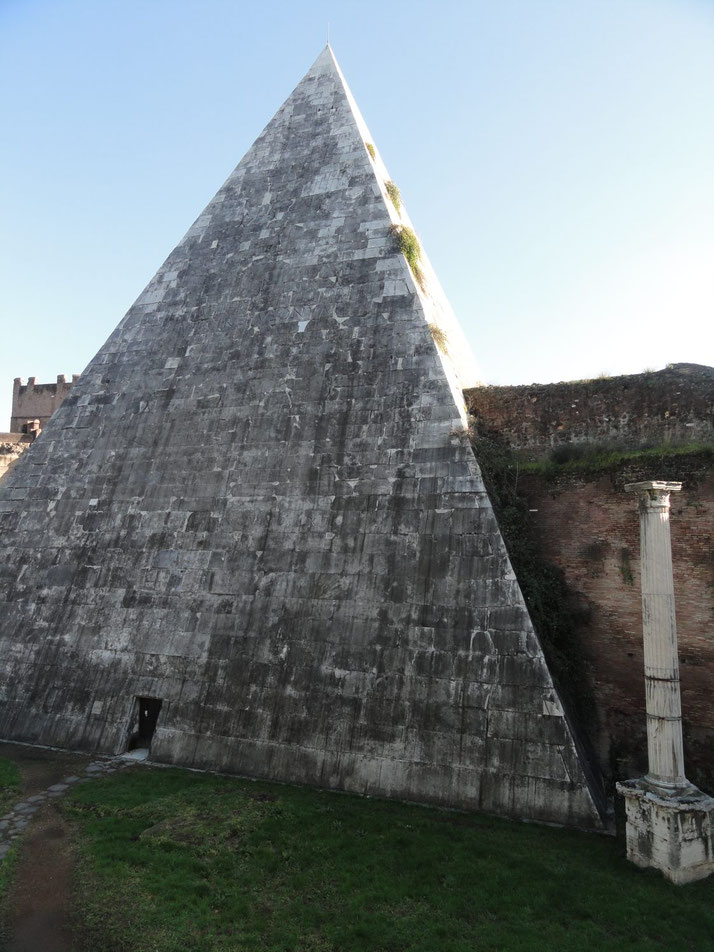
Construction used a core of Roman concrete, known as opus caementicium, faced with Carrara marble, a prized material from northern Italy, which ensured long life and provided a luxury finish.
Instead of hollow interiors or complex passageways, Roman pyramids featured small chambers designed for a single burial.
The chamber inside the Pyramid of Cestius was small and had once included painted decoration that had faded over the centuries.
Traces of painted decoration, which possibly show winged victories and floral motifs, still appear to show parts of the original design.
Roman architects did not attempt to copy Egyptian structures in full. Instead, they adapted surface form, and they used Roman tools, techniques, and materials.
For example, the lack of detailed internal design generally reflected a Roman approach to tomb-building, which preferred symbolic form over hidden ritual chambers.
At the same time, the steep angle and pointed summit gave it a clearly Egyptian outline.
When they had used Roman methods to recreate an Egyptian image, the builders had created a structure that appeared ancient while being clearly modern.
What the mysterious inscriptions tell us
Two inscriptions, which were carved on the marble exterior, give important information about the tomb and its occupant. The primary text reads:
C·CESTIVS·L·F·POB·EPVLO·PR·TR·PL
VII·VIR·EPVLONVM
This short but compact statement identifies the deceased as Gaius Cestius, son of Lucius, of the Pobilia tribe, praetor, tribune of the plebs, and a member of the Septemviri Epulonum (feast priests).
Each part confirms a different element of his public identity. His tribe indicated his legal citizenship; his offices showed his path through public life; and the religious title tied him to Rome's religious duties.
A second inscription, which was added on a different face of the pyramid, recorded that two men, Lucius Pontius Mela and Lucius Septimius Severus, had repaired the monument on the Senate's order.
This occurred during the joint reign of Septimius Severus and Caracalla in AD 203.
Severus launched a major building program across Rome to strengthen the emperor's authority, and the restoration of the pyramid formed part of this broader effort.
The fact that the Senate paid for repairs two centuries after the tomb’s construction suggests that the pyramid kept public importance.
The pyramids dramatic history and survival
The pyramid largely survived because it became part of something else entirely in the late third century AD, when Emperor Aurelian ordered the construction of a defensive wall around the capital.
Instead of demolishing the monument, they included the pyramid within the Aurelian Walls, which were built between AD 271 and 275 in response to increasing military threats from Germanic tribes and internal unrest.
This reuse gave the pyramid a new role, since it had become part of the city's defences and had gained protection from later demolition.
During the Middle Ages, when marble was routinely stripped from ancient buildings to use in churches and civic projects, the pyramid escaped such treatment since its structural role made it too valuable to take apart.
For centuries, it attracted little attention apart from local rumour. At one point, popular tradition claimed it identified the tomb of Remus, brother of Romulus.
Others speculated that Egyptian settlers had built it during the city’s mythical past, and only during the Renaissance did scholars begin to investigate it seriously.
By the seventeenth century, early scholars had recorded the inscriptions and identified Cestius as the builder, and from that point forward, the pyramid gradually became a subject of scholarly interest, artistic sketches, and architectural studies.
Its appearance in drawings by Piranesi and others helped cement its place as one of Rome’s more unusual ancient monuments.
Today, the Pyramid of Cestius is one of the best-preserved funerary monuments from ancient Rome.
It largely owes its survival to chance, its design largely to a cultural trend, and its meaning to a political world in which conquest often brought more than land and brought ideas that changed how people built, remembered, and saw themselves.