
Why did ancient Egyptian pharaohs have five names?
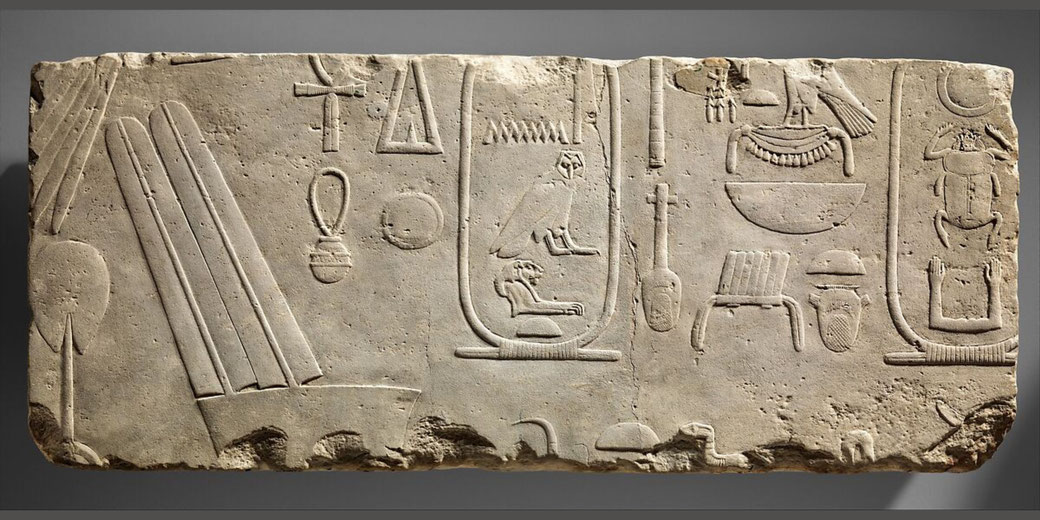
At his coronation, an Egyptian king typically adopted five names that defined his authority over the land and the heavens, along with his rule over the people.
The titulary provided identification and also worked as a carefully planned system of religious and political statements that drew heavily on mythological stories.
While this tradition evolved over time, it had reached its most complete form by the Middle Kingdom, particularly during the 12th Dynasty under Senusret I, when each of the five names carried distinct meanings that supported the pharaoh’s sacred role and royal responsibilities.
The Horus Name
By adopting the Horus Name, the king aligned himself with Horus, who was the falcon-headed god associated with rulership and the sky.
The name appeared in a serekh, a stylised palace front that was topped with the falcon of Horus, which reinforced the king’s role as the earthly stand-in for a heavenly protector.
Early dynastic rulers such as Narmer and Aha seem to have used only the Horus Name as their formal title, and their names survive today through the serekhs that were carved on ceremonial palettes and stone vessels.
One of the most famous examples is the Narmer Palette (Cairo Museum JE32169), which displays his Horus Name prominently above a serekh.
Over time, many pharaohs began to extend their Horus Names with descriptive titles that illustrated their sacred qualities or military strength.
For example, the 3rd Dynasty pharaoh Djoser used the Horus Name “Netjerikhet,” which meant “the god-like of body” and presented the king as a physically perfect being blessed by the gods.
Sneferu was his successor and adopted the Horus Name "Nebmaat," or "Lord of Maat," which emphasised justice and sacred order.
Later rulers introduced further elaboration. Ramesses II chose the name “Horus Kanakht Khaemwaset,” or “Horus, the mighty bull who appeared in Thebes,” which framed him as a powerful, victorious king closely tied to the religious centre of Upper Egypt.

The Nebty Name (Two Ladies’ Name)
The Nebty Name usually introduced another layer of approval from the gods through the protective power of Nekhbet and Wadjet, the patron goddesses of Upper and Lower Egypt.
Their symbols, a vulture and a cobra perched on baskets, always began the name and acted as sacred signs that symbolised balance and unity.
Unlike the Horus Name, the Nebty Name never appeared in a serekh or cartouche, but its use in temple inscriptions, stelae and statues showed its significance.
Examples have been found on stelae from Karnak and Abydos that record these titles with careful attention to religious detail.
Over successive reigns, the Nebty Name had often taken on more religious language.
For instance, Senusret I used the name “He who repeats births, he who renews births,” which expressed his responsibility to maintain the cosmic cycle of renewal.
Since both goddesses belonged to different parts of Egypt, their pairing in a single title also affirmed the king’s control over the entire country.
The name legitimised territorial rule and declared the pharaoh’s protection by the gods in every part of his domain.

The Golden Horus Name
The Golden Horus Name often introduced a more symbolic message that linked the king with permanence and purity as visible signs of the power of the gods.
The name, which was often shown as a falcon above the hieroglyph for gold, showed qualities of lasting purity and favour from the gods.
Since gold never tarnished, its association with Horus implied that the king possessed eternal authority that could not decay or be challenged by chaos.
Some scholars have debated whether the gold hieroglyph originally suggested holy power, military strength, or ritual purity, but all interpretations emphasise an unchanging and very high status.
By the Middle Kingdom, the Golden Horus Name had largely become standardised and appeared regularly alongside other titles in inscriptions.
It sometimes included military or religious phrases that reinforced the king’s image as a victorious and sacred figure.
For example, Thutmose IV used the name “Powerful of arm, who smites the Nomads,” which celebrated his role as a warrior-king and guardian of Egypt’s sacred order.
Although less frequently cited in popular memory, the Golden Horus Name conveyed an important spiritual message about the king’s place in the struggle between order and chaos in the universe.
On rare occasions, this name appeared within a cartouche, although this was not the standard convention.
The Prenomen (Throne Name)
When a man became pharaoh, he usually received a throne name known as the prenomen, which was introduced by the title nsw bity, a phrase that meant “He of the sedge and the bee.”
This referred to Upper and Lower Egypt and stressed the ruler’s responsibility to govern both lands as a single, unified country.
Unlike earlier titles, the prenomen appeared inside a cartouche, and most included the name of the sun god Ra to indicate the king’s selection by Ra and eternal support.
For instance, Ramesses II used the throne name “Usermaatre Setepenre,” which translated as “The justice of Ra is powerful, chosen of Ra.”
This name connected him to Ra and suggested that his rule aligned with cosmic balance and justice.
Almost every public monument and official document, along with royal inscriptions, included the prenomen, which reinforced the image of the king as approved by the gods.
The formula of sedge and bee continued to repeat the central concept of unity under sacred rule.
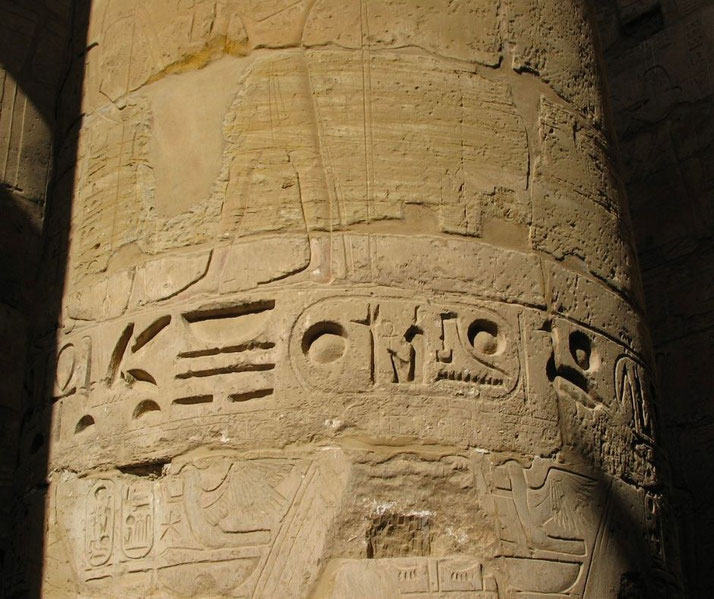
His cartouches can be seen carved on the great rock temples of Abu Simbel, where the prenomen appears alongside solar symbols.
The Nomen (Birth Name)
Alongside the throne name, the pharaoh usually kept a personal name, or nomen, introduced by the phrase “Son of Ra.”
Although it began as the name given at birth, kings often modified it to reflect religious or political intentions once they came to power.
Since it appeared in a cartouche like the prenomen, it held both ceremonial and public weight, and the mention of Ra highlighted the solar religious ideas that had become central to sacred kingship during the New Kingdom.
One of the most dramatic changes occurred when Amenhotep IV became Akhenaten, a name that tied him to the Aten and marked a complete religious transformation.
Others used their nomen to signal devotion toward specific gods, and, for example, Seti I had the nomen “Seti Merenptah,” which meant “Seti, beloved of Ptah,” and which expressed devotion to the Memphite deity while preserving dynastic continuity.
Since the nomen retained a connection to the king’s family identity, it often humanised the sacred figure and helped preserve dynastic memory across generations.
In many cases, the full titulary, including Horus, Nebty, Golden Horus, prenomen, and nomen, was carved in temple reliefs, and this allows modern historians to understand royal ideas through temple inscriptions and other artwork.