
The Mykonos Vase and the earliest known depiction of the Trojan Horse
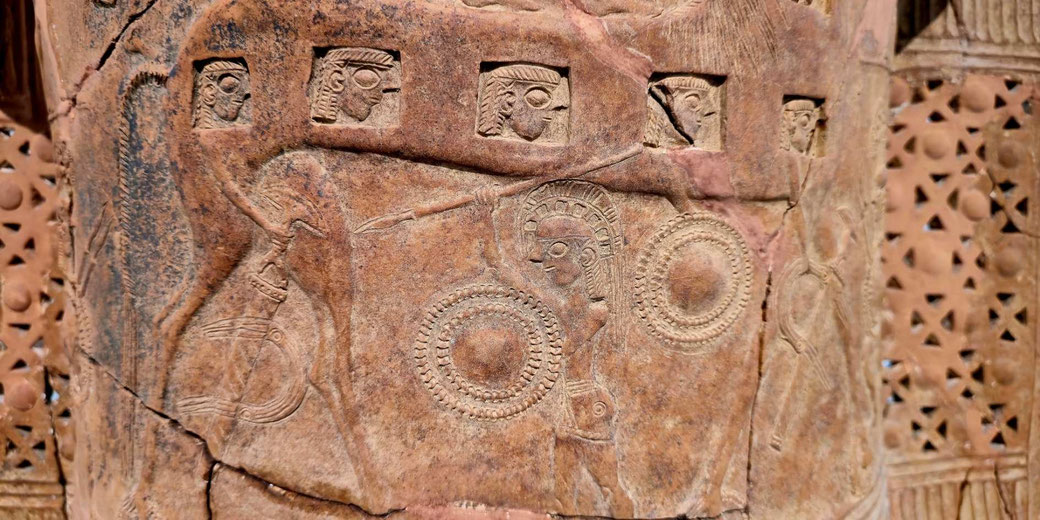
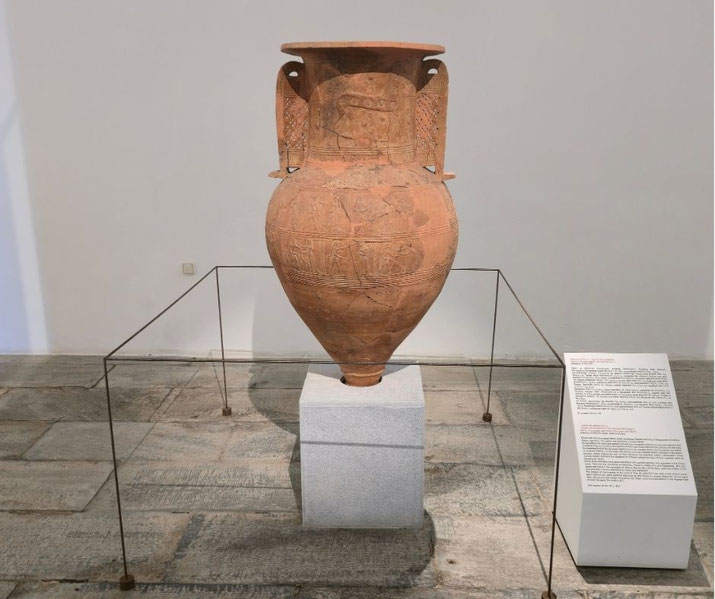
In the summer of 1961, a resident of the Greek island of Mykonos struck something solid as he dug a well near the centre of town: a terracotta storage jar, standing 1.34 metres tall, with human bones sealed inside and scenes of warfare moulded across its surface.
The jar dates to approximately 675 BCE and belongs to the Archaic period of Greek art, an era when the Homeric epics were first being written down and artists across the Cyclades were beginning to depict mythological stories on pottery.
Known today as the 'Mykonos Vase', the vessel is extraordinary because its neck carries the oldest confirmed image of the Trojan Horse, connecting the literary tradition of the Iliupersis directly to the visual culture of seventh-century BCE Greece.
An accidental discovery on a Cycladic island
According to local accounts, the man who found the pithos did not immediately report it to the Greek Archaeological Service because he feared the state would expropriate his land to conduct further excavations.
An archaeologist later noticed fragments of the vessel by chance, and the significance of the find became clear.
Miriam Ervin published the first scholarly study of the vase in 1963 in the journal Archaiologikon Deltion, where she catalogued its relief decoration and identified it as part of an established tradition of decorated storage jars from the Cycladic islands.
The pithos is now housed in the Archaeological Museum of Mykonos. It belongs to a category of pottery known as the Tenian-Boiotian group, named after the islands and regions where similar relief pithoi have been found.
Most scholars now believe that the primary production centre for these vessels was the island of Tenos, since the earliest examples of figured relief pithoi were discovered there during excavations at the fortified settlement of Xobourgo.
Craftspeople from Tenos likely travelled to other islands as itinerant potters, carrying their techniques with them, which explains why similar jars appear in locations as distant as Boiotia on the Greek mainland.
The Mykonos Vase is one of the finest known examples from this tradition, and its subject matter is considerably more ambitious than the usual decorative motifs found on other pithoi of the same class.
What does the Trojan Horse scene actually show?
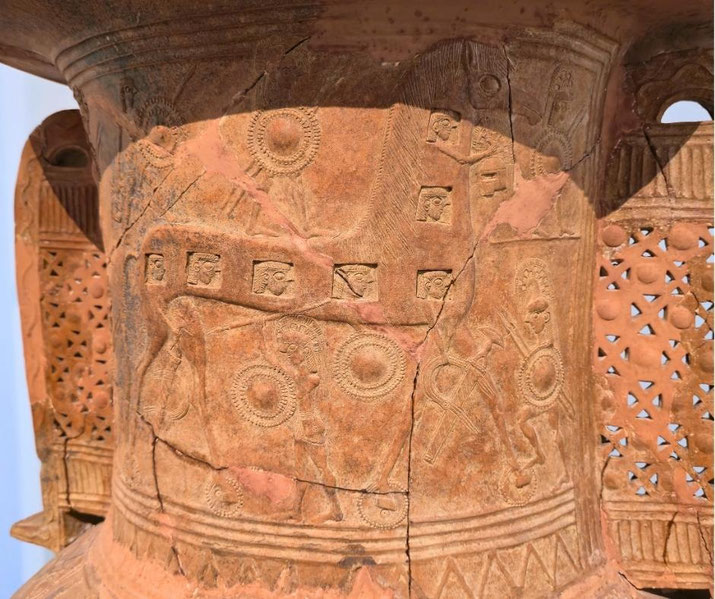
On the neck of the pithos, between the two handles, the artist moulded a large relief of the wooden horse.
The horse has a tubular body with a high straight neck and a small head, and wheels are set beneath its hooves.
Seven small square windows, sometimes called portholes, punctuate the horse's flanks, and through each one the face of an armed Greek warrior is visible, ready to descend.
Seven additional warriors surround the horse on the outside, identifiable by their rounded bossed shields and spears.
Scholars have tentatively identified one figure near the horse as Odysseus, who appears to be receiving a sword from a companion, and another figure positioned beneath the horse's belly may be Neoptolemus, the son of Achilles, holding a spear upright.
Beneath the neck scene, the body of the vase is divided into three horizontal registers containing a total of nineteen individual panels, or metopes.
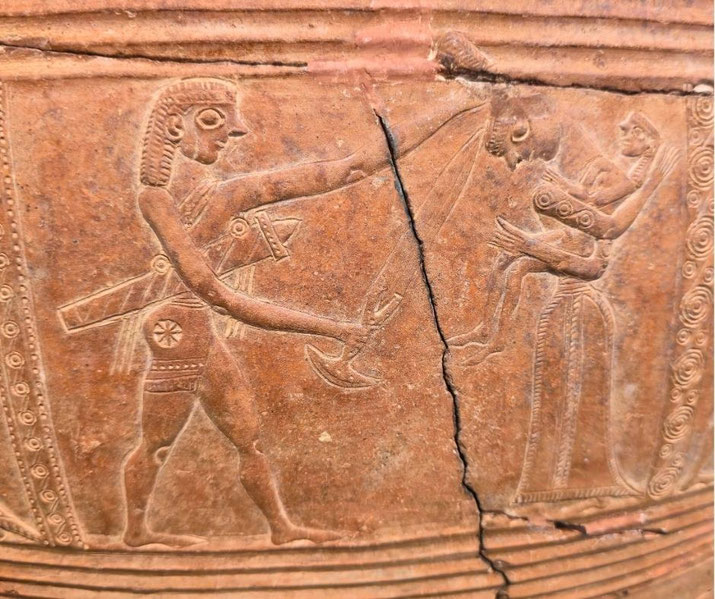
Each metope depicts a separate vignette from the sack of Troy. The warriors in these lower panels no longer carry shields, and they are shown attacking Trojan women and children, whose long flowing hair and raised hands convey visible distress.
One recognisable scene appears to show the infant Astyanax, the son of Hector and Andromache, being seized by the ankle, a moment described in the lost Epic Cycle poem known as the Little Iliad, attributed to the poet Lesches of Pyrrha.
The lower portion of the vase is left entirely undecorated.
Why did the artist focus on women and children?
As a depiction of the Iliupersis, the Mykonos Vase takes an unusual approach. No Trojan male warriors appear anywhere on the vessel.
Every victim is either a woman or a child, and every aggressor is a Greek soldier.
The artist made a deliberate choice to present the sack of Troy as a systematic massacre of defenceless civilians.
Since the Trojan War stories were well known in the seventh century BCE, any viewer of the pithos would have understood that Troy's male defenders were already dead by the time the horse was opened, which makes the imagery all the more confronting.
Three metopes are distinctive because they isolate individual figures from the surrounding violence.
At the far right of the middle register, a lone warrior draws his sword and advances.
At the far left, a solitary woman clasps her hands to her chest in a gesture of despair.
Directly below the horse, in the centre of the panel arrangement, a single fallen warrior lies crumpled over his shield, stabbed in the neck, reaching for his scabbard with his right hand.
The identity of this central figure is unknown: he may be Greek or Trojan. By placing this ambiguous figure at the visual centre of the composition, the artist appears to comment on the shared fate of all combatants, regardless of which side they fought on.
War, in this reading, destroys everyone it touches.
A warning for seventh-century aristocrats?
One of the most compelling scholarly interpretations of the Mykonos Vase was proposed by Susanne Ebbinghaus in a 2005 article published in the Journal of Hellenic Studies, titled "Protector of the City, or the Art of Storage in Early Greece."
Ebbinghaus argued that relief pithoi of the Tenian-Boiotian group were, in her analysis, a form of "conspicuous storage" that communicated the wealth and social status of the household that owned them.
In the seventh century BCE, aristocratic families depended on stored agricultural surpluses as the foundation of their social power, and a richly decorated pithos advertised that power to anyone who entered the home.
Ebbinghaus went further by arguing that the imagery on the Mykonos Vase carried a moral message directed at the aristocratic elite.
Since the scenes show what happens when a city's leaders fail to protect their people, the vase operated as a kind of cautionary guide.
The men are slaughtered, and their children are murdered. The women and girls are taken as slaves.
Ancient Greek epic literature, particularly the Iliad, treated these consequences as the inevitable result of military defeat, and the Mykonos Vase translates that literary idea into visual form.
Euripides would later explore the same themes when he wrote The Trojan Women in 415 BCE, depicting the suffering of Hecuba and Andromache after Troy's fall, but the Mykonos Vase had already presented that perspective more than two centuries earlier.
The vase also has value as evidence for the transmission of the Trojan War stories during the seventh century BCE.
The Homeric epics were composed around this period, and the lost poems of the Epic Cycle, including the Iliupersis attributed to Arctinus of Miletus and the Little Iliad attributed to Lesches of Pyrrha, were likely taking their written form at roughly the same time.
So, the Mykonos Vase demonstrates that the story of the wooden horse and the sack of Troy was already well established in the Cycladic artistic imagination by 675 BCE, providing independent visual evidence that these stories circulated widely before they were recorded in writing.