
What was the ancient Greek myth of the terrifying Minotaur?

Among the myths of ancient Greece, few stories frightened audiences as much as that of the Minotaur. Firmly based in the palace culture of Bronze Age Crete, the myth told of a monstrous mix of man and bull, which was hidden within a wide, twisting underground maze and fed on human flesh.
The tale combined punishment from the gods with a story of unnatural desire that led to political humiliation, and it explained how a foreign king forced Athens to send its children to die, until one young hero entered the darkness and killed the beast.
King Minos, Queen Pasiphae, and the bull from the sea
According to Greek sources, Minos ruled the island of Crete and claimed that the gods had chosen him to govern.
To prove he had the gods' favour, he vowed to sacrifice whatever creature the sea delivered as a sign.
Soon after, Poseidon sent a brilliant white bull that rose from the waves. Minos had accepted the creature and displayed it to the people, and then he defied the god by sparing the animal and offering a lesser bull in its place.
As a direct result of this broken promise, Poseidon put a curse on Minos’ household.
Specifically, he caused Queen Pasiphae to develop an overwhelming desire for the very bull her husband had refused to sacrifice.
Faced with this unnatural urge, Pasiphae turned to Daedalus, a skilled inventor who was associated with Athens in some traditions and had taken refuge at the Cretan court.
At her request, Daedalus had built a hollow wooden cow, which allowed her to conceal herself inside and mate with the animal.
From this act came a creature with the body of a man and the head of a bull, a being that caused horror even among the gods.
To hide the monster and contain its threat, Minos ordered Daedalus to build a prison so confusing that no one who entered could escape.
In response, Daedalus designed the Labyrinth, a massive underground maze beneath the palace at Knossos.
The creature was later named the Minotaur, a name that means “bull of Minos”, and it roamed its halls, hidden from view and feared by all who spoke of it.
The term “Minotaur” was a later Greek invention, and the creature originally had no personal name.

Why the Minotaur consumed young Athenians
After the death of his son Androgeos, who had travelled to Athens and died under suspicious circumstances, Minos blamed the Athenians and declared war.
After his victory, he imposed a cruel penalty. Every nine years, according to some versions every year, the city of Athens had to send seven young men and seven young women to Crete.
Once they arrived, the captives were forced into the Labyrinth, where the Minotaur hunted and devoured them.
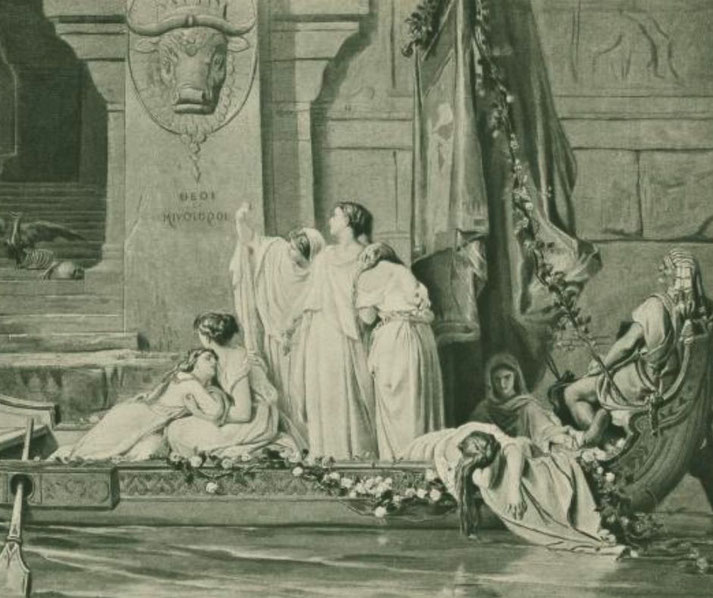
For the Athenians, the selection of victims involved noble households, and the drawing of lots created a public scene of sorrow.
As the ship with black sails left the port, families wept, and they knew that their sons and daughters would never return.
According to Plutarch, the sacrifices came to be seen as a symbol of foreign humiliation, with the Labyrinth serving as a place where Athenian youths vanished without trace.
Some scholars believe this part of the myth may reflect older political arrangements during the Late Bronze Age, when Crete likely exercised influence over parts of mainland Greece, possibly demanding hostages or tribute.
Importantly, the myth can be read as turning the act of sacrifice into a statement of power.
By forcing Athens to surrender its youth, Minos reinforced his control and reminded the mainland of its weakness.
How Theseus killed the Minotaur
At the time of the third tribute, the young prince Theseus volunteered to be among those who were sent to Crete.
As the son of King Aegeus, he vowed to end the suffering of his people by killing the Minotaur.
Before he departed, he promised that if he returned alive, he would replace the ship’s black sails with white ones so his father would know he had succeeded.
Soon after he arrived, Theseus caught the attention of Ariadne, the daughter of King Minos and Queen Pasiphae.
Struck by love and pity, she resolved to help him survive. She asked Daedalus for advice, and he gave her a ball of thread and told her to tie one end at the entrance of the Labyrinth so that Theseus could find his way back after confronting the beast.
On the day of the sacrifice, Theseus entered the maze and unwound the thread as he went.
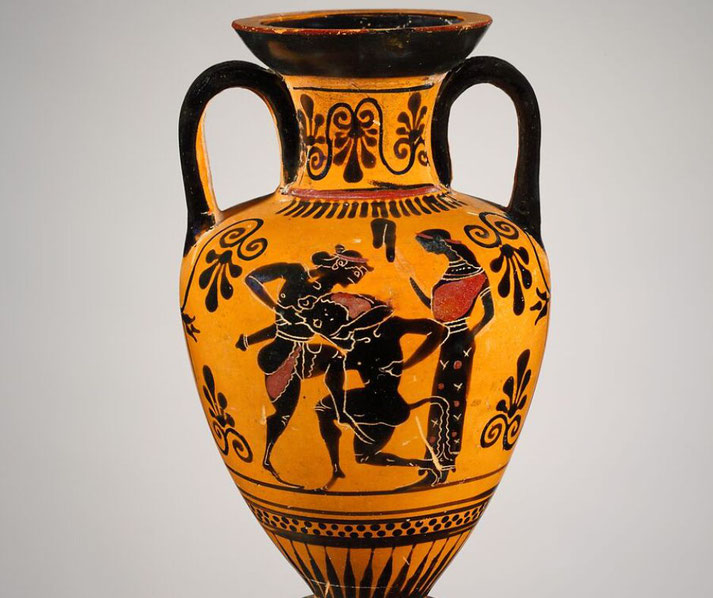
Eventually, he found the Minotaur. Accounts differ on the exact nature of the battle, but most describe a hand-to-hand struggle within the twisting passages.
Theseus used either a sword given to him by Ariadne or a club he had brought himself, and he managed to kill the creature.
He then followed the thread back to the entrance and gathered the other Athenian captives before escaping Crete with Ariadne by night.
According to many versions of the myth, he later abandoned Ariadne on the island of Naxos, where the god Dionysus found her and made her his wife.
On his return voyage, Theseus forgot to raise the white sails, and from the cliffs of Athens, King Aegeus saw the black sails and believed his son had died, so he threw himself into the sea that would later bear his name.
What was the meaning of the Minotaur Myth?
At its core, the Minotaur myth seemed to warn of the consequences of broken oaths and unchecked pride.
By refusing to honour his promise to Poseidon, Minos set off a curse from the gods that brought disgrace to his family and horror to his people.
Within the story, Pasiphae’s unnatural union and the birth of the Minotaur provided a warning about the destruction caused when rulers acted without restraint or reverence.
For Athenians, the tale also likely offered a story of redemption and national pride.
During the Late Bronze Age, Crete may have dominated parts of the Aegean, and the myth preserved memories of Athenian submission.
However, by placing Theseus at the centre, later storytellers transformed a story of defeat into one of triumph.
The prince who entered the Labyrinth brought freedom to the captives and to his entire city.
The Labyrinth itself seems to have held special meaning. As a building with no clear way out, it signified the loss of control and the terror of being consumed by a force that could not be reasoned with.
Some scholars suggest the word “Labyrinth” may derive from the Lydian term labrys, which means “double axe,” a symbol that was closely associated with Minoan palace culture.
Did the Minotaur ever exist?
Although no direct evidence supports the existence of a literal Minotaur, the ruins of Knossos helped explain why the myth may have taken root.
When Sir Arthur Evans began excavating the palace in 1900, he discovered a complicated layout of rooms that joined onto each other and winding corridors.
To modern eyes, the structure resembled a maze, which made it easy to associate with the Labyrinth.
Many rooms contained images of bulls, and several frescoes showed young men and women who did daring jumps over their backs.
Other bull imagery, such as what Evans called the “Horns of Consecration”, has often been taken to suggest the ceremonial importance of the animal in Minoan religious life, although the interpretation of their meaning is still debated.
For some scholars, these bull-leaping rituals indicated that the animal held ceremonial importance in Minoan religion.
When scholars set this cultural role beside the presence of impressive palace buildings, they argue that the Greeks may have preserved older memories in mythic form.
Stories of youths who were sent to Crete could have originated from real political arrangements that involved tribute, trade, or even hostages, later recast in horrifying detail.
Though no creature matched the Minotaur’s description, and no evidence confirms human sacrifice, the myth lasted because it explained emotions and fears rather than telling a true historical event.