
The role of the legendary El Cid during the Spanish Reconquista
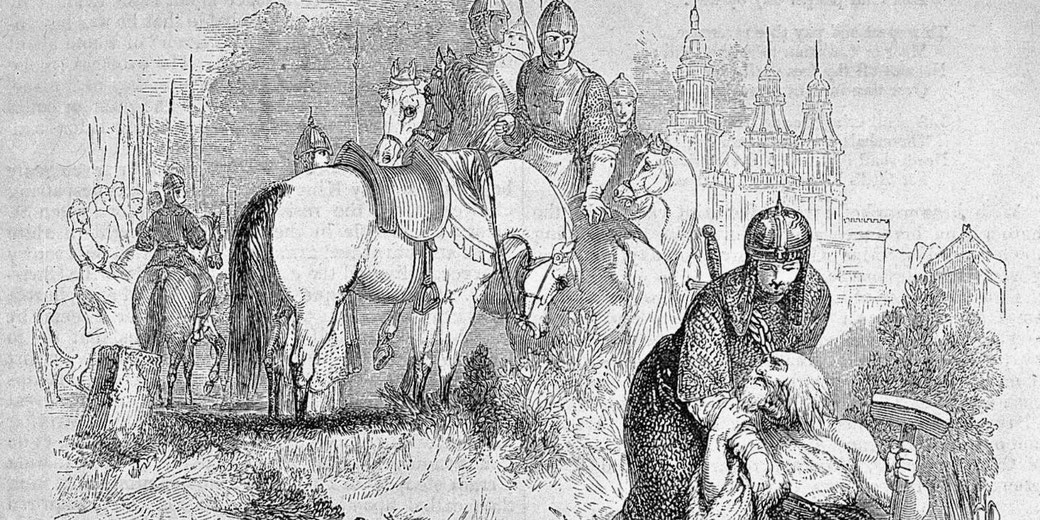
In 1094, a Castilian knight who had been banished from his own kingdom rode into the conquered city of Valencia as its new ruler, and he commanded an army of Christians as well as Muslims.
Rodrigo Díaz de Vivar, who was known to history as El Cid, had turned exile into opportunity, and he forged a personal dominion on the Mediterranean coast at a time when the boundaries between Christian and Muslim power were constantly shifting.
His career tells us something important about the Reconquista itself: that this centuries-long struggle was arguably never a simple contest between two faiths, but was instead an opportunistic affair in which military skill often mattered more than religion.
A minor noble in a world of warring kings
Born around 1043 in the village of Vivar, roughly ten kilometres north of Burgos, Rodrigo Díaz came from the lower tier of the Castilian nobility.
His father, Diego Laínez, was a cavalryman as well as a minor court official who had fought in frontier skirmishes during the 1050s.
Through his mother's aristocratic connections, the young Rodrigo secured a place in the household of Prince Sancho, who was the eldest son of King Ferdinand I of Castile, where he received a thorough military education in horsemanship and combat as well as literacy in both Latin and Arabic.
When Sancho became King Sancho II of Castile in 1065, he appointed the twenty-two-year-old Rodrigo as his armiger regis, or standard-bearer, and this effectively made him commander of the royal army.
In 1067, the pair campaigned against the Moorish kingdom of Zaragoza, and they forced its emir, al-Muqtadir, to become a tributary vassal of Castile.
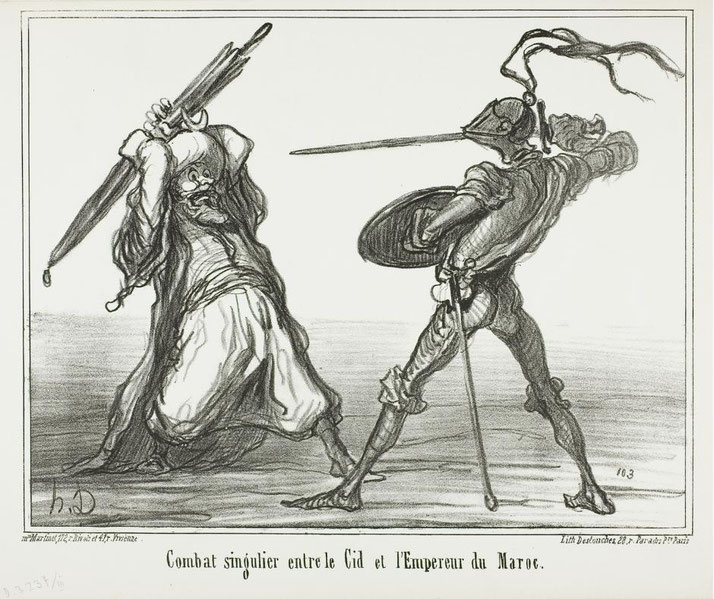
At the Battle of Graus in 1063, Rodrigo had already earned a considerable reputation by reportedly killing an Aragonese knight in single combat, which was a feat that earned him the title "Campeador," from the Latin campidoctor, which meant "master of the battlefield."
Exile and the service of Muslim rulers
After Sancho II was assassinated during the siege of Zamora in 1072, the throne passed to his brother Alfonso VI, who was the very man that Rodrigo had helped to dethrone.
Alfonso allowed Rodrigo to stay at court and arranged his marriage in 1074 to Jimena Díaz, who was a noblewoman of the Asturian royal family.
Rodrigo's position was, however, precarious, because powerful nobles such as Count García Ordóñez resented his influence.
In 1079, Alfonso sent Rodrigo to the taifa of Seville to collect tribute payments that were known as parias.
During that mission, war broke out between the taifas of Seville and Granada, and Rodrigo commanded Christian troops in defence of Seville.
At the Battle of Cabra, he routed the Granadan army and captured García Ordóñez. Alfonso, who was furious at what he considered an unauthorised expedition, exiled Rodrigo from Castile in 1081.
After Barcelona's rulers had refused his offer of service, Rodrigo travelled to the taifa of Zaragoza, where the Muslim king Yusuf al-Mu'taman ibn Hud welcomed him.
For roughly five years, Rodrigo led Zaragoza's armies against the forces of Aragon as well as Barcelona.
In 1082, he defeated Count Berenguer Ramón II of Barcelona at the Battle of Almenar and held him captive for a time.
During this period, his Muslim soldiers began calling him al-Sayyid, which meant "the lord," and this later became the Castilianised title El Cid.
His willingness to fight for a Muslim ruler highlights a key truth about eleventh-century Iberia: military alliances frequently crossed religious lines, and capable warriors could find employment with any ruler who was willing to pay.
The Almoravid invasion and the road to Valencia
In 1086, a new threat arrived from North Africa. The Almoravids were a movement of Berber warriors who were committed to a strict interpretation of Islam, and they crossed the Strait of Gibraltar at the invitation of several taifa rulers who feared Alfonso VI.
On 23 October 1086, the Almoravid commander Yusuf ibn Tashfin inflicted a crushing defeat on Alfonso at the Battle of Sagrajas, near Badajoz.
Alfonso was panicked by this disaster, and he recalled Rodrigo from exile in 1087, and rewarded him with lands as well as the fortress of Gormaz.
The reconciliation proved short-lived. Rodrigo returned east, where he pursued his own strategic interests rather than joining Alfonso's campaigns.
His target was Valencia, which was one of the wealthiest cities on the Mediterranean coast, and which was then ruled by the Muslim king al-Qadir under the Cid's informal protection.
Before he moved on Valencia, Rodrigo needed to neutralise Barcelona's influence in the region, which he achieved through a second defeat of Berenguer Ramón II at the Battle of Tébar in May 1090.
Over the following two years, the Cid steadily tightened his control over Valencia and its tributary arrangements.
The conquest and defence of Valencia
In October 1092, a rebellion inside Valencia changed the situation dramatically.
The city's chief judge, Ibn Jahhaf, who was backed by Almoravid agents, murdered al-Qadir and seized power.
Rodrigo responded by laying siege to the city for many months, during which an Almoravid relief force attempted to break through in December 1093 and failed.
By May 1094, starvation forced Ibn Jahhaf to surrender. Rodrigo entered Valencia as its conqueror, and he quickly demonstrated the ruthlessness that accompanied his military brilliance: after he had initially offered Ibn Jahhaf a pardon, he had the former judge burned alive.
As ruler of Valencia, Rodrigo governed both the city's Christian and Muslim populations, and he acted as chief magistrate.
He converted the main mosque into a cathedral in 1096 and installed a French cleric who was named Jerome as its first bishop.
Rodrigo cemented his princely status through strategic marriages: his daughter Cristina married Ramiro of Monzón, who was an Aragonese prince, and his other daughter María married Ramón Berenguer III, who was the count of Barcelona.
The Almoravids did not accept the loss of Valencia. In 1094, shortly after the city's capture, a major Almoravid army advanced on Valencia.
Rodrigo met them on the plains of Cuarte and inflicted upon them one of their first serious defeats on Iberian soil, and he held Valencia against further incursions for the remaining five years of his life.
An afterlife larger than the man himself
Rodrigo Díaz de Vivar died on 10 July 1099. His wife Jimena took over the defence of Valencia, but the city proved impossible to hold without him.
Alfonso VI intervened personally, but he concluded that defending Valencia would require too many troops that were needed elsewhere.
He ordered the city evacuated and burned. On 5 May 1102, the Almoravids occupied the ruins; Valencia would not return to Christian control until 1238, when King James I of Aragon reconquered it.
After his death, Rodrigo was buried at the monastery of San Pedro de Cardeña, near Burgos, where his tomb became the centre of a popular cult.
Over the following century, poets transformed the mercenary into a romanticised hero.
The Cantar de mio Cid, which was an epic poem that had been composed around 1200, presented him as the ideal medieval knight who was loyal and pious above all else.
Much of this was likely invention, as the real Rodrigo had been a pragmatic warlord who had fought for Muslim rulers as readily as Christian ones and who had pursued personal power ahead of any religious cause.
The poem did, however, capture something true: that through sheer ability and a refusal to accept defeat, a minor nobleman from a small Castilian village could rise to rule one of the Mediterranean's great cities.
In that sense, the story of El Cid is really the story of the Reconquista in miniature: a struggle that was defined less by ideology than by the capabilities as well as the drives of individual men.