
The incredible underground churches of Lalibela
High in the Lasta Mountains of northern Ethiopia, beneath the rust-coloured volcanic plateau, a sacred architectural wonder exists where worship has largely continued for more than eight centuries.
Between the late 12th and early 13th centuries, under the rule of King Gebre Meskel Lalibela, who reigned from approximately 1181 to 1221 CE, a series of eleven main churches were carved directly from the earth to create a symbolic “New Jerusalem” for Ethiopian Christians who had lost access to the Holy Land.
According to tradition, angels aided the king’s craftsmen as they chiselled sanctuaries out of solid rock, but archaeological evidence points instead to the skill of local stonemasons who fashioned these monuments by hand with iron tools and remarkable geometric accuracy.
Why were the Lalibela churches built?
During a period of rule by the Zagwe royal family, King Lalibela aimed to create a religious centre that would rival the great holy sites of the Christian world.
According to the Gadla Lalibela, which is a religious biography compiled centuries later and whose name translates as “The Acts of Lalibela,” the king had received sacred instructions during a pilgrimage and returned determined to carve an entire group of churches from the living rock of his native highlands.
After 1187, when Muslim forces led by Saladin recaptured Jerusalem, Christian pilgrims from Ethiopia had found themselves cut off from the sacred shrines of the Levant.
In response, Lalibela turned to the red tuff of the Lasta region to create a symbolic replacement for Jerusalem in stone.
By establishing the site in a high and easy to defend position, he also strengthened the political power of the Zagwe dynasty.
At the same time, he positioned the site near a trade route that connected the remaining highland networks once associated with Aksum and Shewa, which helped ensure a steady flow of pilgrims and a degree of economic activity.
Over time, the churches helped turn Lalibela into an important spiritual and cultural centre, where kingship and faith reinforced each other under the authority of the Ethiopian Orthodox Tewahedo Church, which grew in influence over the centuries.
Some historians believe the churches also served as venues for royal liturgies, reinforcing the bond between God's favour and sovereign authority.
The remarkable architectural construction techniques
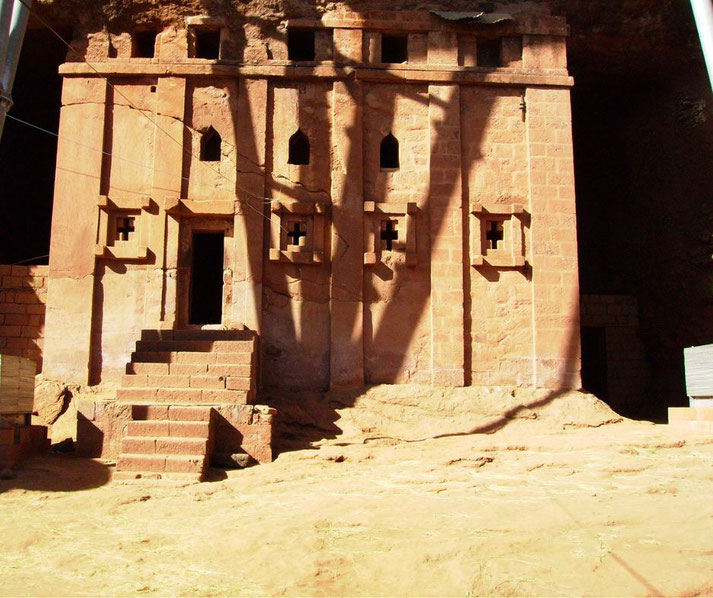
To create entire buildings out of solid stone, workers began by cutting deep trenches that isolated large blocks of rock from the surrounding bedrock.
Then, as they used chisels and hammers along with iron picks, they hollowed out interiors so that walls, columns, arches, and decorative carvings were fully integrated within a single monolithic mass.
Early on, artisans had to visualise the final structure from the roof down, as mistakes could not be reversed once excavation began.
The choice of volcanic tuff, which was soft enough to carve but strong enough to bear weight, made such an approach possible.
Archaeological investigations in the early 21st century have helped explain different stages of construction and the methods used by medieval artisans.
Importantly, builders incorporated both artistic and practical design. They carved drainage channels to prevent water damage and linked the churches with sunken walkways and concealed tunnels that allowed for processions and monastic movement.
In several churches, such as Bete Medhane Alem and Bete Maryam, builders replicated basilica layouts complete with internal columns and vaulted ceilings, with carved capitals added as ornament, although such features were structurally unnecessary in monolithic architecture.
Other churches, such as Bete Gabriel-Rufael and Bete Amanuel, contain design elements that resemble earlier Aksumite structures, and some scholars have suggested they may have been adapted from pre-existing or secular buildings.
As a result, the buildings showed both local traditions and wider Christian elements drawn from Coptic and potentially Byzantine influences, though direct connections to Byzantine architects or patrons remain speculative.

Religious symbolism and sacred design
Each of the eleven principal churches bears particular religious significance, and their layout shows careful symbolic planning.
On either side of a narrow channel known locally as the Jordan River, the two main clusters of churches suggest a sacred division between earthly and heavenly realms.
The positioning of the churches allowed pilgrims to follow a ritual path, progressing from outer chapels toward more sacred spaces where access was restricted to clergy and initiated monks.
Among the structures, Bete Medhane Alem is notable for its sheer size and impressive scale.
It measures over 33 metres in length and houses what many believe to be the Lalibela Cross, which is a highly valued processional crucifix cast in metal and often described as gold or bronze, rather than made of gold and ebony.
Meanwhile, Bete Maryam is believed to be the earliest of the churches and contains carved rosettes and biblical frescoes, together with a baptismal pool still used for holy rites.
While some frescoes appear to date from the original construction period, others may have been restored or added in later centuries.
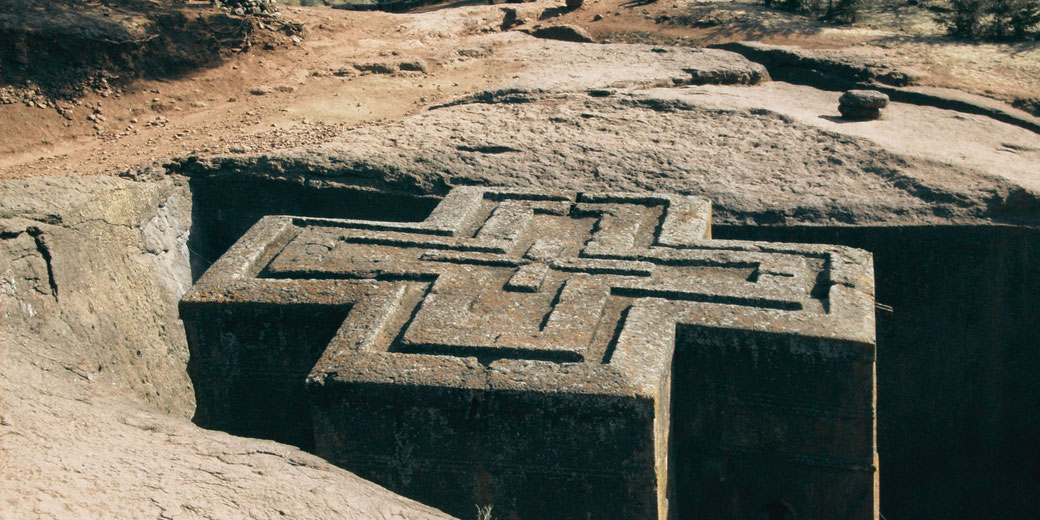
Most striking of all, Bete Giyorgis (House of St George) was cut into the form of a Greek cross and lies sunken more than 12 metres below the surface.
According to oral tradition, King Lalibela built it after receiving a vision from St George, who reproached him for failing to include a church in his honour.
Pilgrimage and monastic life
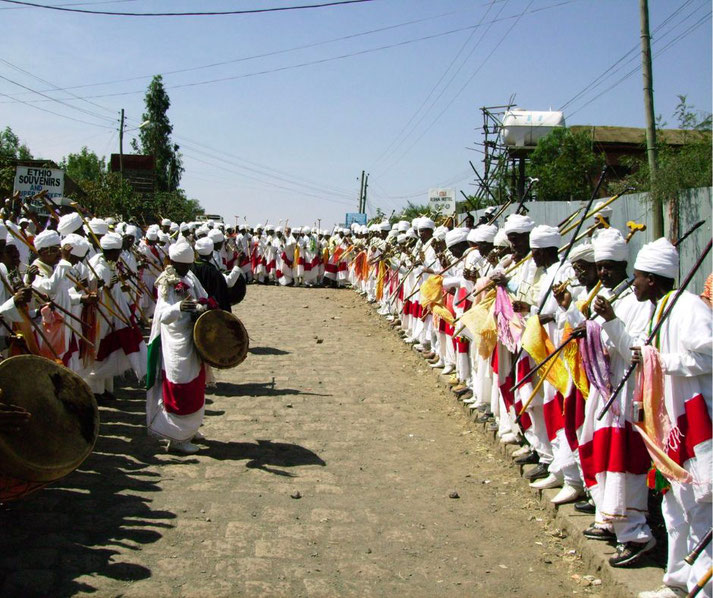
Early in the morning, priests clad in white robes chant prayers in the ancient Ge’ez language, a liturgical tongue no longer spoken in daily life but still central to Ethiopian Orthodox tradition, accompanied by rhythmic sistrum and drums.
Sacred manuscripts are kept in stone niches, and holy water drawn from baptismal pools is used in blessing rituals.
On major feast days such as Genna, which typically draws tens of thousands of pilgrims each January, worshippers crowd the site, filling narrow passageways and stone courtyards with hymns that echo across the walls.
Traditionally, monastic communities have grown in the rock shelters that surround the churches.
Many monks live in seclusion, where they study scripture and copy texts, and they also offer spiritual guidance.
Religious instruction passes orally from one generation to the next, with younger initiates who are trained in chant and doctrine, within a carefully maintained ceremonial tradition.
Although the number of clergy has declined in recent decades, the spiritual role of the site has largely continued without interruption.
In recognition of both its architectural significance and continuing religious use, UNESCO added Lalibela to the World Heritage list in 1978.
Since then, conservation projects have worked to stabilise exposed surfaces and protect the churches from water erosion and tourist impact.
The World Monuments Fund has partnered with local authorities to assist in these efforts, and temporary protective shelters were erected during the early 2000s to shield the most vulnerable structures.
Where possible, preservation efforts have been conducted in consultation with the clergy, who have emphasised that religious life should not be disrupted by outside interference.
Tourist visits are now regulated by a ticketing system, and access to some areas is restricted during liturgical celebrations.