
What was the Islamic Golden Age?
Between the eighth and thirteenth centuries, under Abbasid rule, the Islamic world experienced a long period of scientific and philosophical progress, alongside steady growth in literature centred in major cities such as Baghdad and Córdoba, as well as in Cairo, which became an important hub.
Often dated from around AD 750 to 1258, this era witnessed a large translation movement, an active network of scholars, and the creation of new ideas in many fields.
During this time, Muslim scholars in many cases preserved, translated, and expanded upon Greek and Persian knowledge, along with key Indian texts, which covered fields such as astronomy and mathematics, along with medicine.
Supported by wealthy patrons and caliphs who promoted scholarship, this intellectual growth influenced the Islamic world and also, to some extent, affected later European developments during the Renaissance.
The Abbasid Revolution and a new scholarly capital
After the Abbasids overthrew the Umayyads in AD 750, they had relocated the capital of the caliph from Damascus to Baghdad in AD 762.
Caliph al-Mansur founded the city with a circular layout inspired by Persian urban design, and its location along the Tigris River offered a strategic connection between Mediterranean trade routes and Persian commercial centres.
Over the following decades, the city had gradually grown into a large city that increasingly attracted merchants, poets, theologians, translators, and scientists from across an Islamic world that continued to expand.
Some medieval geographers claimed that by the tenth century, Baghdad had reached a population of more than one million, although modern estimates suggest several hundred thousand is more likely.
Crucially, the Abbasid caliphs in many cases invested heavily in the study and creation of new knowledge.
During the reigns of al-Mansur, Harun al-Rashid, and al-Ma’mun, libraries and observatories, together with a range of learning institutions, had generally received regular support.
For instance, caliphs imported texts from Byzantium, sponsored translations of Greek philosophy, and commissioned astronomical instruments.
As a result, Baghdad developed into a city of wealth and trade and became a centre of sustained intellectual activity across multiple disciplines.

The House of Wisdom
Though the beginnings of the House of Wisdom may date back to the reign of al-Mansur, it was under al-Ma’mun in the early ninth century that the institution developed into the centre of academic life in Baghdad.
Initially intended as a library and translation institute, it gradually evolved into a busy research centre where scholars gathered to work together on astronomical observations and mathematical theories, along with demanding philosophical questions.
Importantly, its translation movement preserved and spread many classical texts.
Translators such as Hunayn ibn Ishaq and Thābit ibn Qurra rendered Greek and Syriac works into Arabic, especially those of Galen, Ptolemy, and Aristotle.
Hunayn alone translated around 100 of Galen’s medical texts. The project also relied heavily on Nestorian Christian scholars who had preserved earlier manuscripts in Syriac.
Often, these translations included detailed commentaries or revisions that corrected earlier errors.
As a result, the scholars often actively developed them into new sets of ideas, particularly in fields that required measurement and categorisation, as well as carefully designed experimentation.
For example, the Banu Musa brothers contributed to geometry and mechanics, along with the design of automatic devices, such as those described in their Book of Ingenious Devices.
Scientific progress in mathematics and astronomy
By the early ninth century, mathematicians such as al-Khwarizmi had, to a significant extent, transformed arithmetic and algebra into distinct disciplines.
In his treatise Kitab al-Jabr wal-Muqabala, written around AD 820, he outlined procedures for solving equations by means of logical rules and introduced systematic methods that later became the foundation for modern algebra.
His works had also helped standardise the Hindu-Arabic numeral system, which replaced awkward numerical notations used in earlier Mediterranean cultures.
At the same time, astronomers further improved observations of planetary motion.
Scholars including al-Battani and al-Tusi calculated the solar year more accurately than Ptolemy had.
Al-Battani’s estimate was approximately 365 days, 5 hours, 46 minutes, 24 seconds, which was remarkably close to the modern value.
They also designed new astronomical tables and developed instruments, which included the astrolabe and quadrant.
Significantly, their measurements assisted in determining prayer times, navigation, and the Islamic calendar.
Although driven by religious necessity, their work met scientific standards based on repeated observation and predictive accuracy.
In medicine, physicians often applied careful observation to diagnosis and treatment.
Al-Razi’s al-Hawi collected case studies and critiques of earlier authorities, which included a clinical distinction between smallpox and measles.
Ibn Sina’s Canon of Medicine carefully organised knowledge on anatomy and pathology, as well as pharmacology.
Both works stayed standard references in Europe and the Islamic world for many centuries, particularly in university settings where Latin translations circulated widely, for example at institutions such as Montpellier and Bologna.
Philosophy and literature
While scholars studied science, others explored questions about reality and logic derived from Greek philosophy.
Al-Kindi worked in Baghdad during the ninth century and used Aristotelian logic to support Islamic theology, and he emphasised that reasoned study could work together with revelation from God.
His works included treatises such as On the Use of the Indian Numerals. Later, al-Farabi and Ibn Sina expanded upon these methods by constructing metaphysical systems that explained the relationship between God and intellect, together with the natural world, by means of step-by-step logical reasoning.
Al-Farabi alone reportedly wrote over 100 works, including The Virtuous City.
Equally influential, Ibn Rushd (Averroes) in twelfth-century al-Andalus challenged religious limits on philosophical inquiry.
In his commentaries on Aristotle, he argued that reason was necessary to understand God's truth and should not be treated as less important than a literal interpretation of scripture.
His writings were translated into Latin and Hebrew, where they sparked intense debate among medieval Christian and Jewish thinkers in Europe, including Albertus Magnus and Thomas Aquinas.
In literature, courts and gathering places in the cities often hosted poets who composed works on love and satire, as well as themes of heroism.
Poets such as Abu Nuwas with his daring and playful style and al-Mutanabbi with his classical Arabic form created verses that circulated widely in manuscript form.
Meanwhile, collections like One Thousand and One Nights, which developed over several centuries and reached a more familiar compiled form by the Mamluk period, blended Persian and Arabic storytelling traditions to produce stories within stories that entertained audiences from Cairo to Samarkand.
Art, architecture, and urban innovation
Under the Abbasids and later regional rulers, architecture in many regions evolved to express both spiritual devotion and technical change.
The Great Mosque of Córdoba, begun in AD 785 under Abd al-Rahman I, featured double-tiered arches and a richly decorated mihrab, while the Abbasid-built mosque of Samarra included the massive Malwiya spiral minaret, completed in the mid-ninth century and rising to around 52 metres.
Builders often incorporated Byzantine mosaics and Sassanian layouts, together with locally available materials to construct religious and public structures that met both aesthetic and functional needs.
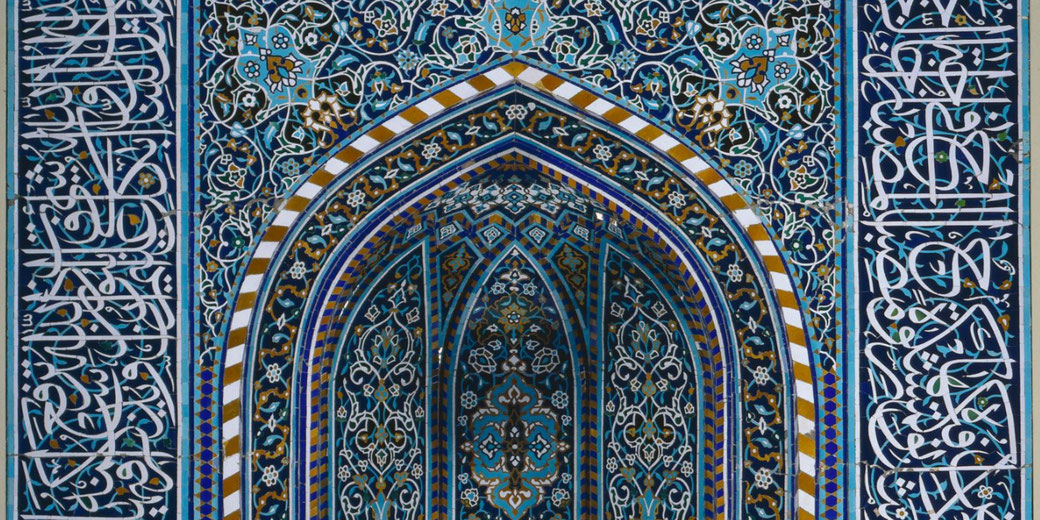
In visual art, Islamic culture focused on geometric pattern and plant designs, alongside calligraphy.
Since religious doctrine discouraged images of people and animals in sacred settings, artisans developed decorative styles that required mathematical planning and artistic discipline.
Calligraphers elevated Arabic script to an art form used in Qur’ans, architectural inscriptions, and court documents, especially in Kufic, Naskh, and Thuluth styles.
In many cities, planners introduced organised layouts, with commercial quarters, public baths, and fountains integrated into daily life.
City officials often regulated street lighting, water distribution, and waste management.
Supported by waqf endowments, hospitals and schools together with libraries provided services to the poor and the learned alike, which showed the importance of charitable responsibility in Islamic law.
Documents from cities such as Cairo and Jerusalem show detailed waqf arrangements, which funded medical and educational services.
Why did the Islamic Golden Age come to an end?
By the mid-thirteenth century, political fragmentation and foreign invasions, together with administrative decline, had severely disrupted scholarly life.
Most devastatingly, the Mongol siege and sack of Baghdad on 10 February 1258 destroyed libraries, observatories, and learning institutions, ending the city’s position as a central hub of scholarship.
Although other centres such as Cairo and Shiraz continued many intellectual traditions, the pan-Islamic scholarly networks that had supported the Golden Age no longer operated with the same unity or size.
Even so, Arabic texts had already travelled westward, and from the eleventh century onward translators in Sicily and Spain rendered Arabic medical and mathematical texts, together with philosophical works, into Latin.
For example, Gerard of Cremona had translated over 90 works, which included works by Ibn Sina, al-Khwarizmi, and al-Razi.
These translations helped reintroduce lost Greek knowledge to Europe and also introduced original Islamic contributions that strongly influenced European science and learning during the twelfth-century Renaissance and the later Scientific Revolution.
Many of these Arabic works eventually became central to the Quadrivium, which included arithmetic, geometry, astronomy, and music, in medieval European education.
Through this long intellectual effort, the scholars and poets of the Islamic Golden Age and its scientists helped create a tradition based on curiosity and careful study, as well as careful transmission.
Their methods, manuscripts, and observations continued in use for centuries and influenced thinkers across cultures who worked to understand the world using observation and logic, together with structured learning.