
The tragic murder of the young girl Iphigenia: Human sacrifice in Ancient Greece
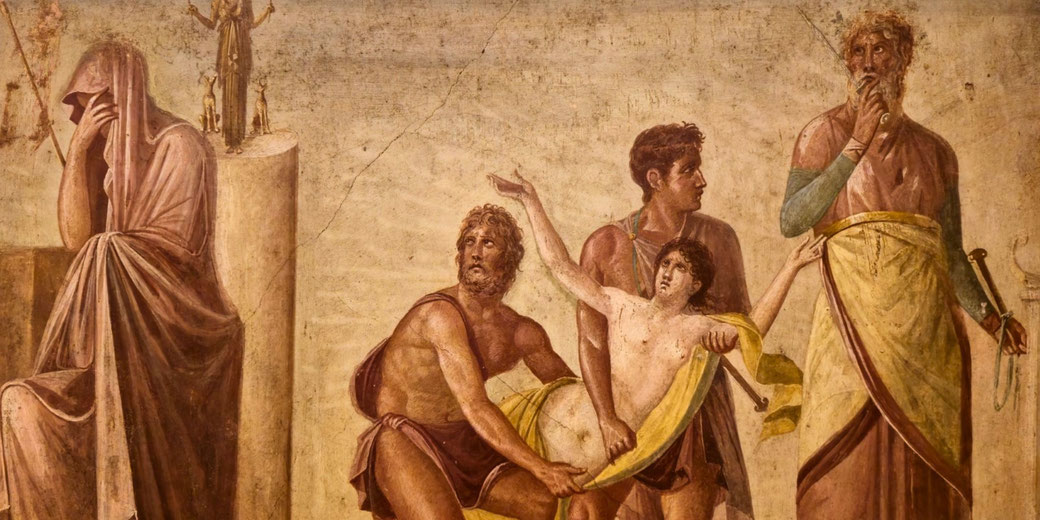
In the late mythological tradition of the Greek world, one girl’s name became known not for what she accomplished, but for the silence that followed her death.
Iphigenia, who was the daughter of Agamemnon and Clytemnestra, was led to slaughter at Aulis so the Greek fleet could sail to war.
Her story, recorded in tragedy and ritual memory, seemed to show an ancient belief that the anger of the gods could, in extreme cases, be calmed by innocent blood.
The terrible curse on the House of Atreus
According to Greek myth, the House of Atreus carried a history of betrayal and murder under punishment from the gods.
Agamemnon, who was its most powerful figure in the late heroic age, inherited the role of high king and led the Achaean forces against Troy after Helen’s abduction.
After the Greek leaders had sworn an oath to defend Menelaus’ marriage, Agamemnon gathered the army at Aulis, where hundreds of ships waited to cross the Aegean.
According to later ancient writers, the Trojan War was believed to have occurred in the decades around 1200 BCE, near the end of the Late Bronze Age.
For some time, the winds failed to rise, and the soldiers, increasingly restless, demanded answers.
According to the seer Calchas, Artemis had withheld favourable winds after Agamemnon had either killed one of her sacred deer or compared his hunting skills to hers.
In response, she demanded the sacrifice of his daughter Iphigenia. Seers like Calchas held a lot of authority in Greek warfare, and they often interpreted omens and advised commanders on the will of the gods.
The fleet could not move, and supplies began to run low, and the military leaders urged Agamemnon to obey the oracle.
Under growing pressure, he agreed to the unthinkable.
To bring Iphigenia to Aulis, he sent word to Clytemnestra that their daughter would marry Achilles.
She had arrived with joy, but her hopes collapsed when the truth became clear.
The wedding had been a lie. Some later traditions placed the blame entirely on Calchas, but most versions of the myth left no doubt that Agamemnon knew what he ordered.
According to Euripides, the girl eventually offered herself willingly to die for the success of the Greek army.
He dramatised this event in his Iphigenia at Aulis, first performed around 405 BCE.
Aeschylus, who wrote about this in a passage from Agamemnon, described the sacrifice in indirect terms, referring to a daughter gagged and carried to the altar, a scene widely interpreted by ancient and modern audiences as a reference to Iphigenia.
Sophocles may have written a version of the myth as well, though no full text has survived and the attribution remains uncertain.
The sacrifice at Aulis
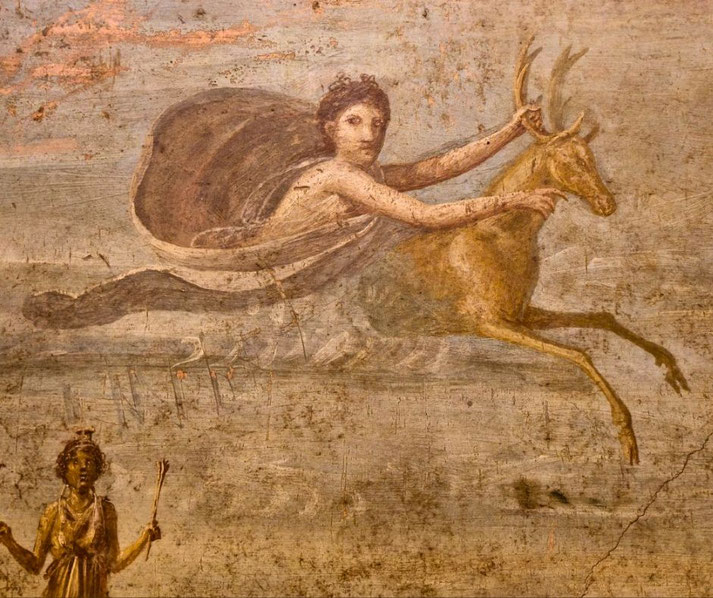
At the moment of death, some claimed that Artemis replaced the girl with a deer and carried her away to the distant land of Tauris.
There, Iphigenia held the role of the goddess’ priestess and took charge of new sacrifices.
However, earlier sources usually did not include any rescue. Instead, they described a religious killing performed by the priests, watched by Greek warriors who had convinced themselves that the death of one child was justified by the promise of victory.
The Apulian red-figure volute krater by the Darius Painter (Naples, Museo Archeologico Nazionale, Inv. 81947) shows one version of the story, with Iphigenia near the altar with Artemis and a deer, which matches the version in which the goddess intervened.
Clearly, the myth of Iphigenia held a mirror to the darkest side of religious belief.
Ancient audiences heard the story as a warning about what people might do when fear and power collided with claims of orders from the gods, and they did not treat it as a defence of murder.
When the story placed a child on the altar, the myth forced its audience to face the limits of duty and exposed the cold reasoning behind collective violence.
Human sacrifice in Greek religion
Ordinary Greek rituals normally did not involve human blood. City-states held public festivals where animals were killed and hymns were sung, with offerings burned to honour the gods.
Priests and officials managed these rites according to strict rules, and any act of violence against a person inside a sanctuary could lead to legal or divine punishment.
However, myth allowed Greek authors to look at situations where human sacrifice could be imagined without saying it was right.
Importantly, stories of extreme or wartime sacrifices sometimes appeared in several well-known myths.
Homer described how Achilles killed twelve Trojan captives over Patroclus’ grave.
In another tradition, Polyxena was slain by the Greeks to honour Achilles after his death.
Euripides’ plays included multiple scenes where sacrifice became a test of loyalty or power, particularly in moments where personal survival threatened to interfere with religious or political goals.
His Iphigenia in Tauris was composed around 414 BCE and imagined the survival of Iphigenia and her role in a distant land where she oversaw the ritual killing of strangers.
In rare cases, writers like Herodotus included claims about real human sacrifices.
He described reported instances where leaders or generals killed enemies or captives in ways that looked like a ritual.
For example, he reported that Themistocles offered Persian prisoners in sacrifice to Dionysus Carnivorous before the Battle of Salamis (Histories 8.90), though he brought in the story with the phrase “they say,” showing that it came from rumour rather than from confirmed facts.
Some of these stories involved non-Greek peoples, though he occasionally suggested that such acts had taken place among Greeks in the distant past.
In Sparta, ritual beatings at the altar of Artemis Orthia were also recorded and may have started in earlier rites involving blood offerings, though this interpretation remains debated among scholars.
From an archaeological point of view, evidence for actual human sacrifice in ancient Greece is still unclear.
At the Minoan site of Anemospilia, excavators led by Yannis Sakellarakis in 1979 found the skeleton of a young man on an altar, along with signs of sudden destruction.
Scholars still disagree about how to explain this find, and some believe it may be the best example of a ritual murder that we have, possibly carried out just before an earthquake destroyed the building.
Others argue that the death may have resulted from the disaster itself or may reflect execution or punishment rather than sacrificial ritual.
The legacy of Iphigenia
Across later Greek literature, the memory of Iphigenia often guided poets and philosophers as they wrote about justice handed down by the gods and female obedience, and it gave playwrights a way to examine the moral cost of war.
Aeschylus used her death to explain Clytemnestra’s murder of Agamemnon in the Oresteia, and this created a chain of revenge that ended only with the intervention of Athena.
Euripides gave her a voice in tragedy so that she could accept her death with dignity, only to later revive her in Iphigenia in Tauris to explore her survival and her role as a priestess.
Her name appeared again in Roman poetry, where her sacrifice was a symbol of cruelty masked as honour, and Ovid referred to her in both the Metamorphoses and the Heroides, often casting her as a figure caught between duty and injustice.
Artists in the classical period had depicted her on red-figure vases, where she often stood beside the altar with Artemis and a deer.
Later painters in the Renaissance and Enlightenment often returned to her image as part of a wider interest in classical virtue and martyrdom.
In the seventeenth century, Jean Racine’s Iphigénie presented her as an example of a loyal daughter, while in the twentieth century, Christa Wolf used the myth in Cassandra to explore the emotional harm that war caused women and the ways they tried to fight back during wartime.
Occasionally, modern adaptations have revived her story to explore the abuse of children during conflict or the silence of women in male-dominated religious traditions.
In performance, she is still often a figure of pity and horror, one who never chose to be remembered, but who cannot be forgotten.
By placing Iphigenia on the altar, ancient poets often prompted their audiences to question what kind of world demanded a child’s death to begin a war.