
Pants off! The Roman emperor who banned people from wearing trousers.

During the fifth century AD, Emperor Honorius ruled the Western Roman Empire from the defended city of Ravenna while barbarian groups moved into the empire’s broken borders.
As political control collapsed and cultural confidence had fallen apart, Honorius issued an unexpected order that, according to some sources, prohibited the wearing of trousers in Rome.
Although this may appear minor today, the decree showed deep concerns about Roman identity, the loss of traditional customs, and the clear signs of foreign influence within a crumbling society.
Understanding the political power of Roman clothes
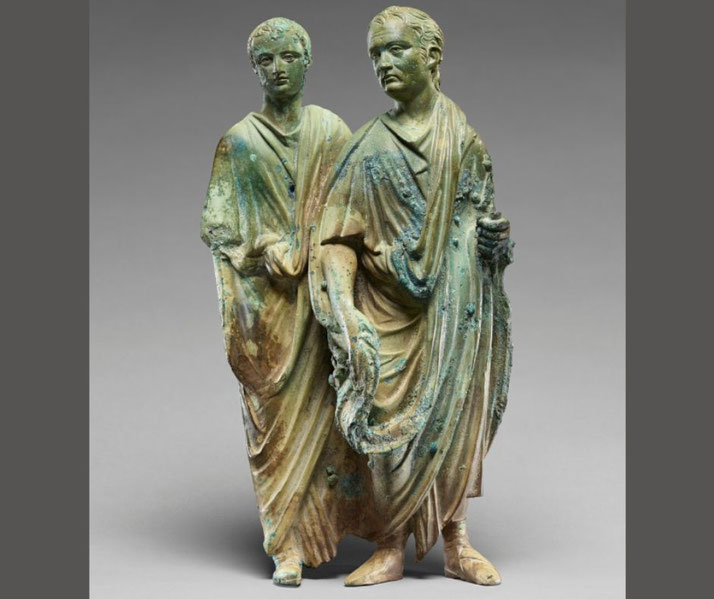
Since the Republican period, Roman clothing had conveyed status through cut and colour, signalled civic belonging to recognised social orders, and enforced moral behaviour by prescribing who could wear certain garments.
The toga was worn only by Roman citizens and was both a legal marker and a social declaration.
Its sheer bulk and complicated drape ensured that only those who had spare time to arrange it, the resources to afford it, and the obligations of public office that required formal dress could wear it properly.
For example, magistrates appeared in the toga praetexta with a purple border, while political candidates wore the bright white toga candida to suggest purity and public virtue.
Women of status wore the stola, which extended to the feet and identified them as honourable wives.
By contrast, tunics marked those without citizenship or standing, such as slaves, foreigners, and freedmen.
Over time, the expansion of the empire introduced new garments that suited the climates and customs of northern provinces.
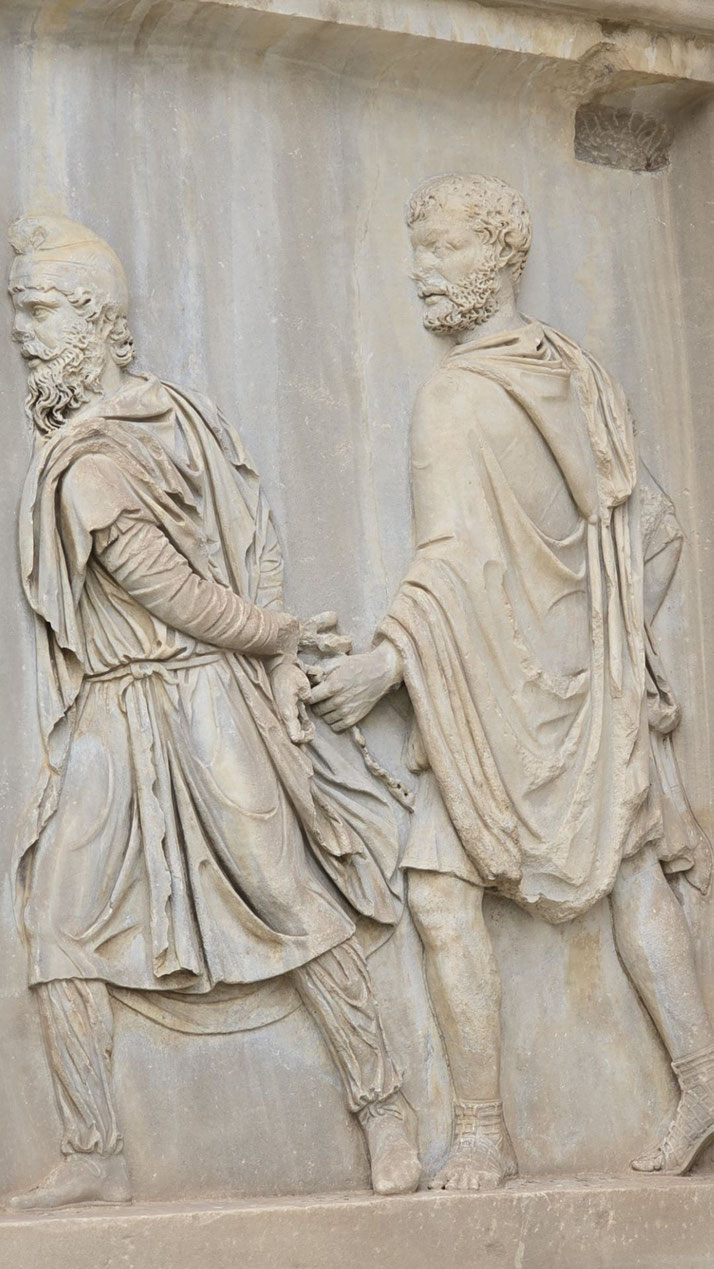
For example, the soldiers stationed in Gaul and Germania adopted bracae, or trousers, which offered warmth and mobility.
Bracae, which were typically made from wool and were fastened with drawstrings or belts, varied in length but usually extended to the knees or ankles.
Trousers, which were initially restricted to military use, gradually became common in many regions among auxiliary forces, frontier civilians, and eventually the urban population.
As a result, bracae entered daily life to varying degrees in many western provinces, including Britain and Hispania.
Some Roman elites viewed this change with increasing alarm. Writers such as Juvenal mocked trousers as foreign and effeminate, when he mocked men who dressed like "barbarians of the north".
Public monuments kept showing emperors, senators, and generals in togas, even when such garments had fallen out of use. By doing so, artists helped keep the idea that Roman identity remained intact.
However, the spread of trousers made Romans and non-Romans look alike. For a society that often relied on visual cues to tell citizens from non-citizens, this shift posed a threat to the entire social order.
Why did Honorius become concerned with clothes?
After the death of Theodosius I in AD 395, his son Honorius inherited the western half of the empire at the age of ten.
As a child-emperor, he had initially depended heavily on Stilicho, his Vandal-born magister militum, who served as guardian and general.
Together, they had moved the imperial capital from Milan to Ravenna, which had marshes and coastal access that favoured defence rather than convenience.
That change was seen as the empire’s retreat from its former heartlands.
By the early 400s, the Western Roman Empire had entered a serious crisis as rebellions broke out in Gaul and Britain, Gothic tribes at times moved freely across Italy, and the treasury struggled to pay the army.
In AD 410, Alaric’s sack of Rome delivered a deep shock to the empire, since the Eternal City fell to those it once called barbarians and Roman leaders increasingly feared that cultural decline had accompanied political collapse.
Under such conditions, Honorius and his advisors focused primarily on preserving the appearance of Roman tradition.
Laws increasingly promoted official Christianity, banned pagan rituals, and attempted to set rules about behaviour.
In AD 399, for example, an order banned blood sacrifices and temple offerings to traditional gods.
Clothing became another area of control. Trousers, which had once belonged to soldiers in remote garrisons, now appeared in urban settings worn by civil servants, merchants, and even members of the elite, so their presence undermined the Roman idea that social rank should be visible.
So, Honorius viewed the popularity of trousers as a sign of a breakdown of Roman culture rather than as breakdown of Roman culture.
Since they originated from the empire’s external enemies, including Germanic tribes like the Visigoths and Alamanni, bracae embodied the weakening of Roman discipline and the adoption of foreign values.
The emperor’s growing concern reflected his broader belief that the Western Roman Empire could only survive by restoring its visible traditions.
Why Honorius banned pants
During his reign, Honorius reportedly issued a decree forbidding the wearing of trousers, particularly within the city of Rome.
Although no copy of the law survives, some scholars interpret later summaries in the Codex Theodosianus, a compilation of imperial legislation, as indirect evidence of such a ban.
These summaries include general provisions regulating attire and reinforcing Roman decorum, but they do not confirm the existence or precise wording of a law targeting bracae.
The idea of a specific anti-trouser decree remains plausible but cannot be definitively proven.
Importantly, the decree, if it existed, did not necessarily ban trousers throughout the empire.
Its likely focus remained primarily on urban centres where traditional dress retained symbolic weight.
For example, senators and patricians in Rome still participated in ceremonies and public appearances where clothing conveyed political legitimacy, so when those individuals began adopting foreign garments, it undermined the fragile distinctions the emperor hoped to preserve.
Honorius interpreted trousers as more than clothing because he saw them as a visible symptom of deeper change and therefore treated them as a threat to the identity of the Roman state.
Since other imperial policies had largely failed to prevent military defeats, economic decline, or civic unrest, symbolic actions like banning trousers gained significance because they offered a way for the emperor to declare authority over daily life when power over events had slipped away.
To reinforce Roman customs, the law effectively treated trousers as a sign of disloyalty.
Since many of the new soldiers serving in the army came from Germanic backgrounds, their habits and attire became associated with instability.
Honorius responded by using legislation to divide Roman from non-Roman. Rather than address the empire’s material weaknesses, he attempted to enforce its cultural boundaries by controlling appearance.
How was this law enforced?
Like most imperial laws, the ban on trousers relied on enforcement by local officials, as in Rome the praefectus urbi, who held responsibility for public order, had the authority to impose fines, deny entry to events, or confiscate garments.
Officials may have also used social pressure or public shaming in some cases to discourage violations.
In cities with strong aristocratic influence, such as Carthage or Milan, similar penalties may have applied.
Even so, enforcement was uneven, so along the frontiers and in military zones trousers largely remained essential.
Soldiers in Germania, Pannonia, and Britannia continued to wear them without interruption.
Since governors in those regions had prioritised defence and faced supply shortages, they rarely enforced symbolic clothing laws, so in many cases imperial officials allowed exceptions or ignored the law altogether outside ceremonial spaces.
Meanwhile, the Eastern Roman Empire gradually developed its own dress codes.
Court officials in Constantinople adopted long tunics, belts, and even fitted trousers, which were influenced by Persian customs.
Their version of Roman identity had already begun to differ, and they did not share the west’s obsession with banning bracae.
As a result, the law Honorius introduced never spread beyond his direct control.
By the mid-fifth century, barbarian groups already controlled large parts of the western provinces, and many former Roman cities now answered to kings who wore trousers as a matter of course, so Roman dress codes lost influence and the toga itself disappeared from daily life.
Tunics became the standard garment, worn with cloaks or belts that showed the wearer’s local customs rather than Roman ideals, so the ban on trousers faded into lost importance.
Yet the law had shown something important about the state of the empire.
Honorius hoped that regulation of how Romans dressed could at least restore a sense of unity and control.
In practice, his decree highlighted the weakness of a state that no longer trusted its citizens to look Roman without force.
The empire could no longer rely on shared customs, and so in many cases it tried to enforce identity by dictating what people wore.