
How Hannibal did the impossible by sailing war elephants across the raging Rhone River
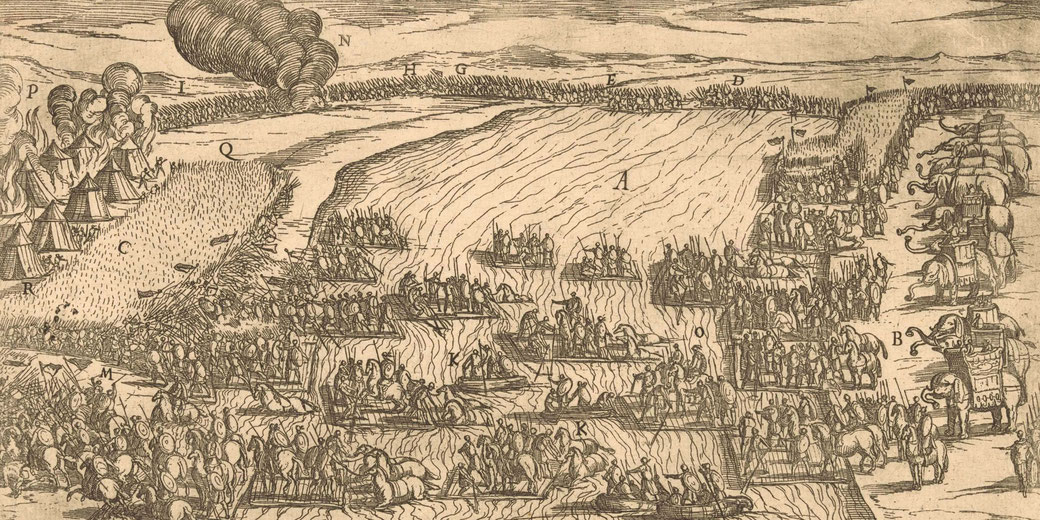
In late September 218 BC, the Carthaginian general Hannibal Barca reached the lower Rhône with an army of nearly 30,000 infantry and 6,000 cavalry, as well as a column of 37 war elephants, after an exhausting march from New Carthage in Hispania.
He stood only days away from the Alps, which offered a narrow path into the Italian Peninsula, but the Rhône River became a sudden and violent obstacle.
The river lay under the guard of hostile Gallic tribes, and autumn rains had already swollen it, which blocked his route to northern Italy and threatened to ruin the campaign before it reached its most daring stage.
The approach to the Rhône
After he left New Carthage earlier that year, Hannibal had already forced his way across the Ebro River and subdued various Iberian tribes, which secured the supplies needed for the long march toward Gaul.
By the time his army approached the Rhône near present-day Arles, likely near Fourques, his soldiers had fought several skirmishes and endured the terrain of southern Gaul as they began preparations for crossing into territory that Roman allies held.
Among the forces was a trained group of elephants, believed to be a North African type of the African savanna elephant that is probably now extinct, which was smaller and easier to handle than their relatives further south.
These elephants had been used effectively for intimidation and battlefield disruption throughout earlier campaigns in the western Mediterranean.
Polybius and Livy both recorded their presence, though Livy provided a more dramatic version of events.
At the riverbank, Hannibal learned that the eastern side was controlled by the Volcae, a Gallic tribe that had received bribes and encouragement from Roman envoys.
The Volcae had previously joined the Romans against rival tribes and now fortified the opposite shore, intending to block any crossing attempt.
Importantly, Roman consul Publius Cornelius Scipio had already landed at Massalia in late September and was believed to be marching north to intercept Hannibal’s column before it could pass into the Italian region.
To avoid being trapped, however, Hannibal acted quickly. He ordered Hanno, the son of Bomilcar, to lead a force upstream along the western bank.
After a full day’s march, Hanno found what he judged a good place to cross and used quickly assembled rafts of timber and animal hides to ferry his troops across the river under cover of night.
Early the next morning, his men launched a surprise assault on the Volcae from behind, which ignited their tents and caused confusion in the camp.
Hanno’s move recalled distraction tactics later used by Julius Caesar during the Gallic Wars and ensured that the main crossing would face minimal resistance.
The surprise assault and river crossing
At the signal, which came from plumes of smoke that rose from the enemy rear, Hannibal ordered the main crossing to begin.
His engineers used rafts that they had constructed from felled trees and lashed with rope to form a group of rafts capable of transporting soldiers and horses across the fast-moving river along with important supplies.
Some accounts suggest the use of towropes or support from swimmers who helped guide the rafts through the current.
Briefly, the defenders resisted, but Hanno’s forces pushed them into chaos, and this allowed Hannibal’s men to get off the rafts with minimal opposition.
Importantly, the movement across the Rhône took place in stages. The light infantry crossed first, followed by cavalry on specially adapted floats that generally kept the animals calm and balanced.
Experienced troops helped steady the rafts and quickly recover any animals or men that slipped into the water.
By midday, the entire western contingent had completed the crossing, and the Carthaginian army had taken control of both banks.
According to Polybius, the entire process probably took around four days.
However, one very serious problem still existed. The elephants were central to Hannibal’s battle plans and use of fear in warfare, but they could neither swim long distances nor be led calmly into fast-moving water.
Without a secure and stable crossing method, they would become an impossible burden.
The engineering of an unthinkable feat
To solve the problem, Hannibal instructed his engineers to construct a large platform of floating rafts that stretched out from the riverbank into the water.
The platform was covered with layers of earth and branches to imitate solid ground, and it had leaves scattered across the surface, so it helped the elephants to step forward.
Once they had walked a short distance from shore, the engineers released the rear portion of the raft, and support crews guided it across the current as they used ropes and manpower.
At first, some elephants hesitated, but their handlers moved calmly beside them and used touch and vocal commands to coax them forward.
The animals followed as they stepped carefully across the surface, and the raft rocked beneath them.
Eventually, the elephants reached the opposite bank without incident, but a few became distressed mid-crossing.
Those that panicked leapt or slipped into the water, and even so they managed to paddle, and they used their trunks as snorkels and their limbs as rudders so that they kept themselves afloat until handlers guided them to safety.
The calm discipline of the mahouts played a vital role in ensuring that most of the 37 elephants survived the dangerous crossing.
Ancient sources offer partly conflicting accounts of this feat, with Polybius claiming the elephants swam across, while Livy describes the disguised raft method in detail.
Altogether, the success of the operation relied on the strength of the animals, the skill of the engineers, and the unity of Hannibal’s support crews.
As far as historians know, no other army in the ancient world had attempted such a move under combat conditions, and its success added further to Hannibal’s reputation as a leader who could command obedience under extreme stress.

The Roman delay
By the fourth day, the Carthaginians had completed the crossing and had begun to form up again for the next leg of the campaign.
Hannibal left a relatively small garrison on the western bank that would secure his line of retreat and prevent Volcae revenge attacks, while the rest of the army began to march north toward the Alpine passes.
Because he secured the Rhône crossing, Hannibal ensured that his route into the Alps stayed open.
Crucially, Publius Scipio arrived at the river only after Hannibal had already disappeared into the countryside, so his attempt to confront the Carthaginian army had failed before it even began.
Since he had no chance of intercepting Hannibal along the Rhône, Scipio returned by sea to northern Italy, where he planned to defend against Hannibal’s arrival.
Meanwhile, Hannibal moved steadily toward the mountains, fully aware that snow and tribal resistance would soon likely replace rivers and Gallic skirmishes as the main threats to his survival.
The Volcae, a local Gallic tribe, attempted to thwart the crossing, drawn by the diversion upstream.
However, Hannibal's strategy proved effective. The Carthaginians not only repelled the Volcae but also ensured that the majority of the army, including the elephants, made it across the river safely.