
The 8 greatest female rulers of the ancient world
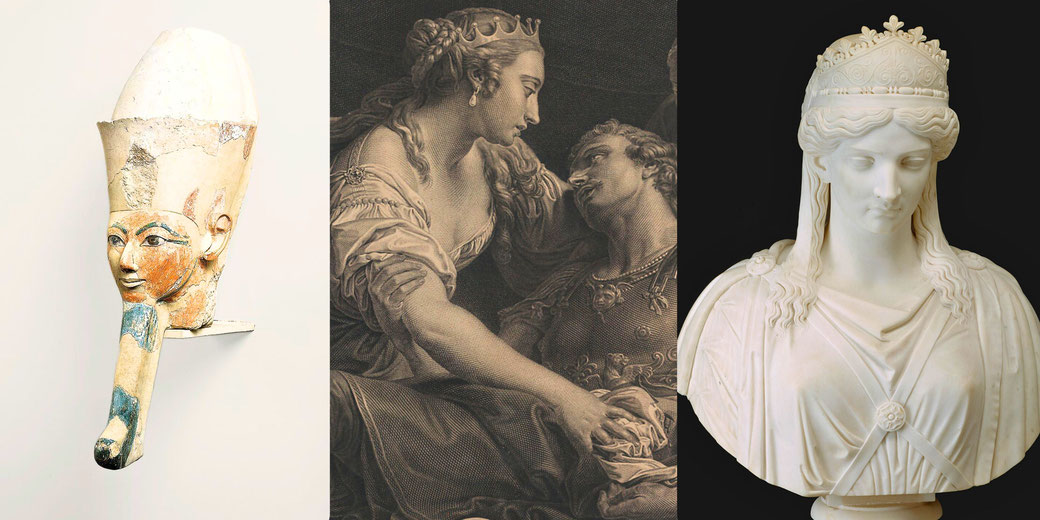
In ancient Egypt, Rome, China, Persia, and other regions, a handful of women rose to power in systems designed to exclude them.
They ruled empires, commanded armies, overthrew rivals, and crafted dynastic alliances that influenced political outcomes across entire regions.
Each woman held authority not through symbolic roles or ceremonial positions, but as military strategists, regents, emperors, and pharaohs with real control over succession, warfare, religion, and policy.
1. Cleopatra
Born in 69 BCE into the Ptolemaic dynasty, Cleopatra VII Thea Philopator reigned as Egypt’s final effective ruler before Octavian annexed the kingdom.
She inherited a fragile state troubled by civil unrest and financial instability, and she restored her authority through powerful relationships with Rome’s leading figures.
Unlike earlier members of her dynasty, she adopted Egyptian religious titles and publicly aligned herself with native cults, presenting herself as a living goddess to win the loyalty of native elites.
Although she promoted Egyptian customs, Greek remained the official language of administration, and there is no firm evidence that she spoke Egyptian fluently.
At first, Cleopatra ruled jointly with her brother Ptolemy XIII, and their rivalry escalated into open conflict that drew in Roman power.
After Julius Caesar arrived in Alexandria, she persuaded him to support her claim, and he restored her position after he had defeated her brother’s forces.
By 47 BCE, she had given birth to Caesar’s child, Caesarion, and ruled beside him under the watchful eyes of both Roman administrators and the Egyptian priesthood.
Caesarion later reigned briefly after her death, although he never held effective power.
After Caesar’s assassination in 44 BCE, she secured Egypt’s position again through an alliance with Mark Antony.
His command over Rome’s eastern provinces gave Cleopatra the ability to shield her throne from Octavian, but it also placed her at the centre of a growing civil war.
Their defeat at the Battle of Actium in 31 BCE forced a retreat to Alexandria. As Octavian invaded the city, Antony and Cleopatra both took their own lives.
By 30 BCE, Egypt had become a Roman province, and this ended the independence of one of the last Hellenistic kingdoms.

2. Hatshepsut
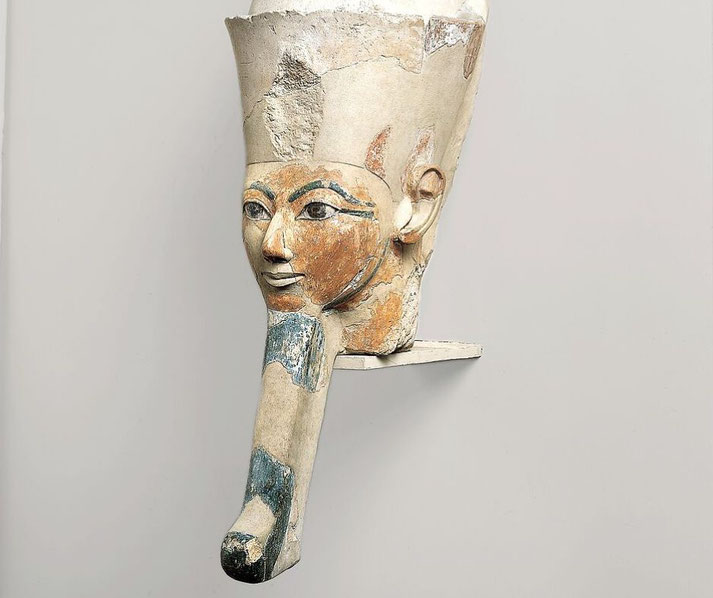
Hatshepsut was the daughter of Thutmose I and wife of Thutmose II and took control of Egypt after her husband’s death and initially ruled as regent for her stepson, Thutmose III.
Over time, she assumed full kingship and presented herself as a male pharaoh. She used traditional royal titles and male iconography that drew on stories of a sacred birth to justify her rule.
Her reign, which lasted from around 1479 to 1458 BCE, focused on internal prosperity, support for the temples, and careful statecraft.
She did not launch major military campaigns, although Egyptian inscriptions indicate that her forces stayed active in Nubia and possibly the Levant.
To reinforce her authority, she launched extensive construction programs, most famously her mortuary temple at Deir el-Bahri.
That structure contained reliefs that described her birth from the god Amun as the act of a god.
This message allowed her to assert both political and religious legitimacy. She also revived trade expeditions, such as the celebrated voyage to Punt, which returned with incense, gold, myrrh trees, and exotic animals.
These goods probably strengthened the economy and allowed the priesthood to increase temple offerings.
For nearly two decades, Hatshepsut ruled as Egypt’s de facto king, and she maintained peace and strengthened state offices that enlarged the wealth of the temples.
After her death, Thutmose III resumed sole control and began removing her image from monuments. Some writers interpreted this as an act of revenge, although it probably helped to reaffirm his own authority by erasing the precedent of female kingship and presenting his reign as the uninterrupted continuation of the Thutmosid line.
3. Zenobia
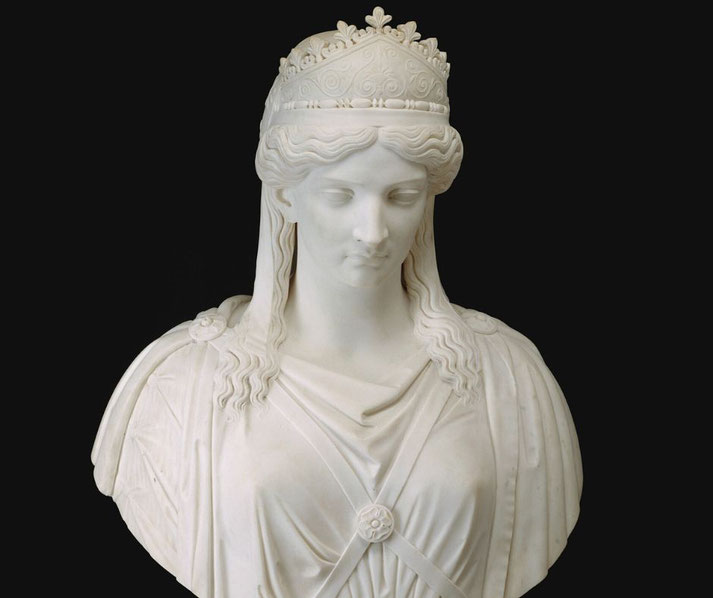
Zenobia rose to prominence during the Roman Crisis of the Third Century, when imperial authority across the eastern provinces started to collapse under military, economic, and dynastic pressure.
After the assassination of her husband Odaenathus in 267 CE, she took control of Palmyra and declared herself regent for her son Vaballathus, although in practice she ruled independently.
By 270, she had launched a campaign that placed Syria, Palestine, Egypt, and parts of Asia Minor under Palmyrene control.
At first, she maintained an appearance of loyalty to Rome, and she struck coins in the name of the emperor Aurelian and granted Vaballathus Roman titles.
However, as her power increased, coins that were minted in Alexandria and Antioch showed Vaballathus styled as Augustus.
Some ancient sources claimed she declared herself Augusta, although this title is not consistently attested in surviving inscriptions and may have expressed local propaganda rather than a formal imperial claim.
She claimed descent from Cleopatra and cultivated an image of Eastern royal power and commanded an army made up of many different peoples, supported by former Roman officers.
By early 272, Aurelian marched east to reclaim the territory. After victories at Immae and Emesa, he forced Zenobia to retreat toward Persia in search of allies.
Roman troops captured her near the Euphrates. The Historia Augusta reported that she later appeared in Aurelian’s triumph in Rome, although modern historians question the reliability of this account.
Later stories claimed she lived out her life under house arrest, and her ultimate fate is still uncertain.
Her revolt showed how fragile Roman control could be during a period of instability and suggested that regional leaders could mobilise effectively against imperial rule.
4. Boudica
Boudica was queen of the Iceni and led a violent and nearly successful revolt against Roman rule in Britain after Roman officials annexed her kingdom and violated her family.
Her husband, Prasutagus, had left a will that had named both the Roman emperor and his daughters as joint heirs, but the Romans seized his land, whipped Boudica, and assaulted her daughters.
In response, she organised a coalition of Brittonic tribes and launched a rebellion that shocked Roman administrators.
Within months, her forces destroyed Camulodunum, Londinium, and Verulamium, killing thousands and burning Roman temples, homes, and garrisons.
Roman historian Tacitus estimated that 70,000 people died in the revolt, a figure that modern scholars still debate.
Boudica addressed her warriors before each attack, and she invoked the anger of the gods and demanded vengeance for Roman cruelty.
As her forces grew, the Roman administration scrambled to respond, and Governor Gaius Suetonius Paulinus finally assembled a disciplined army to face her.
Although his soldiers were outnumbered, Suetonius lured her army into a narrow battleground that removed their advantage.
Roman discipline and heavy infantry tactics helped to break the rebel lines, and Boudica, unwilling to suffer capture, reportedly took her own life.
Her uprising failed to remove Roman power, and it forced the Empire to reconsider its methods of provincial rule and to change both taxation policies and the treatment of native elites in Britain.
5. Artemisia
Artemisia I of Caria governed Halicarnassus under Persian rule during the reign of Xerxes I and took a direct role in the Greco-Persian Wars.
As one of the few female naval commanders of the period, she brought five ships to the Battle of Salamis in 480 BCE, and her reputation for cunning and courage earned high praise from Xerxes and astonishment from her enemies.
Herodotus, who came from the same city, left the most detailed account of her actions.
Before the battle, Artemisia reportedly advised Xerxes to avoid naval engagement in the narrow waters near Salamis.
She argued that the Greek triremes, with their superior manoeuvrability, would exploit the terrain to their advantage.
Xerxes ignored her counsel and ordered the attack, and this decision produced a crushing defeat for the Persian fleet.
During the battle, she escaped pursuit by ramming a friendly ship, possibly to deceive the Greeks so that they would believe she had changed sides, and in this way she avoided destruction.
Modern historians have debated whether this manoeuvre showed a calculated plan or an act of sheer desperation.
After the campaign, Xerxes praised her effectiveness and trusted her judgment more than that of many male commanders.
Her presence on the battlefield and her command decisions challenged common ideas about gender in military leadership, and although little information survives about her later life, her role in one of antiquity’s most studied battles made a lasting impression on both Greek and Persian traditions.
6. Tomyris
Tomyris was queen of the Massagetae and led her people against the expansionist plans of Cyrus the Great during the 6th century BCE.
When Cyrus attempted to conquer her lands by offering a deceptive marriage alliance and then ambushing her forces with large quantities of wine, her son Spargapises, who had been captured, then took his own life in captivity.
Tomyris, angered by the loss and the betrayal, gathered her warriors and challenged Cyrus to face her in open combat.
According to Herodotus, the Massagetae defeated the Persian army in a battle that decided the war.
Cyrus died in the fighting, and Tomyris ordered his head placed in a wineskin filled with blood, declaring that she had satisfied his thirst for conquest.
This dramatic account survives only in Herodotus’ Histories, and most modern historians treat it as a story from legend rather than confirmed fact.
Greek writers later elevated her to near-mythical status and often used her image to illustrate the dangers of underestimating tribal resistance.
The Massagetae left no written records, and Tomyris became a symbolic figure in the historical imagination of the ancient world.
Her name appeared in later Persian, Greek, and medieval European texts as an example of a ruler who avenged her family and defeated one of the most powerful kings in history.
7. Olympias
Olympias was the wife of Philip II of Macedon and mother of Alexander the Great, and she used marriage and religious authority, along with calculated violence, to maintain her position within a court that was plagued by dynastic intrigue.
As a member of the royal house of Epirus, she traced her ancestry to the hero Achilles, and this story of heroic descent reinforced her claims to special favour from the gods.
After Philip had married Cleopatra Eurydice, tensions rose in the royal household, and Philip’s assassination in 336 BCE immediately altered the balance of power.
To secure her son’s succession, Olympias eliminated rival claimants. Ancient sources credit her with arranging the deaths of Cleopatra Eurydice and her child, although the exact method and circumstances are unclear.
During Alexander’s campaigns in Asia, she kept her influence over the court because she maintained correspondence and took part in religious ceremonies that upheld his status as a god.
After his death in 323 BCE, she returned to political life as a power broker during the Wars of the Diadochi.
In 317 BCE, she seized control of Macedonia, ordered the execution of Philip III Arrhidaeus and his wife Eurydice, and briefly held power.
Her use of violence alienated many allies, and Cassander’s forces soon besieged her.
Once captured, she was condemned and executed, likely by relatives of her victims.
Her involvement in Alexander’s rise and the deadly succession crisis that followed showed how family power and political struggle could become closely connected in the era of Hellenistic monarchies.
8. Wu Zetian
Wu Zetian began her rise to power as a concubine under Emperor Taizong before becoming the preferred consort of his son, Emperor Gaozong.
After his death, she controlled the imperial court as empress dowager and controlled who would succeed to the throne while pushing her opponents aside.
In 690 CE, she claimed the Mandate of Heaven for herself and proclaimed a new dynasty also named Zhou, which should not be confused with the earlier Zhou dynasty of the first millennium BCE.
She ruled directly as emperor until 705.
As ruler, she reorganised court administration, and she promoted officials based on merit rather than aristocratic birth.
She expanded the civil service examination system and introduced reforms to strengthen central authority, then sponsored Buddhist art and temples that promoted her role as a chakravartin monarch chosen by heaven
Her political messages presented her as the rightful ruler of a new golden age.
Opponents accused her of using secret police and assassinations to remove rivals, and historians who wrote under later dynasties often depicted her reign with suspicion.
However, her policies created long-term administrative improvements and helped include more men from families outside the old aristocracy in the bureaucracy.
After she stepped down from the throne, the Tang dynasty resumed control, and many of her appointments and reforms stayed in place.
Wu’s reign created an example that future women in China never matched, because no other woman again ruled as emperor in her own name.