
How Giovanni Belzoni removed massive statues without modern machinery
In the scorching Egyptian summer of 1816, a former circus strongman from Padua managed to do what Napoleon’s trained military engineers could not: move a seven-tonne granite bust of Pharaoh Ramesses II out of an ancient temple and transport it to the banks of the Nile.
Giovanni Battista Belzoni accomplished this feat using nothing more than wooden poles, palm-fibre ropes, hand-carved rollers, and the organised labour of 130 local workers.
His methods were drawn from a self-taught understanding of hydraulics and leverage, which provide a curious example in how resourcefulness could overcome enormous physical challenges before the invention of cranes or motorised vehicles.
From the circus to Egypt’s most unlikely engineer
Born in Padua on 5 November 1778, Giovanni Belzoni was the son of a barber who raised fourteen children.
As a young man, he moved to Rome and claimed to have studied hydraulics, likely through informal observation of the city’s fountain systems.
When French troops occupied Rome in 1798, Belzoni fled north and eventually reached England in 1803, where he married an Englishwoman named Sarah Banne.
Belzoni, who stood at an extraordinary 6 feet 7 inches tall, found work as a circus performer at Sadler’s Wells and Astley’s Amphitheatre in London, where he was billed as the “Patagonian Samson,” and his signature act reportedly involved carrying up to twelve people around the stage on an iron frame strapped to his waist.
Over nearly a decade of touring fairs, he had arguably developed an intuitive grasp of weight distribution and the mechanics of moving heavy loads.
In 1815, he travelled to Egypt and proposed a hydraulic water-lifting machine to Muhammad Ali, who was the Pasha of Egypt, but the Pasha rejected the project, which left Belzoni without employment.
Why had the Young Memnon defeated everyone who tried to move it?
The statue that would define Belzoni’s reputation was a colossal granite bust of Ramesses II, which was commonly known as the “Younger Memnon.”
Cut from a single block of two-coloured granite, the bust measured approximately 2.7 metres high and over 2 metres across the shoulders, and it weighed around 7.25 tonnes.
It had originally flanked one of the entrances to the Ramesseum, which was the pharaoh’s thirteenth-century BCE mortuary temple at Thebes, near modern-day Luxor.
By the early nineteenth century, the bust lay half-buried in sand within the temple’s ruined courtyard.
During Napoleon’s 1798 expedition, French engineers had drilled a hole into the statue’s right shoulder, as they had intended to blast it into smaller fragments with explosives.
Fortunately, that plan was abandoned before detonation, since it would have destroyed the sculpture entirely.
The drill hole is still visible today as a permanent reminder of how close the piece came to destruction.
For nearly two decades afterwards, the bust sat untouched, because no one had possessed both the technical knowledge and the organisational capacity to shift it.
How Belzoni moved seven tonnes of granite
Henry Salt was the British consul-general in Egypt, and on the recommendation of the Swiss orientalist Johann Ludwig Burckhardt, he hired Belzoni in June 1816 to retrieve the Young Memnon for the British Museum.
Salt drew up a formal agreement on 28 June, and Belzoni arrived at Thebes on 22 July.
His approach relied entirely on principles that the ancient Egyptians themselves had used thousands of years earlier: the combination of levers and rollers, as well as coordinated human pulling force.
Belzoni’s first task involved constructing a carrier platform from eight sturdy wooden poles, which cradled the bust above the ground.
He positioned four cylindrical wooden rollers beneath this carrier, which created a low-friction surface across which the assembly could move forward.
Workers at the rear would pick up each roller as it passed out from underneath and carry it to the front, so the statue was always rolling on a continuously recycled set of logs.
Four ropes were each manned by an equal team of labourers and were attached to the carrier to haul it along.
On 27 July 1816, the first day of movement, the team covered only a few yards. By the second day, they had increased their pace to roughly 50 yards, even after Belzoni had deliberately broken the bases of two temple columns that blocked the route.
Over seventeen gruelling days, the crew of 130 men hauled the bust through desert heat toward the riverbank, and Belzoni used wooden levers to adjust its position whenever it shifted on the carrier.
Getting the statue onto the Nile and down to Cairo
On 12 August 1816, the Young Memnon arrived at the bank of the Nile opposite Luxor, but the most delicate stage lay ahead.
Every local boatman who inspected the bust declared that loading it would sink their craft, and for weeks Belzoni negotiated with vessel owners along the river.
After prolonged negotiations, Belzoni obtained a vessel in mid-November. He constructed a sloping causeway from the riverbank, which was about fifteen feet above water level, down to the boat below.
Across the centre of the vessel, he laid a bridge of four poles, with straw mats placed to cushion the landing and a sack of sand as a brake.
A rope that was looped around a palm tree on the bank provided the controlled resistance that was needed to lower the carrier down the incline.
On 15 December 1816, Belzoni loaded the bust onto the boat and began the journey downriver to Cairo, from where it was shipped via Alexandria and Malta to London, and it arrived in 1818.
A career built on brute determination
The removal of the Young Memnon was arguably the most famous of Belzoni’s achievements in Egypt.
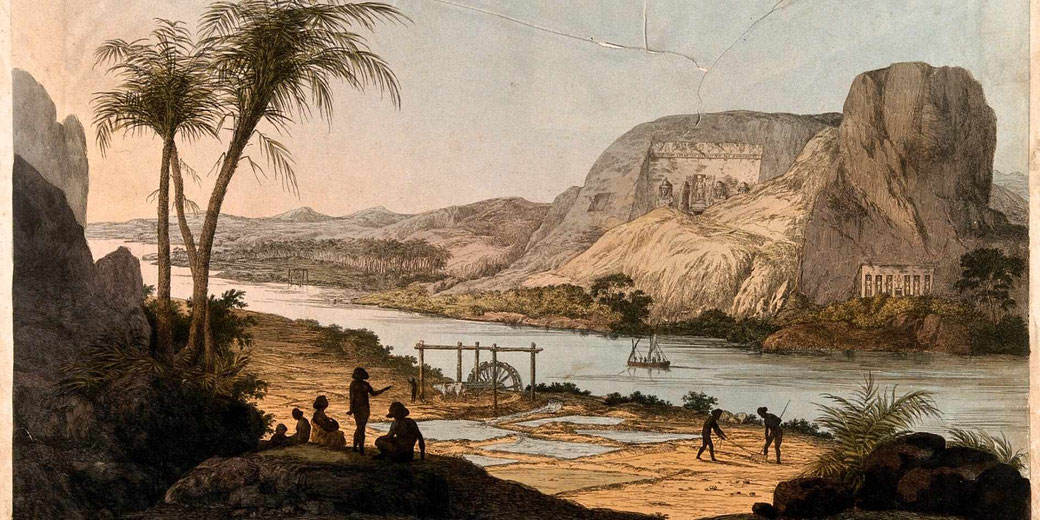
Between 1816 and 1819, he applied similar methods at numerous sites. At Abu Simbel in 1817, he organised teams of up to two hundred men to dig through roughly thirty feet of sand that blocked the entrance to the great temple of Ramesses II.
In the Valley of the Kings, he discovered the richly decorated tomb of Seti I on 18 October 1817, which was a find so significant that the tomb is still sometimes called “Belzoni’s Tomb.”
He was also the first modern explorer to enter the burial chamber of the Pyramid of Khafre at Giza in 1818.
Across all of these operations, Belzoni relied on the same fundamental toolkit: levers to lift and rollers to reduce friction, as well as ropes to pull.
He mobilised local workforces that were funded by Salt and directed their efforts with practical engineering instinct.
Burckhardt noted that Belzoni handled massive stone objects with a skill that made local Egyptians believe he was a sorcerer, and Howard Carter later praised him as “one of the most remarkable men in the entire history of archaeology.”
In 1820, Belzoni published a detailed account titled Narrative of the Operations and Recent Discoveries within the Pyramids, Temples, Tombs and Excavations in Egypt and Nubia.
It is widely regarded as the first English-language book on Egyptology, and it provided practical descriptions of his removal methods alongside illustrations drawn by his own hand.
His career ended when he died of dysentery on 3 December 1823 in West Africa, during an expedition to find the source of the River Niger, at only forty-five years old.
The techniques he had employed to shift the Young Memnon provide a remarkable window into how simple mechanical principles, applied with careful organisation, could achieve results that seemed impossible without powered machinery.