
The ancient story of Noah’s Ark that is older than the Bible itself
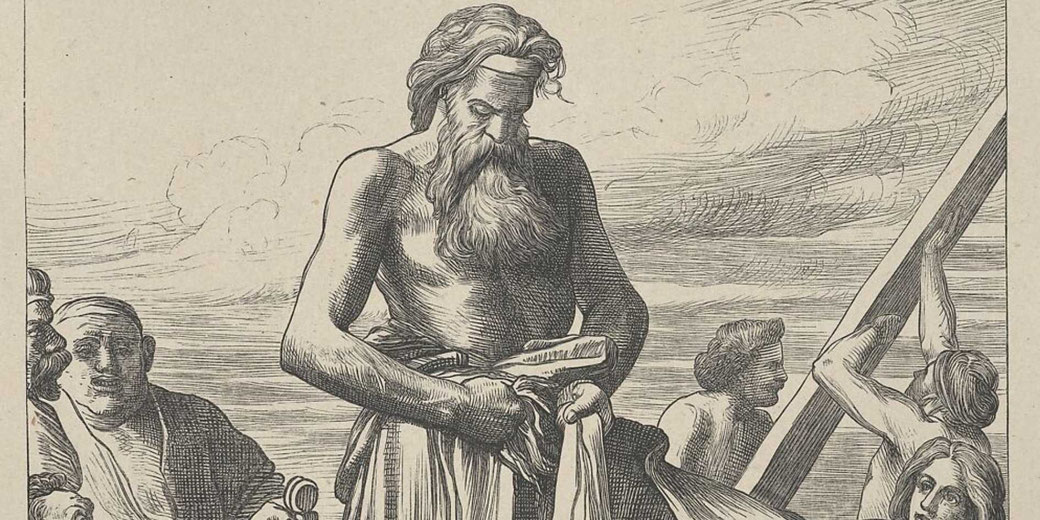
On 3 December 1872, a self-taught engraver named George Smith stood before the Society of Biblical Archaeology in London and read aloud from a 2,600-year-old clay tablet that described a catastrophic flood and a specially constructed boat, as well as the release of birds to find dry land.
The account predated the Book of Genesis by at least a thousand years, and it stunned an audience that included British Prime Minister William Ewart Gladstone.
Many Victorian readers had treated Genesis as the earliest written record of the flood, which made Smith’s discovery all the more startling.
Contained within the eleventh tablet of the Standard Babylonian version of the Epic of Gilgamesh, which is generally considered the oldest surviving long work of literature in human history, the flood story of Utnapishtim forced scholars to confront the possibility that one of the Bible’s most famous passages had drawn from a much older Mesopotamian tradition.
A banknote engraver who changed ancient history
George Smith was born in London on 26 March 1840 to a working-class family with no means to provide a formal education.
At fourteen, he began an apprenticeship at the publishing house Bradbury and Evans, where he learned to engrave banknotes.
During his lunch breaks, he walked to the nearby British Museum and studied cuneiform tablets that had been excavated from the ancient Assyrian city of Nineveh, near modern-day Mosul in Iraq.
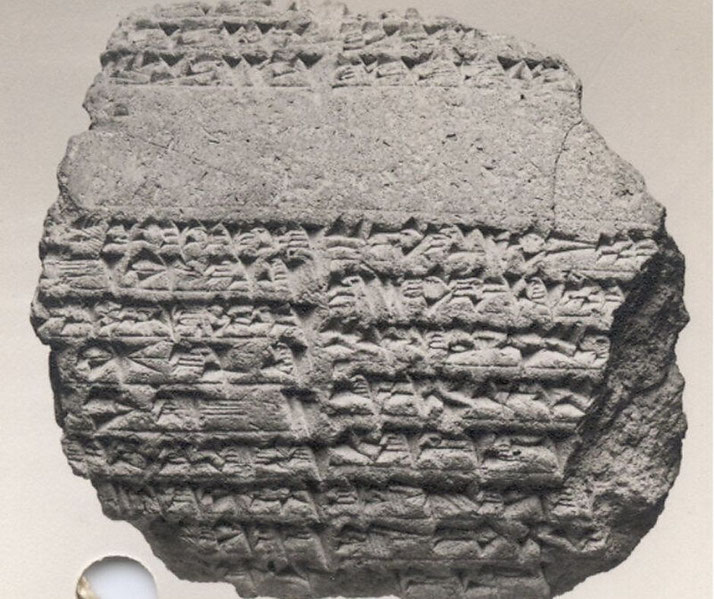
Cuneiform was a wedge-shaped script pressed into damp clay with a cut reed stylus.
His ability to read the script, which he had taught himself from published materials, caught the attention of Samuel Birch, who was the Museum’s Director of Antiquities and who introduced him to Sir Henry Rawlinson, one of the leading Assyriologists of the era.
By 1870, the British Museum had appointed Smith to work on its growing cuneiform collection.
As he sorted through thousands of clay tablet fragments from the Library of Ashurbanipal at Kuyunjik, which was the main mound of ancient Nineveh, he organised them into categories, one of which he labelled ‘Mythology’.
Many of these fragments had been excavated in the 1840s and 1850s by Austen Henry Layard and Hormuzd Rassam.
In 1872, Smith noticed a fragment that referenced a ship resting on a mountain and a dove being sent out to find land. Related pieces from Tablet XI included the fragment now famous as K.3375 and preserved the flood account in striking detail.
According to later reports by colleagues, Smith was so overwhelmed that he began removing articles of his clothing and running around the room.
He had found the Mesopotamian flood story.
The oldest story ever told
The Epic of Gilgamesh is the earliest surviving long work of literature, but its origins can be found in much earlier Sumerian poems about Gilgamesh that date to the third millennium BC.
The version that Smith translated belonged to the Standard Babylonian edition in Akkadian, a literary text that was attributed in later Mesopotamian tradition to the scholar Sîn-lēqi-unninni.
The surviving copies of that version date from the late second to early first millennium BC, and one of the best known came from the library of the Assyrian king Ashurbanipal, who ruled from 668 to 627 BC.
The epic tells the story of Gilgamesh, who was a semi-legendary king of the Sumerian city of Uruk and whose historical reign is believed to have occurred around 2700 BC.
Gilgamesh befriends a wild man named Enkidu, and the two undertake adventures together, which included defeating a demon called Humbaba in a cedar forest.
After Enkidu dies, Gilgamesh becomes consumed by the fear of his own mortality and sets out to find the secret of eternal life, which leads him to Utnapishtim, who was the only human ever granted immortality by the gods.
What Utnapishtim told Gilgamesh
The flood account appears on Tablet XI and occupies the first 203 lines.
Utnapishtim tells Gilgamesh that the gods, led by Enlil, had decided to destroy humanity with a great flood.
The god Ea, who had created humankind, disagreed and secretly warned Utnapishtim through a dream, and he instructed him to tear down his house and build a large boat.
Utnapishtim was told to abandon his wealth and save all living things, as well as load his family and animals onto the vessel.
The text describes a craft with equal length and width, which made it far closer to a cube than the long rectangular ark of Genesis.
Once construction was complete, the storm arrived. For six days and seven nights, wind and rain battered the earth.
When the waters subsided, the boat came to rest on Mount Nimush, which scholars usually place somewhere in the Zagros region.
Utnapishtim first released a dove, which returned because it found no resting place, and then a swallow, which also came back.
He then released a raven, which did not return and which confirmed that the floodwaters had receded.
After offering a sacrifice, the gods gathered around the offering ‘like flies’, and they were drawn by the smell.
Enlil was furious that anyone had survived, but Ea criticised him. Enlil eventually relented, and he blessed Utnapishtim and his wife before he granted them eternal life at the mouth of the rivers.
How closely does the flood story match Genesis?
The similarities between the Gilgamesh flood and the story of Noah in Genesis 6–9 are so numerous that Assyriologist Andrew George has argued few scholars doubt a direct connection.
Both accounts describe a god or gods who decide to destroy humanity and a righteous man who is warned to build a boat and load animals onto it.
In both versions, a devastating flood covers the earth before the boat comes to rest on a mountain, and birds are then sent out to test whether the waters have receded.
In both stories, the survivor offers a sacrifice, and the deity or deities respond favourably.
Genesis follows a slightly different order in its bird sequence, since Noah first sends out a raven and later sends out doves.
Significant differences do exist between the two accounts. In the Gilgamesh version, the flood lasts only six days, and Utnapishtim’s boat is described as a near cube with six decks.
In Genesis, the flood lasts 40 days and 40 nights, and Noah’s ark has a rectangular design.
In the Mesopotamian version, the gods punish humanity because humans have become too noisy.
In Genesis, God destroys the earth because of humanity’s wickedness. The reward also differs: Utnapishtim receives immortality, and Noah receives a covenant and the command to multiply.
The Atrahasis Epic and an even older source
Scholars have long recognised that the Gilgamesh flood story was itself an adaptation rather than the original.
The account on Tablet XI had likely been adapted from an even older Mesopotamian poem known as the Atrahasis Epic.
The surviving Old Babylonian copies date to the seventeenth century BC. In this version, the flood hero is called Atrahasis, and the plot follows a familiar pattern: the gods create humans as labourers to do work for them and humanity grows too numerous, so Enlil orders a flood, and Ea warns Atrahasis to build a boat.
Irving Finkel of the British Museum later studied and published another flood tablet from a private collection that described a round, coracle-like ark rather than a box-shaped vessel.
Rabbinic scholar Robert Wexler wrote in a 2001 Torah commentary and proposed that both Genesis and Gilgamesh had likely drawn from a common Mesopotamian flood tradition, which then diverged as each culture adapted the story.
Most modern scholars now treat the biblical flood account as an Israelite reworking of a much older tradition from the ancient Near East.
That comparison has become one of the clearest examples of the Bible’s relationship to earlier Near Eastern literature.
Why the flood tablet still matters
When Smith presented his translation on 3 December 1872, the implications were immediate.
The Daily Telegraph funded an expedition to Nineveh so that Smith could search for the missing fragments, and on 7 May 1873, after just five days of digging, he found a piece that filled part of the gap.
His 1876 book was titled The Chaldean Account of Genesis and became one of the best-selling works of its time.
Smith died in Aleppo on 19 August 1876 at the age of 36 during his third expedition.
His work arguably changed the way scholars understood the Hebrew Bible and its connection to the older civilisations of Mesopotamia on a permanent basis.
The flood tablet is now best known as object K.3375 and is displayed in the British Museum, where it reminds visitors that the story of a catastrophic flood has been told and retold across cultures for over four thousand years.