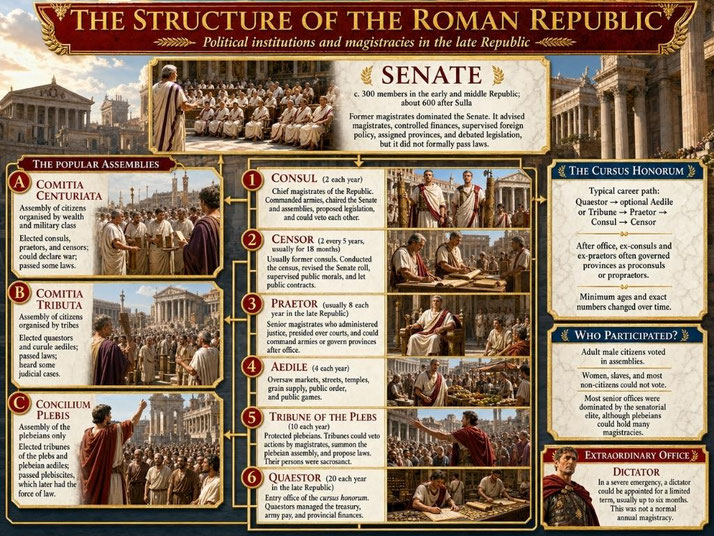
The cursus honorum in the Roman Republic and the roles of the magistrates
In the Roman Republic, no citizen could simply declare himself consul and take command of Rome’s armies, because the state demanded that every aspiring politician prove his competence through a set sequence of public offices.
This system was known as the cursus honorum, which means the “course of honours,” and it required candidates to hold progressively senior magistracies over many years, each of which carried specific duties and minimum age requirements.
The cursus honorum was formalised by the Lex Villia Annalis in 180 BCE and was later tightened under the dictator Lucius Cornelius Sulla around 81 BCE, and it arguably became the governing framework of Roman political life for over two centuries.
How did the system work?
The cursus honorum was a regulated career ladder that forced Roman politicians to accumulate administrative and military experience before reaching positions of real authority.
Every candidate had to complete at least ten years of military service before entering public life, so most men could not begin their political careers until their late twenties.
The Lex Villia Annalis of 180 BCE was proposed by the plebeian tribune Lucius Villius and introduced the first legal requirements for minimum ages as well as intervals between offices.
Then, Sulla’s constitutional reforms around 81 BCE tightened these rules considerably, and they set the minimum age for the quaestorship at 30 and the praetorship at 39.
The consulship required a minimum age of 42. A mandatory two-year gap was known as the biennium and was required between holding successive magistracies, and no individual could hold the same office again within ten years.
A man who held each office at the youngest possible age was said to have been elected suo anno, which means “in his year.”
By the time a politician reached the consulship, he had already demonstrated competence in financial administration as well as judicial authority.

Summary of magistracies
| Office | Number elected | Min. age | Term | Key duties | Mandatory? |
| Censor | 2 | Ex-consul | 18 months |
Census; Senate membership roll; public morals |
No (outside cursus) |
| Consul | 2 | 42 | 1 year |
Supreme imperium; presiding over Senate; military command |
Yes |
| Praetor | 6–8 | 39 | 1 year |
Judicial authority; legal cases; provincial command |
Yes |
| Aedile | 4 | 36 | 1 year |
City maintenance; market regulation; organisation of the ludi |
No |
| Quaestor | 20 | 10 | 1 year |
Financial administration; treasury management; provincial revenue |
Yes |
| Tribune of the Plebs | 10 | None set | 1 year |
Veto power (ius intercessionis); protection of plebeians |
No (outside cursus) |
Quaestor: the first rung of the ladder
As the first formal magistracy in the cursus honorum, the quaestorship was arguably the essential entry point for any senatorial career.
After Sulla’s reforms, the minimum age was 30, or 28 for patricians, and twenty quaestors were elected annually by the comitia tributa, which was the tribal assembly of Roman citizens.
Each quaestor held office for one year, and when he had completed his term, he automatically received membership of the Senate, which was Rome’s advisory council.
Quaestors were financial administrators who managed public money for senior magistrates.
Some were assigned to oversee the aerarium, which was Rome’s public treasury and which was housed at the Temple of Saturn in the Forum.
Others accompanied a consul or provincial governor as financial assistants, and they handled military pay as well as tax revenues.
Since the quaestorship was the only compulsory starting point for a political career, every senator in the late Republic had held this office.

Aedile: an optional but valuable office
After they had completed the quaestorship, many politicians chose to hold the aedileship, which was an optional office that provided a chance to build a public profile.
Two types existed: the plebeian aediles, which were created in 494 BCE, and the curule aediles, which were established in 367 BCE and were eventually open to both patricians and plebeians.
Four aediles were elected each year, with a minimum age of approximately 36 under the Lex Villia Annalis.
As administrators of the city, aediles were responsible for the upkeep of public buildings as well as temples, and for the regulation of markets and food supplies.
Arguably their most politically valuable duty was the organisation of the ludi, which were the public games that included chariot racing as well as theatrical performances.
Ambitious aediles often spent their personal wealth to stage lavish spectacles, since a well-received programme of games could win the popular support that was needed for election to higher office.
Julius Caesar, for instance, spent enormous sums during his aedileship in 65 BCE to boost his public reputation.
Praetor: Rome’s senior judicial magistracy
Because it carried imperium, which was the formal authority to command armies and interpret the law, the praetorship was arguably the most powerful magistracy below the consulship.
Under Sulla’s rules, the minimum age was 39, and six to eight praetors were elected annually by the comitia centuriata, which was the centuriate assembly.
Each praetor was accompanied by six lictors, who were attendants that carried the fasces, which was a bundle of rods that symbolised the magistrate’s coercive power.
The two most important praetors held specific judicial roles. The praetor urbanus oversaw legal cases between Roman citizens, and the praetor peregrinus handled disputes that involved foreigners or cases between Romans and non-citizens.
After they had completed their year in office, many praetors continued to exercise authority as propraetors, and they governed a province with continued military command.
Consul: the summit of Roman political life
At the top of the cursus honorum was the consulship, which was arguably the most prestigious magistracy in the Roman Republic.
Two consuls were elected each year by the comitia centuriata, and the minimum age was 42.
Consuls held the highest level of imperium and presided over the Senate, but during wartime, they commanded Rome’s largest armies.
Each consul was escorted by twelve lictors, which was double the number that was assigned to a praetor.
So important was the consulship that the Romans identified each year by the names of its two consuls, through a dating system that was known as consular dating.
For example, the year 63 BCE was recorded as “the consulship of Cicero and Antonius Hybrida.”
After their term, consuls typically governed a major province as proconsuls with continued military authority.
For a novus homo, who was a “new man” with no consular ancestors, reaching the consulship was an extraordinary achievement.
Marcus Tullius Cicero, who was elected in 63 BCE, was one of the few novi homines to accomplish this during the late Republic.
Offices outside the ordinary cursus
Two significant offices existed outside the formal sequence of magistracies. The tribunate of the plebs was restricted to plebeian citizens, with ten tribunes who were elected each year.
Tribunes possessed sacrosanctitas, which was a form of religious protection that made any physical attack on them a capital offence.
Their most powerful tool was the ius intercessionis, which was the right of veto, and which allowed them to block any action by another magistrate, including a consul.
Many plebeian politicians held the tribunate between the quaestorship and praetorship to build public support.
Finally, the censorship was arguably the most prestigious office a Roman could hold, and it was reserved exclusively for former consuls.
Two censors were elected every five years by the comitia centuriata, and they held office for eighteen months rather than the standard twelve.
Censors conducted the census, which was the official classification of Roman citizens by wealth as well as tribal membership.
They also had the authority to revise the Senate’s membership roll, and they could expel unworthy members and enrol those who had held the qualifying magistracies.
The censorship carried no military imperium, but the power to remove a senator from office made the position one of the most feared and generally one of the most respected in Roman public life.