
Who was Charon, the mysterious ferryman of the dead in Greek mythology?
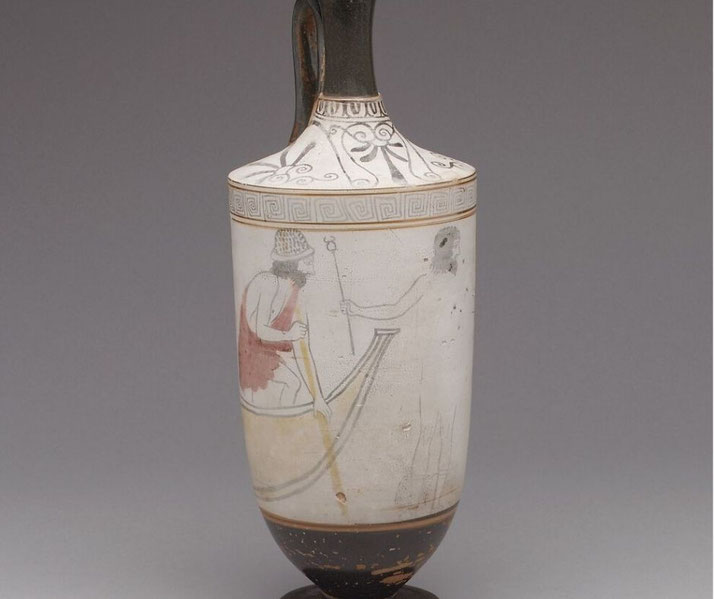
In the 5th century BC, Athenian potters painted a familiar figure onto white-ground lekythoi destined for graves: a thin boatman who leaned on a pole and waited at the edge of dark water to receive the souls of the dead to arrive.
Since the ancient Greeks believed that death required a physical crossing from the world of the living to the underworld, Charon became arguably one of the most recognisable figures in their mythology.
Interestingly, he had no prominent place in the earliest surviving Greek epic, as Homer’s Iliad and Odyssey do not name him.
He appeared more clearly in later literature, from the lost epic Minyas, which was probably composed in the Archaic period and is now known only through fragments and later references.
So, how much do we really know about this mysterious mythological figure?
A god born from darkness and night
In later Greek tradition, Charon belonged to the earliest generation of supernatural beings because he was the son of Erebus, the primordial god of darkness, and of Nyx, the goddess of night.
His parentage placed him among abstract forces rather than among the Olympian gods, so the Greeks understood him as a daemon, which was a spirit tied to a particular duty, instead of as a deity who received worship at temples.
There is no substantial evidence for a major public cult of Charon, which separated him from underworld gods such as Hades and Persephone.
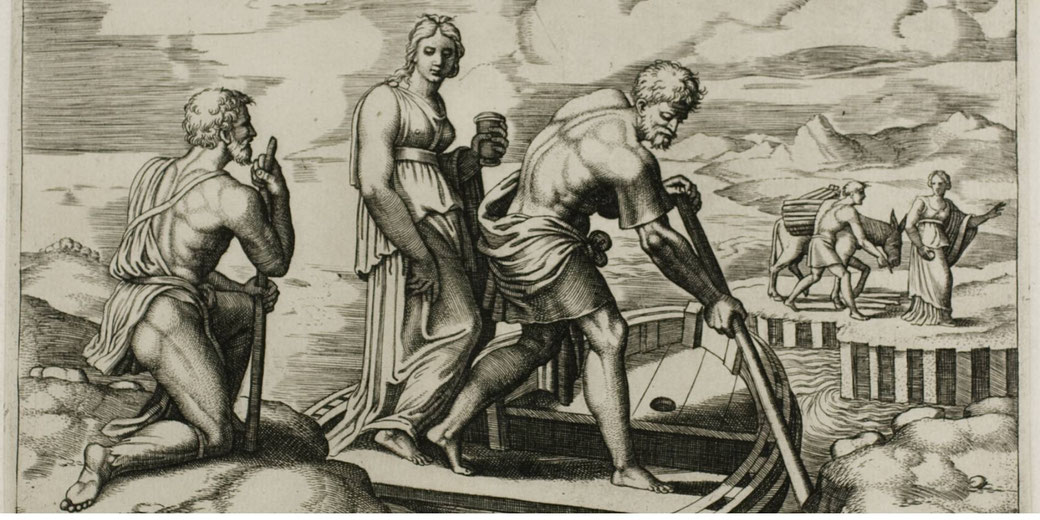
In particular, Seneca’s 1st century AD tragedy Hercules Furens portrays Charon in verses 762 to 777 as an old man who wore filthy clothing and had hollow cheeks with a tangled beard, and who also used a long pole to steer his boat.
Sadly, ancient sources do not describe personal relationships outside his role, because his identity had been defined entirely by his eternal task of ferrying the dead in the service of Hades.
What was the ferryman’s role in the underworld?
Charon’s primary duty involved transporting the souls of the properly buried dead across the boundary waters that separated the living world from the underworld.
Ancient sources disagree about which river he navigated. Greek writers such as Pindar and Aeschylus place Charon on the River Acheron, while Roman poets such as Propertius and Ovid name the River Styx, which Virgil also uses in Book Six of the Aeneid, composed in the late 1st century BC.
Ancient underworld geography was never entirely fixed, and authors also named rivers such as Cocytus and Pyriphlegethon, as well as Lethe, as parts of the same shadowy place.
No matter which river an author specified, the idea stayed the same: a body of water divided the world of life from the world of death, and passage across it required Charon’s boat.
Souls that had received proper funeral rites could board the vessel, but those who had not been buried were denied passage.
That particular idea had older origins in Greek belief about the dead, which had existed long before Charon appeared clearly in surviving literature.
In Homer’s Odyssey, for example, the unburied Elpenor begs Odysseus to return and give him proper funeral rites.
In Virgil’s account, unburied souls had to wander the near shore for one hundred years.
Hermes was the god who guided souls from the upper world and often appears alongside Charon in Greek vase paintings, where he hands the dead over to the ferryman for the final stage of the journey.
Pausanias later described Polygnotus’ famous 5th century BC mural at Delphi, and he stated that it included Charon within a painted vision of the underworld, which indicates that the ferryman had already secured a place in major Greek visual culture.
The obol and the cost of crossing
Passage on Charon’s boat was not free, since literary sources state that the dead needed to pay the ferryman a small coin called an obol, which was worth one-sixth of a drachma.
Families placed the coin in the mouth of the deceased before burial so that the soul would arrive with the means to pay.
The word obol had originally referred to iron roasting spits that had been used as currency before minted coins appeared, and once coinage developed in the 6th century BC, the name transferred to small silver coins.
Archaeological evidence from the Kerameikos cemetery in Athens confirms that coins were placed with the dead from the 5th century BC onward, and excavations at the Porta Stabia necropolis in Pompeii have uncovered coins in cremation burials that historians have interpreted as payment for the ferryman.
However, the custom varied by region and period, and archaeologists do not assume that every burial coin was automatically a payment to Charon.
Only about five to ten percent of known Greek burials contain coins, and many burials have coins positioned in the mouth, in the hand, on the chest, or near the body, so the ritual had never been as uniform as literary sources suggest.
Heroes who dared to cross and still lived
Several mythological heroes confronted Charon during journeys into the underworld.
The ferryman did more than transport the dead, because he also guarded the boundary between the worlds of the living and the dead, which meant that living intruders often faced refusal.
When Orpheus descended to retrieve his dead wife Eurydice, he charmed the ferryman with his lyre and persuaded Charon to grant passage without payment.
By contrast, Heracles used brute force during his twelfth labour. Seneca records that Charon ordered Heracles to stop and that the hero overpowered the ferryman with his own pole and took control of the vessel.
In Virgil’s Aeneid, the Trojan hero Aeneas took a different approach when he had produced the Golden Bough, which was a sacred talisman that compelled Charon to allow him entry.
Each encounter followed a pattern in which the ferryman acted as a boundary guardian, and each visitor had to overcome his resistance through wit and strength, or through sacred authority.
How later writers and artists reimagined Charon
A major Classical appearance came in Aristophanes’ comedy Frogs, which was first performed in 405 BC, in which Dionysus meets Charon during his comic journey to the underworld.
That scene shows that Athenians knew the ferryman well enough for playwrights to place him in a public stage performance.
In the 2nd century AD, the satirist Lucian of Samosata used Charon as a central character in his Dialogues of the Dead, where he placed the ferryman in conversations with Hermes in which the two comment on the foolishness of the living.
During the 14th century, Dante Alighieri placed Charon in Canto Three of the Inferno, which made him the first named mythological figure whom the poet encounters in Hell.
Dante, who drew on Virgil’s earlier account, portrayed Charon as a terrifying old man whose eyes burned like coals and who beat reluctant souls with his oar.
Michelangelo later adapted Dante’s vision in his fresco The Last Judgement, which he completed in 1541 on the altar wall of the Sistine Chapel, and there a muscular Charon raises his oar to strike the damned.
Finally, the Byzantine encyclopaedia known as the Suda was compiled in the 10th century AD and also preserved learned references to Charon, which shows how firmly the ferryman had stayed within the literary memory of the Greek-speaking world.
A figure who crossed cultural boundaries
Charon did not belong only to the Greek world, as the Etruscans, who flourished in central Italy from the 8th to the 3rd century BC, developed their own version called Charun.
In Etruscan art, Charun appears as a winged demon who had a vulture’s beak and carried a heavy hammer instead of a pole.
Painted tombs at Tarquinia include underworld scenes associated with the Tomb of the Orcus.
The 1st century BC historian Diodorus Siculus drew a connection between Greek ideas about the underworld and Egyptian funerary traditions, in which images of boats that carried the dead through the afterlife had been a prominent feature of religious art.
Whether the idea came from Egypt or from another source, the concept of a ferryman who guided souls across water also appears in Mesopotamian mythology in the figure of the boatman Urshanabi.