
Why an elephant, monkey, and giraffe arrived in Europe in the early Middle Ages
In 802, a delegation from the Abbasid Caliphate reached the Frankish imperial court at Aachen with a gift that seemed unbelievable: an elephant named Abul-Abbas.
Behind it followed other animals rarely seen north of the Mediterranean. Some later accounts mention creatures such as monkeys or giraffes reaching Europe during the Middle Ages.
Each recorded gift appeared to have travelled long distances along trade routes that connected Baghdad, the Red Sea, and the Nile Valley to the heart of Charlemagne’s empire, where they amazed audiences and boosted his reputation as a ruler with contacts across the known world.
Why were people sending gifts to Charlemagne?
After he had secured the Frankish throne in 768, Charlemagne spent decades expanding his territory: he defeated the Lombards in Italy, forced the Saxons into submission, and crossed the Pyrenees to press into Al-Andalus.
By the end of the eighth century, his victories had made him the leading ruler in Western Europe.
Then, on 25 December 800, Pope Leo III crowned him Emperor of the Romans during Mass at St Peter’s Basilica in Rome, which restored an imperial title in the West and sent a clear message to rival powers.
At the time, rulers outside Europe recognised the diplomatic importance of the coronation.
Harun al-Rashid, who ruled the Abbasid Caliphate from Baghdad, wanted to keep peaceful ties with Christian rulers who might counter the influence of the rival Umayyads in Spain.
His empire stretched from Tunisia to the Indus River and friendly relations with Charlemagne offered both strategic and symbolic benefits, because the exchange of envoys and gifts helped create a shared understanding between two powerful courts.
Harun al-Rashid was said to have sent a mechanical water clock, richly decorated fabrics, and a perfumed tent that amazed the Frankish court.
Other kingdoms, particularly in Africa, also used gift-giving to establish contact.
Rulers who controlled trade routes from the Sahel to the Mediterranean sent unusual animals that showed they could obtain rare goods.
For instance, leaders along the Nile and in Nubian territories participated in the long-distance trade of animals like giraffes, which were rarely seen outside their native grasslands.
Where the animals came from
Of all the animals that reached Charlemagne, the most documented was Abul-Abbas.
Its exact origin is not known, but may have originated in the Indian subcontinent before reaching Baghdad under Abbasid control.
From there, the elephant joined a delegation led by Isaac the Jew, a Jewish official from Charlemagne’s kingdom who had acted as a diplomatic contact.
Some later sources refer to him as Isaac Judaeus, a Latinised name that does not appear in contemporary records.
Regardless, Isaac was the only member of the Frankish delegation to return alive.
The embassy had likely travelled overland to a Mediterranean port, the specific identity of which is unknown, and had crossed by sea into Italy.
It may have been Brindisi or another southern Italian harbour. From there, the elephant travelled north to Aachen, where it was presented to the emperor.
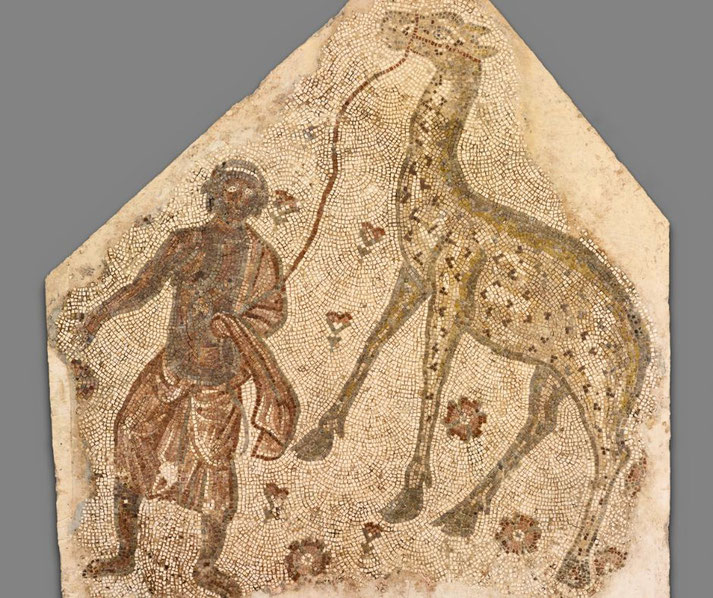
As mentioned above, giraffes likely originated in sub-Saharan Africa and reached Mediterranean trade routes along caravan routes that passed through Nubia and Egypt.
Caravan traffic through Dongola or Aswan could have brought such animals to Egyptian ports, such as Alexandria, which provided access to sea routes that connected to Byzantine or Latin Christian ports.
By the early ninth century, some giraffes had probably reached the Islamic world, where they were already valued curiosities.
However, transport of such a tall and fragile animal would have required extensive planning and constant attention, especially during river and sea crossings.
Meanwhile, monkeys arrived more regularly and were generally easier to transport than larger animals, since traders from the Maghreb and West African kingdoms brought them as part of merchant groups or diplomatic exchanges.
Small primates from tropical forests were captured, caged, and handed off from one region to another until they reached ports in Sicily or southern Gaul.
Once they reached Frankish territory, they became court curiosities thanks to their behaviour, appearance, and foreign origin, which all attracted fascination, especially when they were dressed or trained.
Some may have been Barbary macaques, a species that was already known in parts of Europe during Roman times.
How did Charlemagne keep these animals alive?
Caring for exotic animals in northern Europe required significant logistical adjustments.
Elephants, for example, needed hundreds of litres of water and dozens of kilograms of food each day.
Estimates suggest that Abul-Abbas may have required over 150 kilograms of feed and 200 litres of water daily.
After Abul-Abbas had arrived at Aachen, handlers soon moved him to Lippeham near the lower Rhine, where the land offered more open space and a milder climate.
The Frankish court had no experience with such an animal. However, Isaac the Jew, who had travelled with the elephant, may have provided guidance based on what he had observed in the Abbasid world.
Shelter and feeding were frequent challenges, as a large wooden enclosure would have been necessary to protect Abul-Abbas from the cold.
Grain, hay, and imported produce supplemented local vegetation, because seasonal changes could quickly harm the elephant’s health.
During the colder months, wet soil, freezing temperatures, and shortages of suitable food all carried serious risks.
Local records do not describe any permanent structure built for the elephant, but his survival for several years suggests that the court probably provided regular care and supplies.
Monkeys required different forms of attention, as they could survive in smaller quarters and ate a more varied diet, including fruit, grains, and insects.
Still, their risk of illness and cold meant that handlers needed to make adjustments, which meant that Frankish keepers may have used cloth or straw bedding and placed them indoors during winter.
For giraffes, care proved even more difficult. Their size, diet, and sensitivity to cold made them hard to manage.
Leaves and soft shoots formed the basis of their diet in the wild. Substitutes like hay and fruit could be provided, but this may not have been sufficient.
Reports from Aachen describe the interest that these animals caused, and nobles and clergy tended to view them as symbols of Charlemagne’s global status.
At the same time, some critics within the Church warned about pride and waste.
Later medieval references to such creatures, including in Crusader inventories and natural history texts, often appeared to echo the fascination sparked by these early diplomatic gifts.
What happened to the animals?
Abul-Abbas lived for at least eight years after his arrival, according to later accounts.
In 810, the elephant accompanied Charlemagne’s army during a campaign against the Danes, when it died suddenly near the Rhine, but the exact cause is not known.
Scholars have suggested illness or cold weather as likely factors. Nevertheless, his death ended a remarkable journey that had carried him across Asia, the Middle East, and Europe.
Later chronicles continued to mention him, often as a symbol of Charlemagne’s high status.
The monkey, whose name was never recorded, likely died within a few years. Short lifespans and the lack of veterinary knowledge reduced survival rates, as the animals failed to adjust to colder conditions.
Nonetheless, artistic depictions of monkeys persisted in manuscripts and decorative objects produced in Carolingian scriptoria.
Often, they appeared alongside other exotic creatures or as metaphors in moral illustrations.
For example, the Utrecht Psalter, among other works, included stylised images of foreign animals that indicated that there was clearly continued interest in the topic.
The fate of the giraffe is unknown, and its presence at Charlemagne’s court is unproven, since no existing source mentions its death or its treatment at court.
Most likely, it would have died within a short period.
By the time of his death in 814, Charlemagne had secured recognition through military campaigns and religious reforms and through the spectacle of rare animals that had travelled from distant corners of the known world.
The elephant and possibly other animals provided some physical evidence of his diplomatic success and the reach of his imperial court.
Even after their deaths, they left traces in manuscripts and visual art that storytellers passed on orally, and this probably influenced how later generations understood the idea of a ruler whose power stretched across continents.