
Did Constantine create the Catholic church?

Across the early fourth century, Constantine I changed Christianity from a persecuted sect into a faith supported by the imperial government.
After he had claimed victory at the Battle of the Milvian Bridge in AD 312, he began to promote the Christian Church and he funded its infrastructure, called its bishops and granted it legal protections.
While some claim he founded the Catholic Church, others argue that he simply strengthened a movement that had already developed a clear doctrinal system that combined ritual practice with an organised episcopal structure.
But which is more true?
Constantine's Conversion to Christianity
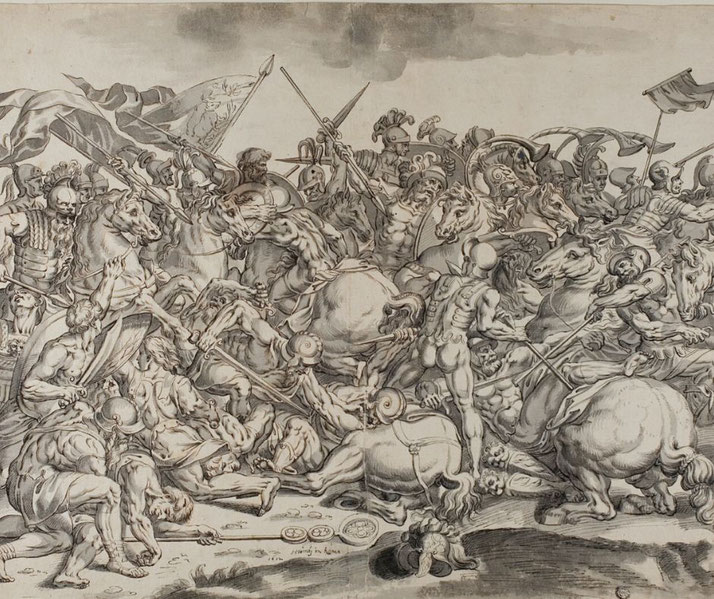
According to sources such as Lactantius and Eusebius of Caesarea, Constantine experienced a divine vision shortly before the Battle of the Milvian Bridge.
As he marched to confront Maxentius for control of the Western Empire, he reportedly saw a cross-shaped symbol in the sky and heard the message in hoc signo vinces: “in this sign, you will conquer.”
The next day, he had ordered his troops to display the Chi-Rho on their shields.
After he had defeated Maxentius and had entered Rome as the sole ruler of the West, Constantine credited the Christian God for his victory, and, soon after he began to support the Church, gave tax breaks to clergy, and returned property taken during earlier persecutions.
Yet he did not immediately abandon traditional Roman religious customs. He continued to issue coinage that bore images of Sol Invictus into the 320s, though the frequency of such imagery declined over time and occasionally adopted unclear symbolism that could appeal to both pagan and Christian audiences.
He retained the title Pontifex Maximus and participated in public ceremonies that honoured the old gods.
His approach to Christianity reflected the gradual nature of conversion in the late empire, where public declarations happened alongside traditional rituals.
In his later years, he issued laws that restricted private pagan sacrifices, and he ordered the seizure of temple treasures, which indicated an increasing imperial preference for Christianity.
Importantly, he postponed his baptism until shortly before his death in AD 337.
When he received the rite on his deathbed from Eusebius of Nicomedia, who held imperial favour and was associated with Arian views, Constantine followed a common belief that baptism should remove all sins at once.
His decision showed personal religious belief and a wider imperial tradition rather than a unique church position.
His mother Helena had already embarked on a pilgrimage to the Holy Land in AD 326, where she ordered the construction of churches and, according to later Christian sources, claimed to have discovered the True Cross.
Edict of Milan and the Legalization of Christianity
In AD 313, Constantine met with his eastern counterpart Licinius in Milan, where they reached an agreement to grant Christians freedom of worship.
Known today as the Edict of Milan, a modern term for the agreement between Constantine and Licinius, the letter, which was issued by Licinius, instructed officials to restore confiscated church property and allow worship without interference.
It did not make Christianity the official religion of the empire, nor did it outlaw paganism.
Soon afterwards, Constantine began to pay for the building of large churches, such as the Lateran Basilica in Rome and the Church of the Holy Sepulchre in Jerusalem.
Around the same time, he gave the Lateran Palace to the bishop of Rome, which became the papal residence and a main centre of Church administration.
He also gave bishops influential roles and allowed them to act as judges in civil disputes, especially when both parties agreed to decisions made by bishops.
This meant that the clergy gained access to state subsidies and legal immunities, which increased their authority within Christian communities.
As a result, the Church expanded its activities, built places for worship, and took on a more public role in Roman society.
Yet the Church had already developed its own structure before this imperial endorsement. C
onstantine did not appoint bishops in the church's usual way, nor did he create new church offices.
Instead, he provided financial and political support that elevated the Church’s status without replacing its internal leadership.
His role in the Council of Nicaea
In AD 325, growing disputes over the teachings of Arius, a presbyter from Alexandria, prompted Constantine to summon the first ecumenical council in Church history.
Arius taught that the Son had been created by the Father and therefore did not share the same divine nature.
His opponents, including Bishop Alexander of Alexandria and his deacon Athanasius, argued that Christ was co-eternal and fully divine.
To resolve the dispute, Constantine invited over 300 bishops to convene at Nicaea, near his imperial residence.
According to tradition, the number of bishops reached around 318, many of whom had endured past persecutions.
Constantine had paid for their travel and accommodation, a gesture which showed his personal investment in the council's success.
At the opening session, he addressed the assembly and urged the bishops to reach agreement for the sake of unity.
He did not propose any theological doctrines himself. Instead, he helped the process and supported the final decision, which rejected Arius's position and endorsed the use of the term homoousios to describe Christ as “of the same substance” as the Father.
The council produced the Nicene Creed, which became a core statement of Christian belief.
Although Constantine had exiled dissenting bishops, including Arius, some of them were later recalled, and religious disagreements continued long after the council.
Arianism retained significant support in parts of the empire, including within Constantine’s own family.
Following the council, he passed laws that enforced its decisions, giving religious rulings the force of imperial law.
His involvement showed that he saw religious unity as a way to keep political order, and it showed that theological decisions were left to bishops who debated Scripture and doctrine.
His earlier intervention in the Donatist Controversy in North Africa, which began in AD 313 and was later addressed at the Council of Arles in AD 314, further demonstrated his willingness to resolve Church disputes when he called councils and when he enforced unity through state mechanisms, even though he did not propose theological doctrines himself.
What was his relationship with the Catholic Church?
By Constantine’s time, Christians already used the word “Catholic” to describe the universal Church, particularly in contrast with local sects and heresies.
As early as the second century, bishops like Ignatius of Antioch had emphasised the unity of the Church under apostolic leadership.
The Christian communities Constantine encountered were structured around bishops, presbyters, and deacons, which had episcopal sees in Rome, Antioch, Alexandria, and other major cities.
Constantine respected this church order and sought to bring it into his government by inviting bishops to work as advisers, appointed some to imperial courts, and granted them authority in civil disputes.
At the same time, he left the Church’s internal matters to its leaders, since he described himself, in the words recorded by Eusebius of Caesarea, as the “bishop of those outside the Church,” meaning that he saw his role as a guardian of peace and order rather than as a religious teacher.
In AD 330, he formally inaugurated his new Christian capital at Constantinople, where he built prominent churches such as the Church of the Holy Apostles and ensured that Christianity had a permanent presence in the eastern empire.
Over time, the Church won more influence within Roman institutions, because Constantine’s patronage allowed the bishop of Rome to increase his influence, though he continued to be one of several leading bishops.
Other cities, such as Alexandria and Antioch, kept their own traditions and influence over doctrine.
Christian leaders continued to meet in synods and councils to settle disputes, sometimes without imperial involvement.
So, did he create the church?
Cleary, the Catholic Church existed before Constantine came to power. By the end of the first century, Christian communities had already formed across the eastern Mediterranean and parts of the Roman West.
These groups recognised the authority of bishops, read scriptural texts aloud in worship, and preserved teachings they believed had come from the apostles.
Martyrs such as Ignatius of Antioch and Polycarp of Smyrna had died under Roman persecution well before Constantine’s reign and their writings show that early Christian theology, ritual, and leadership were already well established.
Still, Constantine changed the conditions in which the Church operated, because his endorsement changed the Church by providing money and resources along with legal protections that secured its public role and gave the Church connections to imperial power.
He pushed for clearer theological statements, sponsored church councils, and gave the clergy rights that set them apart from ordinary citizens.
As a result his policies changed Christianity from a marginalised community into a public institution connected to imperial power.
Even so, he did not set its core beliefs or build its institutional structure because apostolic tradition, early ecumenical councils, and the writings of earlier theologians formed the Church's basic identity.
Constantine had provided legal protection and large financial support, and he had arranged formal imperial recognition, but the Church’s teachings and leadership had already taken form long before he entered the historical record.
In the end, Constantine did not create the Catholic Church, but he did help speed up its development, protected its leaders, and used it to strengthen political unity across the empire.
Yet the Church itself, with its doctrines, bishops, and sacraments, had already faced trials, developed its identity, and survived waves of persecution before Constantine ever marched under the Christian symbol.
Ultimately, his influence changed the Church’s position in Roman society, but not the origins that had given it life.