
Arthur Evans and controversial rediscovery of the lost Minoan civilization
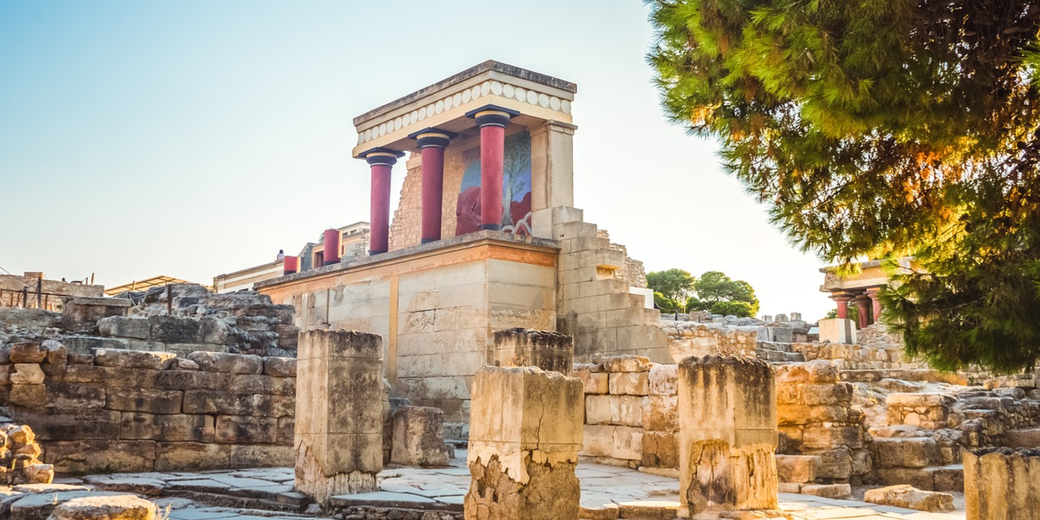
For centuries, the ruins of an ancient Aegean civilisation lay buried beneath the dry hills near Heraklion in northern Crete, largely forgotten except for scattered Greek legends that spoke of a king and of a labyrinth haunted by a monstrous creature.
When British archaeologist Arthur Evans began excavating the site of Knossos in 1900, he believed he had uncovered physical evidence of that very civilisation.
When he linked the archaeological evidence to the mythical King Minos and identified an unknown script that appeared on seal stones and tablets, Evans claimed to have rediscovered an advanced Bronze Age culture that predated Classical Greece by more than a thousand years.
Arthur Evans’ Knossos discovery
At the beginning of the 20th century, the Knossos site, which had been partially revealed decades earlier by Minos Kalokairinos, a Cretan merchant and amateur archaeologist who uncovered parts of the western storerooms in 1878, attracted renewed attention after Crete achieved autonomy from the Ottoman Empire.
Heinrich Schliemann had excavated Troy and Mycenae and had previously expressed interest in purchasing the site, but had not succeeded, likely due to price disagreements or practical obstacles rather than Ottoman restrictions.
Once Evans had acquired the land from the Greek Kalokairinos family in March 1900, he launched excavations on March 23, which quickly uncovered vast corridors, painted wall fragments, storage vessels, and complicated staircases.
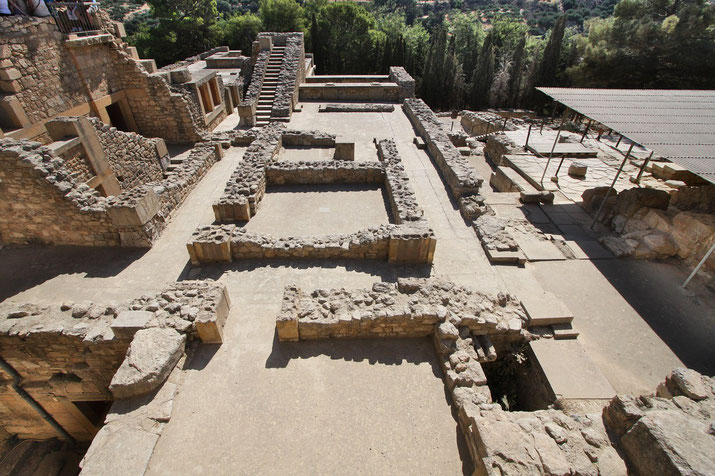
The architecture appeared palatial, and the large amount of artistic and religious material suggested a centralised society with ceremonial activities.
By the early months of the project, Evans had formed a firm belief that he had found the palace of a lost people and began constructing a historical narrative around them.
Arthur Evans had been born in 1851 and had already developed a strong interest in ancient history under the guidance of his father, Sir John Evans, a respected expert on ancient objects and on prehistory.
During his time as a student at Oxford, Arthur pursued modern history, and his interest in archaeology grew and led him to travel across the Balkans, where he collected artefacts and published accounts of prehistoric cultures.
He had developed a special interest in ancient writing systems and had begun acquiring engraved seal stones that were inscribed with unknown symbols.
When news reached him of an unexplored site near Knossos, he believed that the key to a forgotten script, and possibly to Europe’s earliest civilisation, might lie beneath its soil.
Minoan civilisation at Knossos
From the beginning, Evans approached the excavation with a vision informed by classical texts and Victorian ideas of the time.
He believed that the maze-like layout of the ruins matched the myth of the Labyrinth, and he identified the bull images on frescoes and ceramics as evidence for the origin of the Minotaur story.
The famous "Toreador Fresco" showed acrobats who leapt over a bull and became central to this interpretation.
According to Evans, the palace was the administrative and religious centre of a largely peaceful civilisation that had developed artistic skill and sea power, as well as religious rituals that focused on female deities.
He named the people who had built the palace the “Minoans,” drawing directly from the legend of King Minos, and claimed that their society laid the groundwork for later European development.
Soon after, Evans had begun to organise his findings. Between 1921 and 1935, he published The Palace of Minos, a four-volume work in which he presented a detailed picture of Minoan civilisation.
He divided its chronology into three main phases, Early, Middle, and Late Minoan, based on ceramic typology and architectural evolution, along with evidence from burial customs.
He also identified three writing systems: an early pictographic form and a more simplified script now called Linear A, along with a later script, which he believed indicated a Mycenaean presence and which later scholars would term Linear B.
According to Evans, Linear A was the native Minoan language, while the later script reflected external intrusion.
His descriptions of the Minoans portrayed them as peaceful and wealthy, and he explained that, in his view, life centred on ritual and on nature, and that goddesses occupied central positions in their belief system.
Arthur Evans Knossos reconstruction debate
However, Evans' interpretations often showed his own cultural assumptions. He depicted Minoan society as matriarchal and largely non-militaristic, which aligned with contemporary Victorian fantasies about perfect prehistoric societies.
He drew heavily from Johann Jakob Bachofen's Mother Right (1861), which had proposed that early civilisations were governed by female-centric religious systems.
He placed particular emphasis on their artistic achievements, and he argued that Minoan frescoes and ceramics, along with religious icons, showed a careful artistic style absent from the more rigid and warlike cultures of mainland Greece.
He interpreted the lack of defensive walls at Knossos as evidence for apparent internal harmony and peaceful external relations, although later findings would contradict this view.
Although he often emphasised social unity, Evans acknowledged the existence of elite rulers and levels of ceremonial authority, and he never explicitly claimed the society was classless.
As the excavations progressed, Evans began large-scale reconstructions of the palace that used modern materials.
His architect Christian Doll used reinforced concrete to rebuild columns and staircases, along with upper storeys according to Evans’ sketches and interpretations.
Notable examples include the "Grand Staircase" and the "Hall of the Double Axes," which were reconstructed to show what Evans believed were ceremonial spaces.
In some areas, reconstructions stood where little original material survived. For example, in the Throne Room, Evans identified an alabaster seat as the throne of a priest-king or possibly a goddess, and interpreted the presence of griffin frescoes as symbols of divine rulership.
However, no inscription confirmed this use. Some archaeologists have suggested that the room may have been a council chamber or ritual space instead.
The lustral basin nearby, which he viewed as a site for purification rituals, may have served a completely different purpose, though alternative interpretations lacked archaeological clarity.
Minoan frescoes and Linear B scholarship
To improve the visual impact of the site, Evans’ team also recreated frescoes from broken pieces.
Artists used a combination of plaster that still survived and watercolour, supported by modern pigment, to fill gaps and reconstruct figures.
The Prince of the Lilies fresco was perhaps the most famous image from Knossos and was pieced together from a few surviving fragments, with much of the final figure based on artistic guesswork.
Some scholars argue that the fragments may have belonged to different figures and that they were combined into a single composition.
Though such reconstructions made the site easier for visitors to understand and clearly showed Evans’ personal vision, they also risked replacing uncertain archaeological findings with imagined pictures.
As a result, Evans’ vision of Minoan civilisation became inseparable from the restored walls and painted scenes he had commissioned.
Over time, scholars began to question some of the assumptions that had guided Evans’ interpretations.
After the decoding of Linear B in 1952 by Michael Ventris and John Chadwick, the script was shown to record an early form of Greek.
Its confirmation came from tablets found at Pylos, which demonstrated a Mycenaean administrative system.
Linear B had been used by the Mycenaeans during their occupation of Knossos in the later stages of its history, rather than by the original Minoans.
This discovery weakened Evans’ claims about the ongoing development of language and culture within Minoan civilisation and forced a new study of the palace’s final phase.
Additionally, the continued inability to decipher Linear A left major aspects of Minoan society unknown.
Why Arthur Evans has become so important
New excavations at other Cretan sites such as Phaistos and Malia, together with Zakros, uncovered defensive structures and burned layers, along with tombs for high-status people that suggested competition and hierarchy expressed in episodes of violent destruction.
Finds such as the gold bee pendant at Malia or the archive rooms at Zakros showed a complicated society that existed outside Knossos and challenged Evans' overly perfect picture.
Studies of trade networks and imported goods indicated that Minoan Crete participated in a busy trade network with the Near East and Egypt, one that involved both cooperation and rivalry.
The eruption of the Theran volcano around the mid-16th century BCE, which devastated the island of Santorini, likely upset trade routes and settlements across the Aegean.
Radiocarbon analysis based on tree-ring and ice-core data places the eruption closer to 1628 BCE, though historians still argue over its exact timing and impact.
While Evans had underplayed such outside forces, later researchers identified them as key factors in the decline of Minoan political power.
Even so, Evans’ influence on the field of Aegean archaeology remained highly significant for much of the 20th century.
His ceramic typologies and chronological schemes and his terminology had become widely adopted among Aegean specialists, and his enthusiasm for ancient scripts inspired future major discoveries.
However, his decision to reconstruct Knossos in concrete locked his interpretations into the physical structure of the site, and this decision made it difficult for future generations to separate the ancient structures from the modern additions.
The palace, as it appears today, to a considerable extent shows Evans’ imagination as much as it shows the original builders’ intentions.
Arthur Evans died in 1941, shortly before Nazi forces invaded Crete during the Second World War, and he had been knighted in 1911 for his contributions to the Ashmolean Museum and the British School at Athens.
By the end of his life, his version of Minoan civilisation had become firmly fixed in many Western historical stories, and during the interwar period, his portrayal of a peaceful and artistic pre-Greek culture appealed to those who wanted cultural origins free from the violence of modern history.
Although scholars continued to critique and revise his conclusions, many in the general public still often encountered the Minoans largely through the imagery and reconstructions that he left behind.
Knossos had red columns and painted walls and became a powerful symbol for visitors of Europe’s deep past that was influenced by myth and archaeology, together with modern invention.
As a result, Evans’ influence is both basic for the field and also widely debated among specialists, a reminder of how archaeological discovery can blend with interpretation to create not just a history, but a story about history itself.